
Wavicle
What is Wavicle?
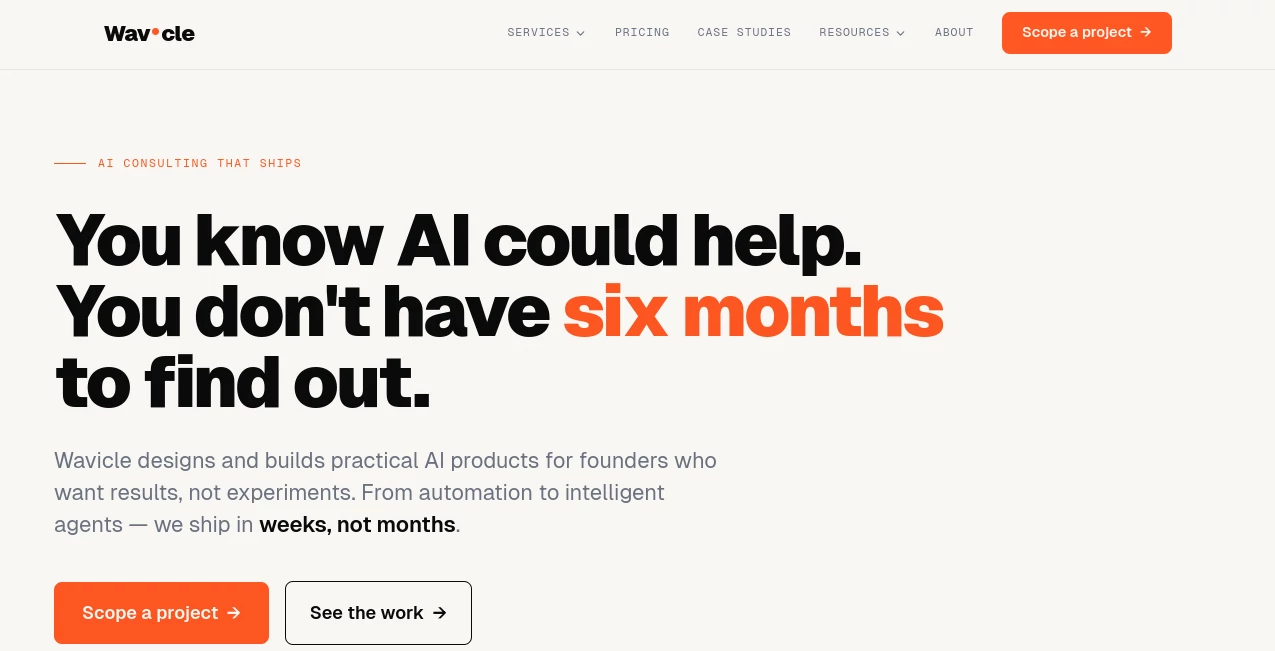
Wavicle is an AI consulting and product development service built for founders and businesses that want to turn practical AI ideas into working products. Instead of leaving teams with a prototype, a slide deck, or a long list of recommendations, the service focuses on taking an idea through discovery, development, deployment, and post-launch support.
The approach is refreshingly straightforward. Businesses can identify a repetitive process, an AI feature they want to add, or an entire product they need to build, then work through a defined scope with a fixed price and a clear delivery timeline. Most projects are designed to reach production in around four to eight weeks, depending on their complexity.
That makes the service particularly interesting for founders who understand the potential of AI but do not want to spend months hiring an engineering team or experimenting with technologies without reaching a usable result.
Key Features
- End-to-end AI product development from initial idea to production.
- AI automation for repetitive business processes and workflows.
- Intelligent agents and assistants designed for practical business tasks.
- Document processing, data extraction, and data analysis solutions.
- Integration with existing software, APIs, and business systems.
- AI features for SaaS products, including assistants, automation, analytics, and content generation.
- Fixed-scope and fixed-price project structures.
- Post-launch support and optimization after deployment.
- Self-hosted AI executive assistant deployment for founders and business teams.
User Interface
There is no single traditional dashboard to learn because the service is centered around building solutions around the customer's existing workflow. The experience begins with a discovery process where the business explains its tools, processes, users, and goals.
For companies adding AI to an existing SaaS product, the final interface can be integrated directly into the product users already know. For automation projects, the result may work behind the scenes, connecting email, CRM systems, messaging platforms, documents, or internal applications.
This approach is useful for teams that do not want another complicated platform sitting alongside everything else. The goal is to make AI part of the workflow rather than creating another destination that employees have to remember to open.
Accuracy & Performance
Performance is approached from a practical business perspective rather than simply focusing on model benchmarks. Projects are scoped around measurable outcomes, with success criteria established before development begins.
Published case studies demonstrate this results-focused approach across logistics, marketing, property management, recruitment, sales, support, and other industries. One logistics project, for example, used document intelligence to process thousands of documents per day, while another customer-support implementation reduced response time dramatically through an AI agent connected to real systems.
For SaaS companies, the service also highlights measurable improvements such as lower support workload, faster onboarding, automated workflows, and improved lead qualification. The exact results naturally depend on the business process, available data, integrations, and implementation scope.
Capabilities
The strongest part of the offering is its range. Businesses can start with a relatively focused automation project or commission a larger AI-powered product.
AI automation can handle repetitive processes such as data entry, report generation, email sequences, document processing, and information extraction. Intelligent agents can also be connected to business systems so they can do more than simply generate a response.
For SaaS companies, possible projects include customer-support assistants, predictive analytics, in-app AI assistants, workflow automation, smart lead scoring, and content generation. API integrations and custom AI implementations are also available for companies that already have an established technology stack.
There is also a dedicated AI executive assistant offering. It can run on infrastructure owned by the customer, monitor email, prepare daily briefings, assist with meeting preparation, and receive requests through channels such as WhatsApp, Slack, and Telegram.
Security & Privacy
Security depends on the type of project and the infrastructure selected, but the self-hosted executive assistant places particular emphasis on keeping business data under the customer's control. The assistant can run on a dedicated VPS owned by the customer rather than functioning as a conventional hosted SaaS application.
The setup described on the site includes Docker isolation, firewall restrictions, OAuth-based integrations, audit trails, and configurable action permissions. This gives businesses more control over which systems the assistant can access and what actions it is allowed to perform.
For custom AI projects, security and compliance requirements can also be included as part of the implementation scope, particularly for larger deployments and enterprise projects.
Use Cases
The service is designed for businesses where AI can remove a measurable bottleneck. A logistics company might use document intelligence to reduce manual processing. A marketing agency could automate reporting across multiple clients. A property management business could deploy an AI support agent that can access real systems instead of merely answering generic questions.
SaaS founders can use the development service to introduce AI features without rebuilding their entire product. An existing application might gain an in-app assistant, automated workflows, predictive analytics, or AI-powered content features.
Founders and executives can also use the self-hosted assistant to reduce the daily administrative load surrounding email, calendars, meetings, messaging, and internal coordination.
Pros and Cons
Pros:
- Practical focus on deploying working AI products rather than producing prototypes alone.
- Fixed-scope and fixed-price project structure.
- Typical production timelines of four to eight weeks.
- Strong focus on automation, AI agents, integrations, and real business workflows.
- Suitable for startups and companies without a large internal AI engineering team.
- Post-launch support is included with many projects.
- Self-hosted options are available for businesses that need greater infrastructure control.
- Published case studies provide concrete examples of completed work.
Cons:
- This is a consulting and development service rather than a simple plug-and-play AI application.
- Pricing can be significantly higher than ordinary monthly AI software because projects involve custom development.
- The final solution depends on the scope and requirements of each business.
- Companies looking for a ready-made tool may find a specialized SaaS product simpler for a narrow use case.
Pricing Plans
Pricing is structured around the type and scope of the project rather than a single subscription. The main AI SaaS development options currently include a Sprint starting around $5,000 to $15,000 for a focused AI feature, a Build package from approximately $15,000 to $50,000 for larger AI products, and an Enterprise option with custom pricing for more complex implementations.
Smaller AI product projects can take around two to four weeks, while larger builds generally take four to eight weeks. Enterprise implementations can extend to eight to twelve weeks depending on requirements.
The self-hosted AI executive assistant is priced separately, with a remote setup option starting at $520 as a one-time fee and optional managed care available afterward. The website also states that projects use fixed pricing, allowing customers to understand the expected investment before development begins.
How to Use the Service
Getting started is more like beginning a development project than signing up for a conventional AI application.
- Start with a free discovery consultation and explain the business problem, product idea, or workflow that needs improvement.
- Review the proposed use case, scope, timeline, and expected success criteria.
- Choose the appropriate project structure and receive a fixed-price proposal.
- Work through development with regular demonstrations and feedback.
- Deploy the completed solution to real users and systems.
- Use the included post-launch support period to resolve issues and make practical improvements.
Businesses that are unsure where AI would have the greatest impact can begin with discovery rather than arriving with a fully defined technical specification. That is particularly helpful for founders who know they need automation but have not yet decided which process should be tackled first.
Comparison with Similar Tools
Traditional AI software generally gives users a predefined feature set, interface, and workflow. That model works well when a company needs a specific capability such as writing, image generation, transcription, or customer support.
This service takes a different route. Instead of asking a business to adapt its processes to an existing application, the development process starts with the business process itself. The resulting system can then be connected to the company's existing software and tailored around its requirements.
Compared with hiring an internal AI development team, the fixed-scope model can also provide a faster way to test and launch a focused AI initiative. The trade-off is that a custom project requires a larger initial investment than a typical software subscription.
The distinction is therefore important: this is best viewed as an AI development and consulting partner rather than another general-purpose chatbot or standalone AI utility.
Conclusion
For businesses that want to move from “we should use AI” to an actual working implementation, this service offers a clear and commercially focused path. Its strongest advantage is the emphasis on shipping: identifying a useful opportunity, defining the scope, building the system, putting it into production, and supporting it after launch.
The combination of AI automation, product development, integrations, intelligent agents, and self-hosted assistant solutions makes it suitable for a broad range of business problems. It will not be the right choice for someone looking for a $10 monthly AI app, but that is not really its purpose.
For a founder with a serious automation opportunity, an existing SaaS product that needs AI features, or a business process that is consuming too many human hours, a focused custom implementation can be considerably more valuable than adding yet another disconnected AI subscription.
Frequently Asked Questions (FAQ)
What type of service is this?
It is an AI consulting and development service that helps businesses design, build, integrate, and deploy practical AI products, automations, agents, and assistants.
How long does an AI project usually take?
The typical production timeline is around four to eight weeks, while smaller AI feature sprints can take approximately two to four weeks. Larger enterprise implementations may require more time.
Does the service only build chatbots?
No. The offering covers workflow automation, intelligent agents, document processing, data extraction, AI-powered SaaS features, predictive analytics, integrations, custom AI tools, and other business applications.
Can it add AI to an existing SaaS product?
Yes. AI features can be added to an existing SaaS application without replacing the entire product. Examples include customer-support assistants, in-app assistants, workflow automation, lead scoring, analytics, and content generation.
Is pricing fixed?
The development model is based on fixed scope and fixed pricing. Customers receive a defined proposal covering what will be built, the expected timeline, and the associated cost.
Is post-launch support available?
Yes. The standard development offering includes post-launch support, with the published packages offering between 14 and 30 days depending on the project.
Can the AI assistant run on my own infrastructure?
Yes. The self-hosted executive assistant can be deployed on infrastructure owned by the customer, with security measures such as Docker sandboxing, firewall rules, OAuth integrations, and configurable permissions.
AI Workflow Management , AI Consulting Assistant , AI Customer Service Assistant , AI Developer Tools .
These classifications represent its core capabilities and areas of application. For related tools, explore the linked categories above.

Wavicle Alternatives Product
You.bot
Defapi

Mage Flow AI…

Chatbots AI

GLM 5

Chatzy AI

Vibe Code Pi…

KaneAI

Weblo AI