Will It Replace
What is Will It Replace?
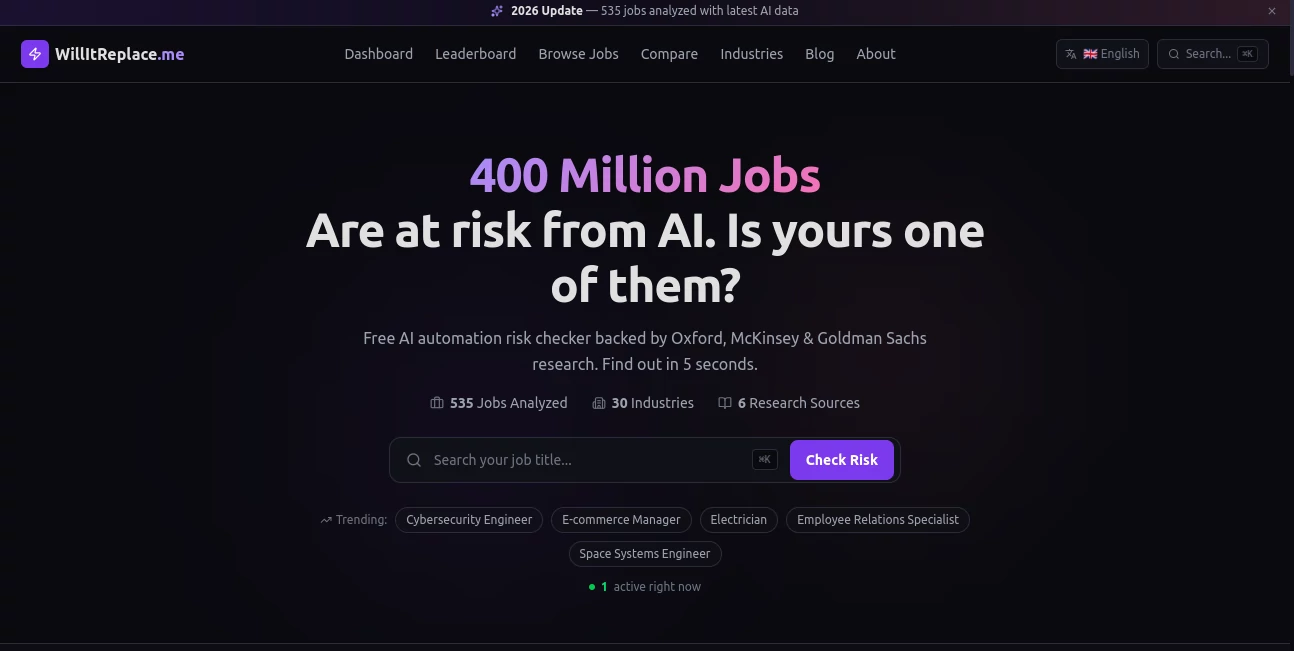
WillItReplace.me is a free AI job automation risk checker designed for people who want a clearer picture of how artificial intelligence could affect their profession. Instead of treating every career as equally vulnerable, the platform breaks jobs down into individual tasks and evaluates how exposed those tasks may be to automation.
The current platform covers 535 jobs across 30 industries and analyzes more than 2,000 individual tasks. Users can search for a profession, review its overall risk score, see which responsibilities are most exposed, and explore alternative career paths with lower automation risk.
This makes the service particularly useful for employees, students, career changers, and professionals who are trying to make practical decisions in a rapidly changing job market.
Key Features
- AI automation risk scores for 535 different jobs.
- Task-by-task analysis showing which responsibilities are most exposed to AI.
- Coverage across 30 industries and multiple countries.
- Job risk leaderboard for quickly comparing professions.
- Side-by-side career comparison tools.
- Industry rankings showing average automation risk.
- Upskill recommendations for professionals in exposed roles.
- Research-backed scoring using sources including Oxford Martin School, McKinsey, Goldman Sachs, the World Economic Forum, BLS, and OECD.
- Regular reviews as AI capabilities and labor-market research change.
User Interface
The interface is built around a straightforward search experience. Visitors can enter a job title and quickly move from a broad question such as “Will AI replace my job?” to a detailed breakdown of the role.
Useful navigation sections such as the leaderboard, job browser, industry pages, comparison tool, and research methodology make it easy to move beyond a single score. The dashboard also highlights trending professions, which is helpful when researching several careers rather than just one.
Accuracy & Performance
The platform does more than attach a generic percentage to a profession. Each job is divided into four to seven core tasks, with individual tasks scored according to factors such as current AI capabilities, future automation potential, task complexity, regulatory barriers, and real-world AI adoption.
The overall job score is calculated as a weighted average, giving more importance to tasks that consume a larger share of the working day. The methodology is also reviewed for consistency, while selected high-impact occupations receive deeper manual research.
For example, a profession may contain several highly automatable duties while still requiring human judgment for communication, leadership, physical work, or complex decision-making. That distinction makes the results more useful than a simple “AI will replace this job” prediction.
Capabilities
The strongest part of the platform is its ability to turn a broad career concern into specific, actionable information. Users can identify the responsibilities most likely to be automated, understand where their profession currently stands, and look for skills or career directions that may offer better long-term resilience.
The industry dashboards add another useful layer. Instead of looking at one profession in isolation, users can examine how entire fields compare. Technology, finance, marketing, healthcare, education, and many other sectors can be explored through industry-level risk data.
The comparison functionality is especially practical for someone considering a career move. Rather than asking whether one job is “safe,” a user can compare several options and see where their existing skills may transfer.
Security & Privacy
The service does not require an account to check job risk. According to its privacy policy, email addresses are collected only when visitors voluntarily subscribe to the newsletter, while anonymous usage analytics are used to improve the site.
The platform states that newsletter information is not sold or shared, and that it does not sell, rent, or trade personal data with third parties. It also uses minimal analytics cookies and does not use advertising cookies.
Use Cases
Career planning: Employees can check how automation may affect their current responsibilities and identify areas where additional skills could strengthen their position.
Students: Students choosing a major or first career can compare several professions before investing years in a particular path.
Career changes: Professionals working in highly exposed roles can explore alternative careers with lower automation risk and transferable skills.
Recruitment and HR: Hiring teams and HR professionals can use industry-level information to understand how AI may change responsibilities within different roles.
AI strategy: Business leaders can use task-level information as a starting point for thinking about which activities could be augmented or automated.
Personal research: Even if someone is simply curious about the future of their profession, the platform offers a quick way to explore the subject without requiring a lengthy research process.
Pros and Cons
Pros
- Free to use.
- No account is required for basic job analysis.
- Large collection of analyzed professions.
- Task-level risk breakdowns provide useful context.
- Covers 30 industries.
- Uses multiple established research sources.
- Includes career comparison and upskilling guidance.
- Methodology is publicly explained.
Cons
- Automation scores are estimates rather than guarantees of future employment outcomes.
- Some careers can change substantially even when their overall replacement risk is relatively low.
- Real-world AI adoption varies by country, company, regulation, and industry.
- The analysis is most useful as a research starting point rather than a standalone career decision.
Pricing Plans
The core job risk checker is free to use. Visitors can search professions, review automation scores, browse job rankings, explore industries, and use the available comparison features without purchasing a subscription.
A free AI Career Survival Guide is also offered for people who want additional information about safer careers, useful skills, and strategies for adapting to workplace automation.
How to Use It
Start by entering a job title into the search field. Select the relevant profession from the available results and review its overall AI automation risk.
Next, examine the individual tasks behind the score. Pay particular attention to responsibilities with high automation potential, since these often reveal where AI is most likely to change the day-to-day nature of the role.
After that, review the recommended skills and related career options. If you are considering a career change, the comparison tools can help you evaluate alternatives with different levels of AI exposure.
It is also worth checking the research sources and methodology before making an important decision. A risk percentage is best viewed as an indicator of potential automation, not a prediction that a particular job will disappear.
Comparison with Similar Tools
Many career websites focus on salaries, employment growth, or traditional job outlook statistics. This platform takes a different angle by concentrating specifically on AI automation and examining the tasks that make up each profession.
That task-based approach is its main advantage. A job can have a moderate overall risk while containing several duties that are highly automatable. Conversely, a profession may use AI extensively without being close to complete replacement because important responsibilities still depend on human judgment, physical presence, communication, or trust.
The combination of job-level scores, industry rankings, task analysis, career alternatives, and published methodology gives users a broader view than a single automation percentage alone.
Conclusion
For anyone wondering how artificial intelligence could reshape their career, this platform offers a practical place to start. Its biggest strength is the decision to look at jobs as collections of tasks rather than treating an entire profession as either “safe” or “doomed.”
With hundreds of professions analyzed, industry-level comparisons, research citations, task-level scoring, and career-focused recommendations, it can turn an abstract concern about AI into something much easier to investigate.
The most useful way to approach the results is with curiosity rather than fear. A high score does not automatically mean a career is disappearing, just as a low score does not guarantee that a profession will remain unchanged. The real value comes from understanding which parts of the work are changing and preparing accordingly.
Frequently Asked Questions (FAQ)
What does the AI risk score mean?
The score represents the estimated potential for AI automation across the core tasks associated with a profession. It is not a guaranteed prediction of job losses.
How many jobs are analyzed?
The platform currently analyzes 535 jobs across 30 industries, with more than 2,000 individual tasks scored.
How are job risk scores calculated?
Jobs are divided into core tasks, and each task receives a score based on current AI capability, future automation potential, complexity, regulatory barriers, and actual adoption. The overall score is then calculated using a weighted average.
Does a high AI risk score mean my job will disappear?
No. A high score indicates substantial automation potential, but actual employment outcomes also depend on factors such as economic feasibility, regulation, social acceptance, AI adoption, and the creation of new roles.
Can I compare different careers?
Yes. The platform includes a comparison feature that allows users to examine different professions and their relative AI automation risks.
Is the service free?
Yes. The core job automation risk checker is available free of charge and does not require account creation for basic use.
How often is the information updated?
The methodology describes a quarterly full review cycle, with additional evaluations when major AI capability announcements, regulatory changes, or important research developments affect particular occupations.
Is the information professional career advice?
No. The results are intended for informational and research purposes. Career decisions should also consider personal interests, experience, qualifications, local employment conditions, compensation, and long-term goals.
AI Life Assistant , AI Education Assistant , AI Research Tool .
These classifications represent its core capabilities and areas of application. For related tools, explore the linked categories above.
Will It Replace details
Website unavailable — View Alternatives
Pricing
- Free
Apps
- Web App
Categories

Will It Replace Alternatives Product

Diploria AI

PlateLens

LocalRAG!

MidJourney

AI Job Risk …

Manus

StarBattle O…

Crawlly AI

AI Meal Plan…