Coral
What is Coral?
Modern AI agents often struggle when they need information spread across multiple services, databases, and internal platforms. Instead of relying on disconnected API calls and custom integrations, this platform introduces a unified SQL-based data layer that allows agents to retrieve information from many sources with remarkable efficiency. The result is faster responses, lower operating costs, and significantly improved accuracy for enterprise AI workflows.
Designed with developers, engineering teams, and AI infrastructure specialists in mind, the platform simplifies access to business data without requiring complex ETL pipelines or duplicated storage. It works as a secure read-only layer, making it possible to connect live systems while keeping production environments protected. Whether building coding assistants, incident investigation tools, customer support agents, or operational dashboards, users benefit from a consistent and reliable way to access enterprise knowledge.
Key Features
- Single SQL interface across APIs, databases, and files.
- Cross-source SQL joins between multiple enterprise systems.
- Works with popular AI agents and MCP-compatible workflows.
- Built-in authentication, pagination, and rate-limit handling.
- Read-only architecture for improved operational safety.
- Semantic schema learning that improves over time.
- Automatic query optimization and intelligent caching.
- Support for unlimited connected data sources.
- Self-hosted deployment with complete infrastructure control.
- Compatible with popular developer and collaboration platforms.
User Interface
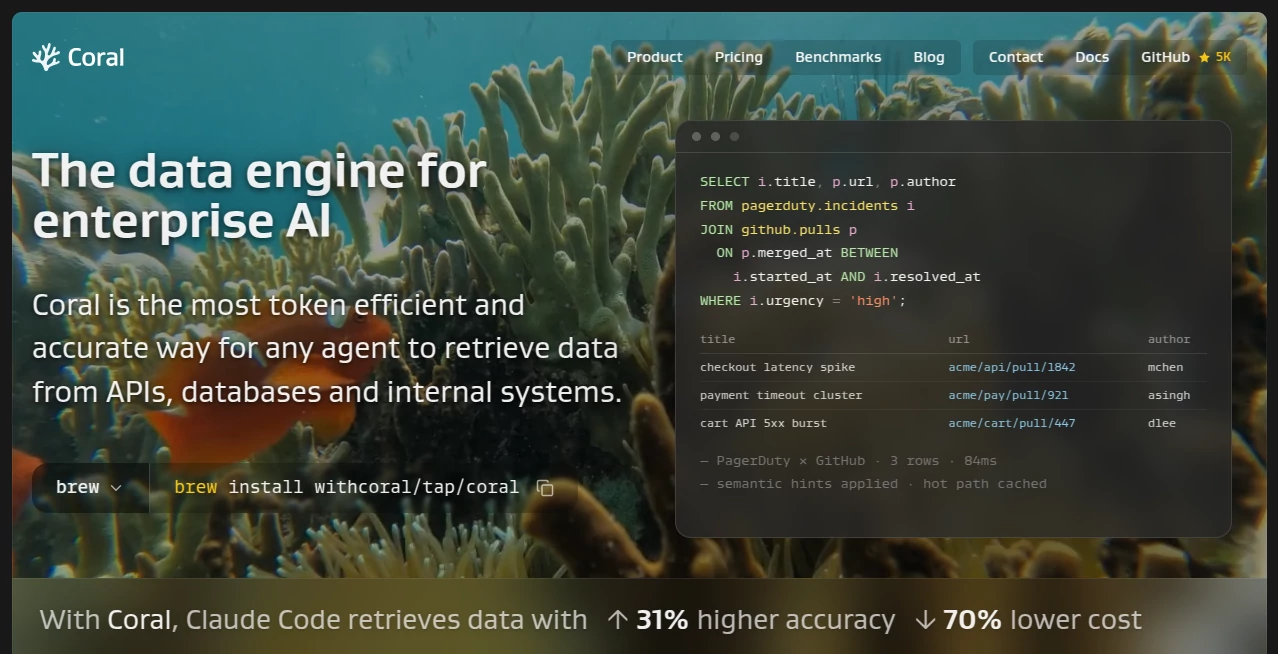
The experience focuses on developers who prefer practical tools over complicated dashboards. Installation is straightforward, data sources can be connected quickly, and querying feels familiar thanks to standard SQL syntax. The command-line workflow integrates naturally into existing engineering environments, while compatibility with agent frameworks allows teams to continue using the tools they already trust.
Accuracy & Performance
One of the strongest advantages is the ability to reduce unnecessary tool calls. Instead of requesting data from multiple services independently, the system performs optimized queries across connected sources and returns structured results. This approach improves retrieval quality, decreases token consumption, reduces latency, and helps AI agents produce more reliable answers for complex enterprise tasks. Public benchmark results also demonstrate measurable improvements in coding-agent accuracy together with significant reductions in AI operating costs.
Capabilities
The platform transforms APIs, cloud services, collaboration tools, monitoring systems, ticketing platforms, and databases into queryable tables. Developers can correlate incidents with deployments, connect engineering discussions with issue trackers, investigate operational events, analyze customer support information, and retrieve live business context without building custom integrations for every workflow.
Security & Privacy
Security is built into the overall design. The read-only architecture prevents accidental modification of production systems while allowing agents to retrieve information safely. Organizations can deploy everything on their own infrastructure, keep credentials under their own control, configure scoped permissions, and ensure sensitive business data remains inside their environment instead of being transferred to external services.
Use Cases
- Building AI coding assistants with live engineering context.
- Software incident investigation and root-cause analysis.
- Customer support automation using multiple business systems.
- Security investigations across cloud and identity platforms.
- Operations dashboards powered by real-time enterprise data.
- AI research assistants connected to internal knowledge.
- Cross-platform analytics without data duplication.
- Developer productivity workflows using unified SQL queries.
Pros and Cons
Pros
- Excellent performance for complex enterprise retrieval.
- Open-source edition available.
- Works with existing AI agents and frameworks.
- Supports numerous enterprise integrations.
- Improves query efficiency while lowering AI costs.
- Read-only model enhances operational safety.
- Flexible deployment options for different organizations.
Cons
- Best suited for technical teams familiar with SQL.
- Advanced enterprise features require paid plans.
- Some organizations may need time to configure multiple data sources.
Pricing Plans
A generous open-source edition is available free of charge under the Apache 2.0 license and supports unlimited data sources, agents, and queries for self-hosted deployments. Managed Team plans are available through a monthly subscription for organizations that want hosted administration and collaboration features, while Enterprise plans offer custom pricing with advanced governance, deployment flexibility, and dedicated support for large organizations.
How to Use Coral
Install the software, connect your preferred business systems, and expose them as SQL-accessible tables. Once the sources are configured, execute SQL queries directly or allow AI agents to access the unified data layer through supported integrations. As usage grows, the platform continuously improves schema understanding, relationship mapping, and query optimization, making future retrieval even more efficient.
Comparison with Similar Tools
Many enterprise AI solutions focus on connecting one application at a time through API wrappers or individual MCP integrations. This platform takes a broader approach by presenting every connected source as part of a unified relational layer. Instead of stitching together multiple API responses manually, developers can perform standard SQL joins across services, making complex enterprise reasoning significantly easier while improving both performance and governance.
Conclusion
For organizations building production-grade AI agents, having reliable access to enterprise information is often more important than choosing another language model. This solution addresses one of the biggest challenges in modern AI infrastructure by providing a unified, secure, and highly efficient retrieval layer. Its combination of SQL simplicity, enterprise-grade security, open-source availability, and measurable performance improvements makes it a compelling choice for teams that want dependable AI systems built on trustworthy business data.
Frequently Asked Questions (FAQ)
Can it connect multiple business platforms?
Yes. It is designed to combine data from APIs, databases, files, and many enterprise services into a single SQL interface.
Does it modify connected systems?
No. The architecture is read-only, helping organizations protect production environments while allowing AI agents to retrieve information.
Is self-hosting supported?
Yes. Organizations can deploy it locally or within their own cloud infrastructure to maintain full control over their data.
Who benefits the most from this platform?
Engineering teams, AI infrastructure developers, enterprise software companies, and organizations building production AI agents gain the greatest value.
Is there a free version?
Yes. An open-source edition is available, while larger teams can choose managed Team or Enterprise plans for additional capabilities.
AI Research Tool , AI API Design , AI Developer Tools , AI Workflow Management .
These classifications represent its core capabilities and areas of application. For related tools, explore the linked categories above.

Coral Alternatives Product

MacroMicro

Skygen AI

AlphaTax

Velokey

JSON to TOON…

Carmatec
ZoraInsights

Grok 4
ChatterSift