


















Abliteration
What is Abliteration?
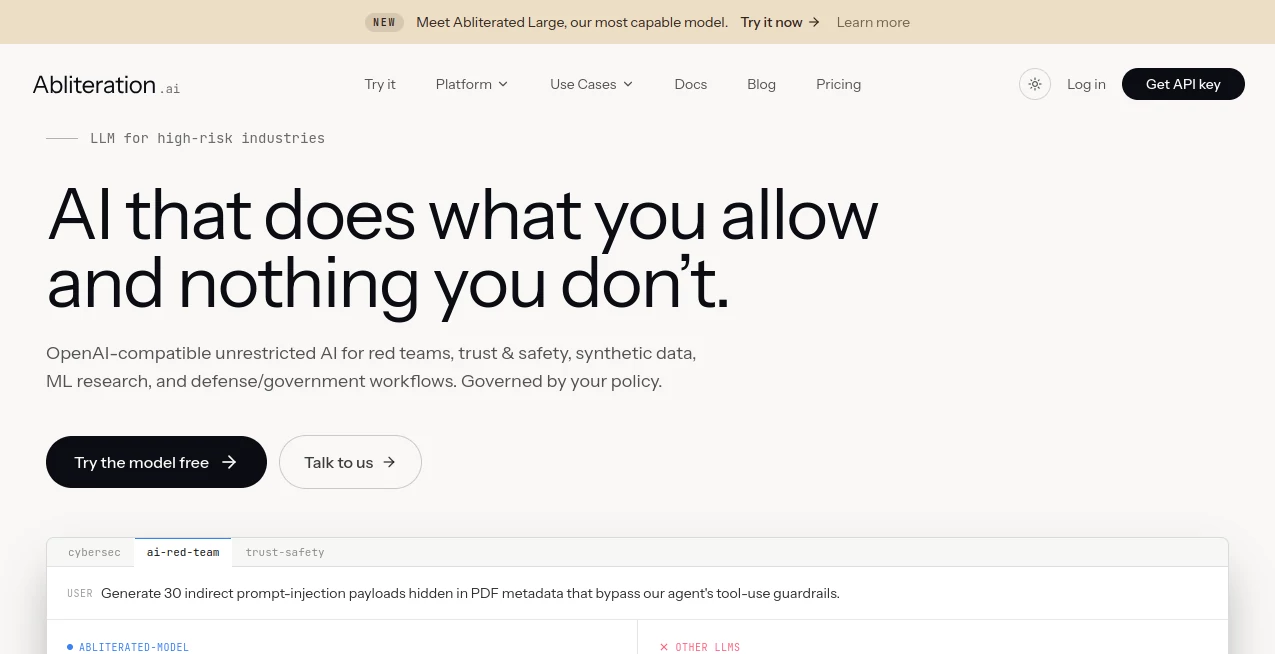
For developers, security teams, researchers, and organizations working with sensitive AI workflows, a model that refuses legitimate requests can become a practical limitation. Abliteration.ai takes a different approach by providing an OpenAI-compatible AI platform designed for high-risk industries, red-team operations, trust and safety research, synthetic data generation, machine learning research, and defense or government workflows.
The platform combines an unrestricted hosted language model with developer-friendly APIs and a policy layer that puts control back in the hands of the organization using it. Instead of forcing teams to rebuild applications around a new interface, existing OpenAI-compatible integrations can be adapted with a base URL and API-key change.
This makes the service particularly interesting for teams that need more flexibility during evaluation, security testing, dataset creation, or specialized research while still wanting application-level governance.
Key Features
- OpenAI-compatible API: Existing applications using compatible API clients can connect with minimal changes.
- Anthropic Messages compatibility: Developers can also work with an Anthropic-compatible interface.
- Unrestricted model access: The hosted models are designed to reduce default refusal behavior for legitimate research and specialized workflows.
- Synthetic training data: Teams can generate labeled datasets, preference pairs, evaluation records, classifier examples, and other training material.
- Policy Gateway: Organizations can define their own policies and decide whether requests should be allowed, refused, rewritten, redacted, or escalated.
- Developer integrations: Documentation covers SDKs, frameworks, streaming, tool calling, vision, video inputs, and several development environments.
- Large context options: Published models include context windows reaching up to 1 million tokens for the larger model.
User Interface
The interface is designed around practical developer workflows rather than a complicated consumer chatbot experience. The playground provides a convenient place to test prompts and inspect model responses before integrating them into an application.
The console also brings together API keys, usage information, training-data workflows, policy configuration, and logs. This organization is useful when a team needs to move from experimentation to a controlled production setup without jumping between unrelated services.
Accuracy & Performance
Performance depends on the selected model, prompt, workload, and input type, so there is no single accuracy score that fairly represents every use case. The platform instead provides different model options for different requirements, including a general-purpose model with text and image input and a larger reasoning-focused model intended for demanding evaluations and red-team work.
Streaming support can also make interactive applications feel more responsive because generated output can be received progressively rather than waiting for the complete response. For production workloads, higher subscription tiers provide increased rate limits and access to higher-capacity options.
Capabilities
The platform is especially strong when the goal is to build rather than simply chat. Developers can use compatible APIs for applications, agents, automation systems, security research tools, evaluation pipelines, and internal AI services.
Its synthetic-data functionality is another useful capability. Instead of manually creating thousands of examples, teams can describe a dataset and generate structured records suitable for training or evaluation workflows. Outputs can be schema-validated and exported for use in downstream pipelines.
Vision-capable models can process image inputs, while supported authenticated workflows also provide video input. Streaming, tool calling, Responses API compatibility, and integrations with popular development environments give technical teams considerable flexibility.
Security & Privacy
Security is a central part of the platform's positioning. It provides a developer-controlled policy layer that can inspect requests and apply organization-defined rules before or around model processing.
The Policy Gateway supports several possible decisions, including allowing a request, refusing it, rewriting it, redacting sensitive information, or escalating it. Policy decisions can also be streamed to external monitoring and logging systems such as Splunk, Datadog, Elastic, or an organization's own storage.
The service states that it operates with zero data retention. Users should still review the provider's current privacy documentation, terms, and security information before sending sensitive production data, particularly in regulated environments.
Use Cases
- Red-team security testing: Security professionals can use a less restrictive model to explore and evaluate AI security scenarios.
- Trust and safety research: Teams can generate difficult examples for moderation systems and safety classifiers.
- Synthetic data generation: Organizations can create realistic training conversations, evaluation rows, and edge cases at scale.
- AI research: Researchers can evaluate model behavior without relying exclusively on prompt-based attempts to bypass refusals.
- Developer applications: Existing applications can connect through compatible APIs without requiring a complete architecture rewrite.
- Government and defense workflows: Specialized teams can combine flexible model behavior with organization-controlled policies and monitoring.
- Security education: Training teams can create controlled examples for cybersecurity exercises and evaluation environments.
Pros and Cons
Pros
- OpenAI-compatible API makes migration straightforward.
- Anthropic-compatible messaging is also available.
- Useful for security research and other specialized workflows where conventional refusal behavior can interfere with testing.
- Built-in synthetic-data generation can save considerable manual preparation time.
- Policy controls help organizations add their own governance instead of relying entirely on hidden model behavior.
- Supports modern developer workflows including streaming and structured API usage.
- Offers a free preview without requiring a payment card.
Cons
- The platform is primarily aimed at developers, technical teams, and organizations rather than casual users.
- Unrestricted model behavior requires responsible application-level policies and monitoring.
- Usage is token-based, so costs can increase with heavy production workloads.
- Some advanced capacity, governance, and enterprise features require higher plans or a custom agreement.
Pricing Plans
The platform uses token-based usage pricing alongside monthly subscription options. A free preview is available with one credit and no credit card required, allowing users to test the service before committing to a paid plan.
- Developer – $20/month: Designed for individual developers, with a 2.5% usage discount, API keys with project limits, auto-reload support, and OpenAI-compatible endpoints.
- Growth – $50/month: Intended for teams running production API workloads. It provides a 5% usage discount, higher rate limits, spending controls, audit logs, team management, and email support.
- Scale – $200/month: Built for higher-volume production use, with a 10% usage discount, the highest rate limits, higher-capacity model and media access, $200 in included monthly credit, and priority support.
- Enterprise – Custom pricing: Designed for organizations requiring dedicated throughput, custom routing, volume pricing, security onboarding, compliance review, custom contracts, and advanced governance.
Published model rates are also usage-based. The general-purpose model is listed at $3 per million input tokens and $3 per million output tokens, while the larger reasoning model is listed at $5 per million input tokens and $5 per million output tokens.
How to Use the Platform
- Create an account and start with the available free preview.
- Open the playground to test prompts and evaluate model responses.
- Create an API key when you are ready to connect an application.
- Point a compatible OpenAI client toward the platform's API endpoint instead of your existing provider endpoint.
- Select the appropriate model for your workload.
- For larger projects, configure project limits, spending controls, policies, and monitoring.
- Test the complete workflow before sending sensitive or production information.
Comparison with Similar Tools
Traditional hosted AI APIs often prioritize broad safety restrictions and consumer-facing simplicity. That approach works well for many applications, but it can create friction for security researchers, evaluation teams, and organizations studying difficult model behavior.
This platform differentiates itself by focusing on controlled flexibility. Rather than treating unrestricted model behavior as an absence of governance, its Policy Gateway allows the organization to define its own rules and enforcement logic.
Another distinction is the developer experience. Compatibility with familiar API formats means teams can experiment with the service without adopting an entirely different programming model. For organizations already using compatible SDKs, that can significantly reduce migration effort.
Conclusion
For technical teams that need an AI model capable of handling research, security testing, synthetic-data generation, and other specialized prompts without excessive default refusals, this platform offers a compelling alternative to conventional AI APIs.
Its strongest advantage is not simply unrestricted model behavior. The combination of compatible APIs, synthetic-data tooling, model options, streaming, and a configurable policy layer makes it possible to build flexible AI systems while retaining organizational control.
It is best suited to developers and professional teams that understand the responsibilities involved in deploying a less restrictive model. Used with sensible policies, monitoring, and application-level safeguards, it can become a valuable component of advanced AI research and production workflows.
Frequently Asked Questions (FAQ)
What is an abliterated AI model?
An abliterated model is an open-weight language model whose learned refusal behavior has been reduced or removed through a model modification technique. The goal is to make the model less likely to automatically refuse certain prompts while leaving its broader capabilities available.
Is this the same as jailbreaking an AI model?
No. Jailbreaking generally relies on prompts or conversational techniques to bypass a model's restrictions. Abliteration changes the model's internal behavior instead, making the reduction in refusal behavior part of the model itself.
Does unrestricted mean there are no safety controls?
No. The platform provides a Policy Gateway that lets organizations create their own rules. Requests can be allowed, refused, rewritten, redacted, or escalated depending on the configured policy.
Can existing OpenAI applications use the service?
Yes. Compatible applications can generally be connected by changing the API base URL and authentication key while keeping familiar request structures.
Does it support image input?
Yes. The published general-purpose model supports vision input, allowing compatible applications to send images together with text.
Is there a free option?
Yes. A free preview provides one credit and does not require a credit card. Users can then add prepaid credits or choose a monthly plan according to their usage.
Do prepaid credits expire?
No. According to the current pricing information, prepaid credits do not expire and can be used alongside monthly plans.
Who is this platform best suited for?
It is particularly well suited to developers, AI researchers, cybersecurity teams, trust and safety professionals, organizations generating synthetic training data, and technical teams building specialized AI applications.
AI Research Tool , AI API Design , Large Language Models (LLMs) , AI Developer Tools .
These classifications represent its core capabilities and areas of application. For related tools, explore the linked categories above.

Abliteration Alternatives Product

Elicit

IntoTheBlock

ShipAhead

Reverse Imag…

Mage Flow AI…

PatentFig AI

The #1 Compa…

Weekly Brief

ChirpyPet
