
Airbyte
What is Airbyte?
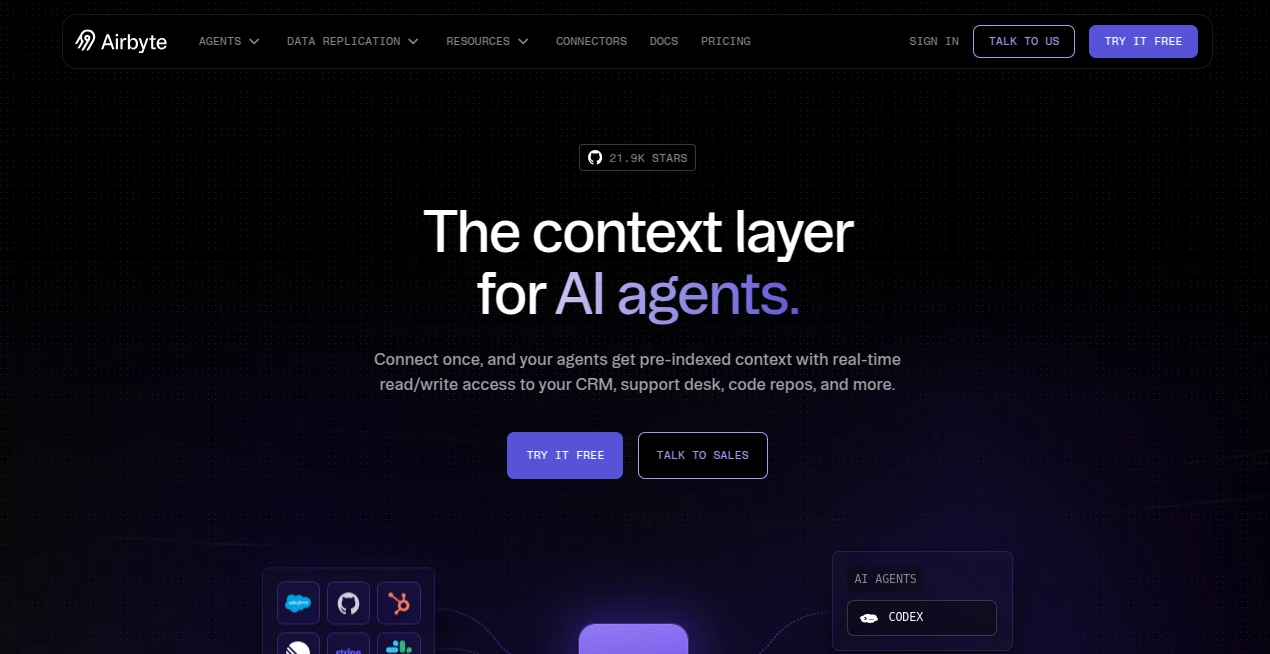
Modern AI agents are only as useful as the information they can access. Business data is often scattered across CRMs, support platforms, databases, spreadsheets, code repositories, and other systems, making it difficult for an agent to work with fresh and reliable context.
Airbyte takes a different approach by acting as a data and context layer between business systems and AI agents. It connects to a wide range of sources, prepares and indexes the information, and makes that context available to agents through interfaces such as APIs, SDKs, CLI tools, and MCP.
The platform is also built around data replication, allowing teams to move information from hundreds of sources into warehouses, lakes, databases, and other destinations. This makes it useful not only for AI applications, but also for analytics, machine learning, reporting, and broader data engineering workflows.
Key Features
- Connectors for more than 600 data sources and destinations.
- Pre-indexed context designed for AI agents.
- Real-time read and write access to connected business systems.
- Data replication for warehouses, lakes, databases, and operational systems.
- Context Store for maintaining fresh, unified information.
- Support for MCP, API, SDK, and CLI-based development.
- Open-source architecture with flexible deployment options.
- Custom connector development through low-code and open-source tooling.
- Support for structured and unstructured data used in AI and machine learning workflows.
User Interface
The platform is designed with developers and data teams in mind rather than casual users. Connections, pipelines, sources, destinations, and synchronization workflows can be managed from a centralized environment, while developers can also work programmatically through APIs, SDKs, Terraform, PyAirbyte, and command-line tools.
That combination is particularly useful for teams that want a visual starting point without giving up automation. A developer can begin by configuring a connection and later move the same workflow into a more controlled engineering environment.
Accuracy & Performance
For data and AI applications, freshness is often more important than simply having a large amount of information. The platform is designed to keep synchronized data current and reduce the need for AI agents to repeatedly crawl individual APIs.
Its architecture can consolidate information before an agent needs it, which can reduce unnecessary API calls and context-window overhead. Advanced change data capture capabilities and scalable pipeline infrastructure are also aimed at handling high-volume data movement with low latency.
Actual performance will depend on the selected connectors, source systems, synchronization frequency, workload size, deployment model, and infrastructure configuration. For production teams, those variables are worth testing with representative data before committing to a specific architecture.
Capabilities
One of the strongest aspects of the platform is its breadth. Teams can connect applications such as CRM systems, support tools, code repositories, collaboration platforms, databases, and cloud services, then make the resulting information available to downstream systems or AI applications.
For AI developers, the context layer is especially interesting. Instead of building separate integrations for every agent, a team can create a common data layer that different agents and frameworks can query. The platform can also work with MCP, making it easier to expose connected data and actions to compatible AI applications.
Data engineering teams can use the same ecosystem for traditional replication and analytics workflows. Data can be moved into warehouses and lakes, while operational activation can send information back into systems where teams actually work.
Security & Privacy
Security becomes critical when an AI application can access internal company information. The platform provides enterprise-oriented capabilities such as role-based access control, single sign-on, encryption, audit and monitoring features, and support for multiple deployment models.
Its deployment options can also support organizations with strict data residency or sovereignty requirements. Depending on the plan and architecture, teams can use cloud, hybrid, or on-premises approaches rather than being forced into a single hosting model.
Organizations working with sensitive information should still configure permissions carefully and review the applicable compliance and data-handling requirements before connecting production systems.
Use Cases
- AI Agents: Give agents access to current business information without requiring every agent to build its own collection of integrations.
- Data Warehousing: Replicate information from operational systems into warehouses and data lakes for analytics.
- Machine Learning: Bring structured and unstructured data into pipelines used for model development and AI applications.
- Customer Support: Connect customer records, support conversations, product information, and other sources to create richer AI-assisted workflows.
- Business Intelligence: Keep reporting environments supplied with fresh information from multiple systems.
- Operational Data Activation: Move processed information back into CRMs, SaaS platforms, and other operational tools.
- Custom Integrations: Build connectors for systems that are not already covered by the existing connector ecosystem.
Pros and Cons
- Pros: Large connector ecosystem, open-source foundation, strong developer tooling, AI-focused context capabilities, flexible deployment options, and support for both data replication and AI workflows.
- Pros: Teams can choose between managed services and self-managed infrastructure depending on their technical and compliance requirements.
- Pros: MCP, APIs, SDKs, CLI tools, and infrastructure-as-code options provide flexibility for engineering teams.
- Cons: The platform is primarily aimed at developers, data engineers, and technical teams rather than non-technical users.
- Cons: Pricing and infrastructure decisions can become more complex as data volume, synchronization requirements, and enterprise governance needs increase.
- Cons: Setting up sophisticated production pipelines may still require knowledge of data engineering, APIs, authentication, and cloud infrastructure.
Pricing Plans
The pricing structure depends on whether the platform is being used for AI agents or traditional data replication.
For AI agents, there is a Free plan with no monthly subscription cost and a monthly allowance of agent operations. The Individual plan is listed at $29 per month, while the Team plan is listed at $299 per month. A Custom plan is also available for companies with larger or specialized requirements.
For data replication, the Core edition is available as a self-managed open-source option. The Standard managed plan starts at $10 per month and uses volume-based pricing, while Pro introduces capacity-based pricing and additional governance and security features. Enterprise Flex is designed for organizations that require more control over where their data movement infrastructure operates.
Because pricing can vary according to usage, capacity, deployment model, and enterprise requirements, companies should review the current pricing structure before choosing a plan.
How to Use the Platform
- Choose your workflow: Decide whether you want to build AI agent context, replicate data, or combine both approaches.
- Connect your sources: Select the applications, databases, APIs, files, or other systems containing the information you need.
- Configure authentication: Set up the required credentials and permissions for each source.
- Build the data flow: Configure synchronization, replication, or context preparation according to your use case.
- Choose your development interface: Use the web interface for configuration or work programmatically through the API, SDK, CLI, Terraform, PyAirbyte, or MCP.
- Connect your AI application: Make the prepared context available to your preferred agent or AI framework.
- Monitor the workflow: Check synchronization activity, data freshness, errors, and resource usage as the system runs.
Comparison with Similar Tools
Traditional data integration platforms generally focus on moving information between sources and destinations. AI-focused data frameworks, meanwhile, often concentrate on retrieval, embeddings, vector databases, or application-level agent orchestration.
This platform sits across several of those areas. Its data replication foundation is useful for conventional data engineering, while its context capabilities are designed specifically around the needs of AI agents. That combination can be valuable for companies that do not want to maintain one integration stack for analytics and another completely separate stack for AI applications.
Compared with building custom integrations from scratch, the main advantage is the existing connector ecosystem and the infrastructure surrounding those connections. The trade-off is that teams must learn the platform's architecture and choose the appropriate deployment and pricing model for their workloads.
Conclusion
AI systems need more than a capable language model to deliver useful results. They need access to reliable, current, well-organized information. This platform addresses that problem by combining data movement infrastructure with an AI-oriented context layer.
Its broad connector ecosystem, developer-friendly interfaces, open-source foundation, and flexible deployment options make it particularly appealing to engineering and data teams. The ability to support both traditional replication and AI agent workflows is another practical advantage.
For organizations building serious AI products rather than isolated experiments, having a dependable way to connect agents with real business data can remove one of the biggest engineering obstacles. This platform is a strong option for teams looking to build that foundation without creating every integration themselves.
Frequently Asked Questions (FAQ)
What is this platform mainly used for?
It is used for data integration, replication, and providing AI applications and agents with fresh context from business systems, databases, APIs, files, and other sources.
How many connectors are available?
The platform currently advertises more than 600 connectors covering a broad range of sources and destinations.
Can developers use it with AI agents?
Yes. Developers can use interfaces such as MCP, APIs, SDKs, and CLI tools to provide connected data and actions to AI agents and compatible agent frameworks.
Is there a free option?
Yes. The AI agent offering includes a Free plan, while the Core data replication edition is available as a self-managed open-source option.
Can it be self-hosted?
Yes. Self-managed deployment is available, and enterprise-oriented options also support cloud, hybrid, and on-premises deployment models.
Is it suitable for enterprise use?
It can be suitable for enterprise environments that require governance, security controls, data sovereignty, multiple workspaces, access management, and flexible deployment options.
Does it only work with AI?
No. Data replication remains an important part of the platform. Teams can use it for analytics, data warehouses, data lakes, operational systems, machine learning pipelines, and AI applications.
Can custom connectors be created?
Yes. Developers can create custom integrations using the available connector-building tools and open-source development capabilities.
What type of teams will benefit most from it?
Data engineering teams, AI developers, machine learning teams, platform engineers, and organizations building data-intensive applications are likely to get the most value from its capabilities.
AI Data Mining , AI Developer Tools .
These classifications represent its core capabilities and areas of application. For related tools, explore the linked categories above.

Airbyte Alternatives Product

CloudByte PMS

Schema Synth

Simple Dev T…
Sendmux

Empiriolabs …

Mythx AI

LPM 1.0

RecoveryFox …

WhatsMyName …