
Cybersecurity AI | Alias Robotics
What is Cybersecurity AI | Alias Robotics?
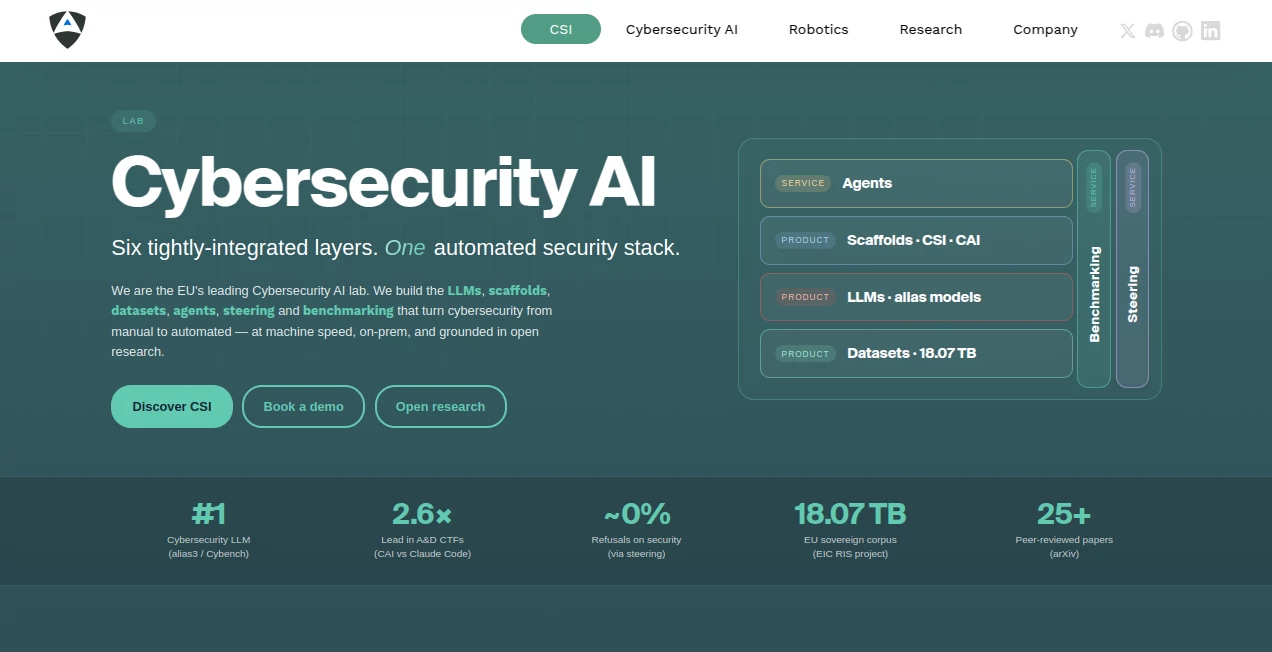
Cybersecurity teams are dealing with a growing number of threats, tools, alerts, and increasingly sophisticated attack techniques. Cybersecurity AI takes a different approach by bringing specialized language models, security agents, datasets, orchestration, steering, and benchmarking into one connected stack.
Built by Alias Robotics, the platform is designed around the idea of moving cybersecurity work from repetitive manual processes toward automated, evidence-driven operations. It is EU-built, grounded in open research, and designed with on-premise deployment in mind, making it particularly interesting for organizations that need greater control over their security infrastructure.
Rather than presenting AI as a generic chatbot for security questions, the platform focuses on practical cybersecurity workflows. Its ecosystem covers offensive security, defensive operations, vulnerability research, red teaming, forensics, and specialized security agents.
Key Features
- Cybersecurity-specialized language models designed for security workflows.
- Integrated scaffolds for coordinating models, tools, context, and agents.
- A large cybersecurity dataset containing 224,766 session logs and 25.7 million user prompts.
- Specialized agents for defender, forensics, bug bounty, red team, APT simulation, and robotics security tasks.
- Benchmarking against humans, other AI systems, cyber ranges, and security competitions.
- On-premise deployment options for organizations requiring local control.
- Research-backed development supported by more than 25 peer-reviewed publications.
User Interface
The experience is built less like a conventional consumer AI application and more like a technical security platform. The ecosystem revolves around models, command-line agents, scaffolds, datasets, and specialized workflows rather than a simple chat window.
For technical users, this approach makes sense. Security professionals can work with the components that match their existing workflow and choose between hosted access, open-source research, or a customized on-premise deployment. The CLI-oriented approach is especially useful for teams that already rely heavily on terminal-based security tooling.
Accuracy & Performance
Performance is one of the strongest parts of the platform's presentation. Its models and agents are evaluated through cybersecurity-specific benchmarks rather than relying solely on general AI benchmarks.
The current platform reports an 85% pass@3 result for its leading cybersecurity model on Cybench. Its security agents have also demonstrated a 2.6× lead over the next-best agent in the reported attack-and-defense CTF testing.
These results are particularly relevant because cybersecurity performance depends on more than generating technically plausible text. An effective security system needs to reason through tasks, interact with tools, interpret evidence, and continue working through complex attack or defense scenarios.
Capabilities
The platform covers a broad section of the cybersecurity workflow. Its specialized models are intended for penetration testers, red teams, vulnerability researchers, and security operations teams.
Its agent layer extends those capabilities into more focused roles. Examples include defenders, bug bounty agents, forensic workflows, command-line red teaming, APT simulation, and robot defense.
Another interesting component is its orchestration layer. The system can combine different cybersecurity scaffolds and models, allowing organizations to build more structured workflows instead of relying on a single AI model for every task.
Security & Privacy
Privacy and deployment control are central to the platform's positioning. The technology is designed to support on-premise operation, including environments where organizations need to keep sensitive security workflows and data under their own control.
The platform also offers custom deployments for governments, intelligence organizations, and critical infrastructure. Air-gapped deployments and domain-specific customization are available as part of its enterprise-oriented offering.
For security teams handling confidential infrastructure information, source code, vulnerability research, or incident data, the ability to operate AI locally can be a major practical advantage over sending sensitive information to a conventional public AI service.
Use Cases
There are several situations where this platform can be particularly useful.
- Penetration Testing: Security professionals can use specialized AI capabilities to support reconnaissance, vulnerability research, and offensive security workflows.
- Red Team Operations: Specialized agents can assist with structured adversarial security tasks and simulated attack scenarios.
- Security Operations: Defensive workflows can use AI agents to investigate information and support security operations.
- Forensics: Dedicated workflows can help security teams organize and investigate forensic tasks.
- Bug Bounty: Security researchers can use specialized agents as part of vulnerability discovery and testing workflows.
- Cybersecurity Research: Researchers can explore the open-source framework, datasets, benchmarks, and published research behind the technology.
- Critical Infrastructure: Organizations with strict security requirements can consider customized on-premise or air-gapped deployments.
- Robotics Security: Its background in robot cybersecurity makes the technology relevant to teams working with connected robots and robotic infrastructure.
Pros and Cons
Pros
- Designed specifically for cybersecurity rather than general-purpose AI.
- Strong emphasis on measurable security benchmarks.
- Supports offensive and defensive security workflows.
- Offers on-premise deployment for organizations with strict data-control requirements.
- Built around a substantial cybersecurity dataset.
- Includes open-source components and publicly documented research.
- Provides specialized agents for different security roles.
Cons
- The platform is primarily aimed at technical cybersecurity users rather than casual AI users.
- Some advanced enterprise capabilities require custom pricing and deployment discussions.
- The breadth of models, agents, scaffolds, and services may take time for new users to understand.
- Users looking for a simple consumer-style security assistant may find the technical approach more complex than necessary.
Pricing Plans
PRO access is currently offered at €350 per month or €3,990 per year. The plan provides unlimited tokens to the hosted cybersecurity models together with access to the associated scaffolds.
Organizations that require their own infrastructure can request a custom on-premise deployment. This option is aimed at governments, intelligence agencies, and critical infrastructure organizations, with pricing determined according to the deployment and requirements.
There is also an open-source path for users interested in research and experimentation, allowing technical teams to explore the underlying framework and published work without starting with a custom enterprise deployment.
How to Use Cybersecurity AI
Getting started depends on what you want to accomplish. A security researcher interested in experimentation can begin with the open-source framework and explore the available research and documentation.
For teams that want immediate access to hosted specialized models, PRO access provides a simpler route. Users can work with the available models and scaffolds without building the entire infrastructure themselves.
Larger organizations can take a different route by discussing an on-premise deployment. This is more appropriate when security requirements demand local infrastructure, air-gapped environments, or models adapted to a particular operational domain.
A practical starting point is to select one well-defined cybersecurity workflow, test the system against existing procedures, and then expand into additional agents or automated operations once the results are clear.
Comparison with Similar Tools
Generic AI assistants can be useful for explaining security concepts, reviewing code, or helping write scripts, but they are not necessarily designed around the complete cybersecurity workflow. This platform takes a more specialized route, combining cybersecurity-focused models with agents, orchestration, datasets, and dedicated benchmarks.
Another distinction is deployment. Many mainstream AI services are primarily cloud-oriented, while this platform places significant emphasis on on-premise and sovereign operation. That can make it more appealing to organizations where security data cannot easily leave their infrastructure.
Its open research approach is also notable. The platform publishes research and benchmark results, giving technical users more context about how its systems are developed and evaluated.
Conclusion
Cybersecurity AI is an ambitious platform for organizations that want to move beyond using general-purpose AI for isolated security tasks. Its combination of specialized models, security agents, orchestration, large-scale cybersecurity data, and benchmarking creates a much more focused environment for professional security work.
The strongest appeal is its technical depth. This is not positioned as an AI assistant for occasional security questions. It is designed for people who want AI to participate in real cybersecurity workflows, while retaining options for local deployment and deeper customization.
For penetration testers, security researchers, red teams, security operations teams, and organizations with demanding infrastructure requirements, it is a compelling platform to investigate. The combination of specialized cybersecurity intelligence and an increasingly automated workflow makes it one of the more interesting approaches to AI-assisted security operations.
Frequently Asked Questions (FAQ)
What is Cybersecurity AI?
It is a cybersecurity-focused AI stack combining specialized language models, security agents, scaffolds, datasets, steering techniques, and benchmarking for automated security workflows.
Who is it designed for?
The platform is primarily designed for cybersecurity professionals, penetration testers, red teams, vulnerability researchers, security operations teams, researchers, and organizations with advanced security requirements.
Can it be deployed on-premise?
Yes. On-premise deployment is one of the platform's key features, with custom deployments available for organizations that require local or air-gapped infrastructure.
Is there an open-source option?
Yes. The associated cybersecurity AI framework is available as an open-source project under a commercial-friendly license, providing a way for researchers and technical users to explore and build cybersecurity workflows.
How much does PRO access cost?
PRO access is listed at €350 per month or €3,990 per year and includes unlimited tokens for the hosted models together with the associated scaffolds.
What kind of cybersecurity tasks can it support?
Its ecosystem covers areas including penetration testing, red teaming, vulnerability research, bug bounty work, digital forensics, defensive operations, APT simulation, and specialized robotics security.
Does it use cybersecurity-specific data?
Yes. The platform reports a cybersecurity corpus containing 224,766 session logs, 25.7 million user prompts, data from 123 countries, and approximately 18.07 TB of curated security data.
Is it suitable for enterprise security teams?
Yes. Its on-premise deployment options, specialized agents, research foundation, and enterprise-oriented services make it particularly relevant to organizations with advanced cybersecurity and infrastructure requirements.
Can it replace a human cybersecurity professional?
It is designed to automate and accelerate cybersecurity work rather than simply remove humans from the process. Professional oversight remains important, especially when AI systems are used for sensitive offensive or defensive security operations.
What makes it different from a general AI chatbot?
The main difference is specialization. Instead of relying on a general-purpose model alone, the platform combines cybersecurity-focused models with agents, tools, datasets, orchestration, and security-specific benchmarks.
AI Research Tool , AI Developer Tools .
These classifications represent its core capabilities and areas of application. For related tools, explore the linked categories above.
Cybersecurity AI | Alias Robotics details
Website unavailable — View Alternatives
Pricing
- Freemium
Apps
- Web App
Categories

Cybersecurity AI | Alias Robotics Alternatives Product

Vibe Coding …

Where Is Thi…

Elicit

AI Podcast I…

Vibe Code Pi…

YTVidHub-you…

MidJourney

Screenshot t…

AyeWatch AI