
B.AI
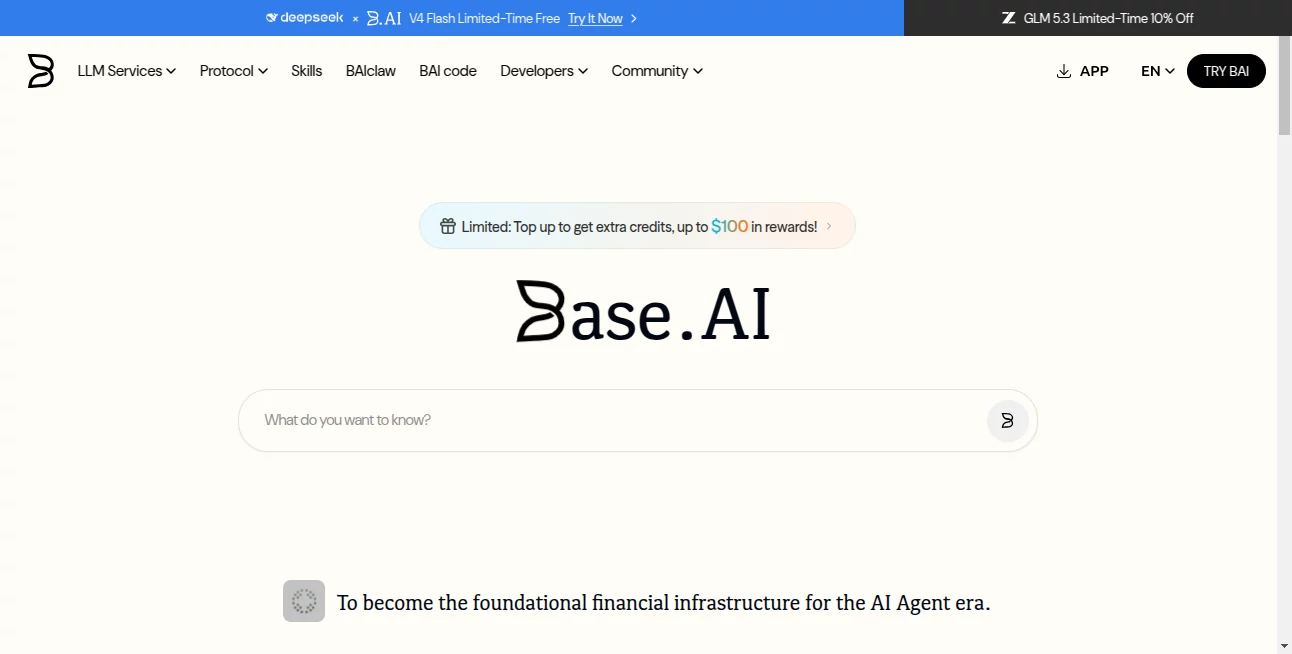
What is B.AI?
Accessing several leading AI models usually means opening multiple accounts, learning different interfaces, and keeping track of separate billing systems. B.AI takes a different approach by bringing multiple large language models into one environment, giving users a simpler way to choose the model that fits a particular task.
The platform is designed around multi-model AI access, with conversational AI available alongside API services for developers. Users can select from available models based on their preferred balance of speed, capability, and cost, while developers can connect applications through an API designed to work with familiar OpenAI-compatible interfaces.
Another interesting part of the platform is its Web3-oriented infrastructure. Users can access the service through conventional account methods or supported wallets, while payments can be handled through both traditional and on-chain options. This combination makes the platform particularly interesting for developers, AI enthusiasts, and users who work across both conventional software and Web3 environments.
Key Features
- Multi-model AI conversations in a single platform
- Access to a growing selection of leading language models
- Model selection based on capability, speed, and usage requirements
- Auto mode for automatically selecting an appropriate available model
- OpenAI-compatible API access for developers
- Support for both centralized account login and Web3 wallet authentication
- Credit-based usage and billing
- Traditional and on-chain payment options
- API support for both streamed and non-streamed responses
- Developer-focused infrastructure for integrating AI into applications
User Interface
The conversational interface follows a familiar chat-based layout, so there is little learning curve for anyone who has used a modern AI assistant before. After signing in, users can choose an available model from the model selector and begin a conversation from the main chat interface.
The ability to switch models is particularly useful when the nature of a task changes. A user might prefer a fast model for a short question and move to a more capable model for coding, analysis, or a complicated reasoning task. There is also an Auto option designed to select an appropriate available model for individual requests.
For everyday users, this model-selection approach can make the experience feel less fragmented. Instead of jumping between several AI services, conversations can remain within one workspace.
Accuracy & Performance
Performance depends largely on the model selected, since the platform provides access to models with different strengths, context capabilities, response speeds, and pricing structures. This is one of the practical advantages of a multi-model environment: users are not locked into a single model for every type of task.
The available model catalog includes options from major AI providers as well as other advanced language models. Some models are optimized for fast responses, while others are intended for demanding reasoning, coding, document analysis, or long-context workloads.
For example, the documentation describes models with very large context windows and specialized capabilities, giving developers and professional users room to work with substantial amounts of information when the selected model supports it.
Capabilities
The platform goes beyond a standard AI chat interface. Its LLM service provides access to multiple models while its API infrastructure allows developers to integrate AI capabilities into their own software.
The API supports chat completions, multi-turn conversations, streaming responses, and model discovery. Authentication can be handled through an API key or a bearer token, making the integration familiar to developers who have already worked with OpenAI-compatible APIs.
The broader ecosystem also includes a command-line programming tool that supports model switching, session management, and context compression. This makes the ecosystem relevant not only to people looking for a conversational assistant but also to developers building and testing AI-powered workflows.
Security & Privacy
Security is an important consideration when working with AI APIs and wallet-based services. The platform provides both centralized login and supported Web3 wallet authentication, allowing users to choose an access method that suits their needs.
Developers should treat API credentials as sensitive information and keep them out of frontend code, public repositories, and publicly accessible documentation. Wallet users should also protect their private keys and recovery phrases.
The service describes itself as privacy-conscious and supports a blockchain-based infrastructure for parts of its service and settlement architecture. Users should nevertheless review the current privacy policy and service terms before submitting sensitive information or connecting a wallet.
Use Cases
AI Research: Researchers can compare different language models without maintaining several separate AI interfaces. This is useful when a task benefits from testing alternative models rather than relying on a single provider.
Software Development: Developers can use the conversational environment for coding and technical questions, while the API can be connected to applications that require programmatic access to language models.
AI Application Development: The API infrastructure makes it possible to add model-powered features to websites, internal tools, automation systems, and other software products.
Long-Context Work: When supported by the selected model, users can work with large amounts of text, documentation, code, or other contextual information.
Web3 Projects: The combination of AI services, wallet authentication, and on-chain payment options makes the platform especially relevant to developers and users working in Web3 environments.
Everyday AI Assistance: For users who simply want one place to ask questions, write content, analyze information, brainstorm ideas, or explore different models, the chat interface provides a straightforward starting point.
Pros and Cons
Pros
- Provides access to multiple AI models from one environment
- Useful model-selection system for different types of tasks
- Includes an Auto option for users who do not want to choose models manually
- Offers an API designed around familiar OpenAI-compatible conventions
- Supports both traditional account access and Web3 wallet authentication
- Combines fiat and supported on-chain payment options
- Useful for both general users and developers
- Credit-based usage provides a unified way to track AI consumption
Cons
- Pricing and availability can vary depending on the selected model
- Some subscription options may require an invite code
- Users need to understand credits and model-specific consumption to manage costs effectively
- Wallet-based access adds an additional layer of responsibility for Web3 users
- The large selection of models may initially feel confusing to users who are unfamiliar with model differences
Pricing Plans
The platform uses a unified credit system for AI usage. According to the current documentation, 1 USD corresponds to 1,000,000 credits, while the number of credits consumed depends on the model and the amount of input and output generated.
Users can also see token-usage information in the response details, which can help them understand where their credits are being spent.
Two subscription levels are currently documented. The Pro plan costs $200 per month and is aimed at individual developers and frequent AI users, with approximately 50 to 500 messages available within a rolling 12-hour window depending on usage conditions. The plan provides access to the full model series and selected additional skills, although a valid invite code is required for purchase.
The Max plan costs $2,000 per month and is intended for ambassadors and heavy users. It provides a substantially higher allowance, approximately 500 to 5,000 messages within a rolling 12-hour window, priority access to beta models, and dedicated support.
Because model pricing, available payment channels, and service limits can change, users should check the current pricing information before purchasing a subscription or adding credits.
How to Use the Platform
Getting started is relatively straightforward. Users can enter the chat service, choose a preferred login method, and begin a conversation after authentication.
- Sign in using an available centralized account option or supported Web3 wallet.
- Open the AI chat interface.
- Select an available AI model from the model selector.
- Choose Auto if you prefer the system to select an appropriate available model.
- Enter a prompt or describe the task you want to complete.
- Continue the conversation when additional context or follow-up questions are needed.
- Use the Top Up section when additional credits are required.
Developers have a separate route through the API. After obtaining the required credentials, an application can communicate with the API using supported authentication methods and chat-completion endpoints. This makes it possible to move from experimenting with AI in the chat interface to embedding similar capabilities directly into software.
Comparison with Similar Tools
The biggest difference between this platform and a conventional single-model AI assistant is its multi-model approach. Traditional AI services often center their experience around one provider's model family, while this platform is built to give users a choice among several available models.
That difference matters when users have changing requirements. One model may be preferable for speed, another for advanced reasoning, and another for coding or long-context analysis. Having those choices in one environment can reduce the need to maintain several separate AI subscriptions.
It also differs from a typical AI API gateway by combining conversational access, developer APIs, credit-based billing, and Web3-oriented account and payment options. For users who only need a basic chatbot, some of these features may be unnecessary. For developers and AI-heavy users, however, the broader infrastructure can be a significant advantage.
Conclusion
A multi-model approach makes sense for users who do not want every AI task tied to the same model. By bringing different language models, conversational access, developer APIs, and flexible payment methods into one ecosystem, the platform offers a practical option for both experimentation and more serious AI development.
Its strongest appeal is the freedom to choose. Developers can work with an API, everyday users can switch between models in a familiar chat environment, and Web3 users have additional authentication and payment options. The credit system and broad model selection do require some attention, particularly for anyone managing a larger workload, but that trade-off comes with considerably more flexibility.
For people who regularly use multiple AI models or developers looking for a unified route into different LLM capabilities, it is an interesting platform to explore.
Frequently Asked Questions (FAQ)
What is this platform used for?
It provides access to multiple large language models through a unified AI service. Users can chat with available models, while developers can use the API to integrate supported AI capabilities into their own applications.
Can I choose which AI model to use?
Yes. The chat interface provides a model selector that allows users to choose from available models. An Auto option is also available for users who prefer automatic model selection.
Does it provide an API?
Yes. The service provides an API with chat-completion functionality and support for OpenAI-compatible integration patterns. Both streamed and non-streamed responses are supported.
How does billing work?
The service uses credits to measure AI consumption. The amount deducted depends on the selected model and token usage, with additional charges potentially applying to certain features such as web search.
Does it support cryptocurrency or blockchain payments?
Yes. The service supports supported on-chain payment methods alongside several traditional payment options. The exact networks, tokens, and payment channels available can vary over time.
Can I log in without a crypto wallet?
Yes. In addition to supported Web3 wallet authentication, centralized login options such as Google sign-in are available, making the service accessible to users who do not want to use a wallet.
Is it useful for developers?
Yes. Developers can use the conversational interface for technical work and access the API for integrating language models into applications. The broader ecosystem also includes developer-oriented tools for working with AI models from the command line.
Which category does this AI tool belong to?
The platform is best suited to categories covering large language models, AI chatbots, developer tools, and Web3-related AI infrastructure.
AI Chatbot , Large Language Models (LLMs) , AI Developer Tools , Web3 .
These classifications represent its core capabilities and areas of application. For related tools, explore the linked categories above.

B.AI Alternatives Product

Dewy Chat

JSON-Tools

OGimage

Agent Grid

eesel AI

Vapi

CodeSpy AI

tanship

AI Workflow …