CodeRabbit
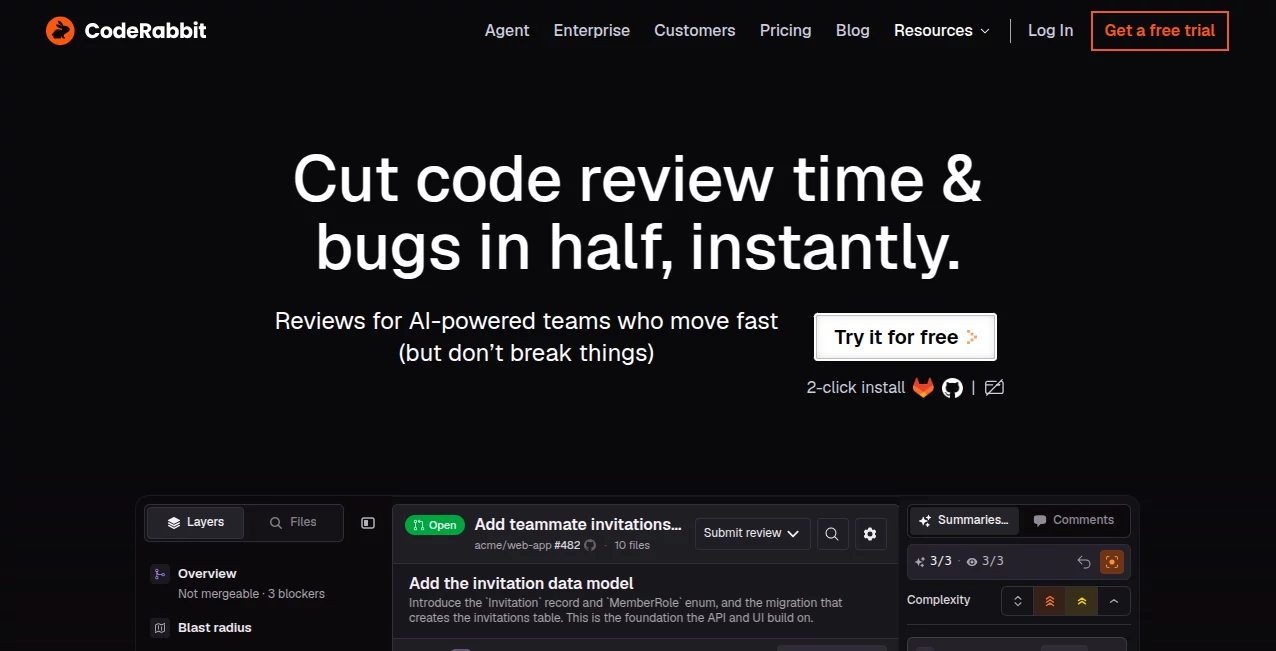
What is CodeRabbit?
CodeRabbit is an AI-powered code review platform built to help developers identify bugs, improve code quality, and accelerate pull request reviews with intelligent suggestions. Designed for modern software teams, it integrates directly into existing development workflows, making reviews more productive without adding unnecessary complexity.
Instead of replacing human reviewers, the platform acts as a reliable teammate that highlights potential issues before they become production problems. From detecting security concerns to recommending cleaner implementations, it helps engineers spend less time searching for mistakes and more time building valuable features. Whether you're an independent developer or part of a large engineering organization, the review process becomes faster, more consistent, and easier to manage. It supports GitHub, GitLab, IDEs, and CLI workflows while offering contextual feedback that adapts to each project.
Key Features
User Interface
The interface is clean and naturally fits into existing development environments. Developers can receive review comments directly inside pull requests or work within their preferred editor without switching between multiple applications. Suggestions are presented in an organized way, allowing users to understand issues quickly and apply improvements with minimal effort.
Accuracy & Performance
The review engine analyzes code changes with project context instead of relying only on isolated snippets. It identifies logic errors, potential security vulnerabilities, performance bottlenecks, code smells, and style inconsistencies while reducing unnecessary comments on simple modifications. Incremental reviews also ensure that only newly introduced changes are analyzed, making the process significantly more efficient. These capabilities are enhanced through integrations with linters, static analysis tools, and repository knowledge. :contentReference[oaicite:0]{index=0}
Capabilities
The platform offers pull request reviews, code summarization, automatic documentation generation, AI-assisted fixes, unit test generation, merge conflict assistance, repository analysis, issue planning, analytics dashboards, IDE reviews, terminal-based reviews, and integrations with engineering tools such as Jira and Linear. Enterprise deployments also include advanced access controls, API access, self-hosting options, audit logging, and multi-organization management. :contentReference[oaicite:1]{index=1}
Security & Privacy
Security is treated as a core requirement. The service is SOC 2 Type II certified, GDPR compliant, and uses industry-standard encryption practices. Organizations also have options for self-hosting, enterprise security controls, and data privacy settings, including the ability to opt out of data storage in supported scenarios. :contentReference[oaicite:2]{index=2}
Use Cases
Development teams can use the platform to automate pull request reviews, identify security risks before deployment, improve collaboration between reviewers, generate documentation, enforce coding standards, review code directly inside IDEs, analyze repositories for architectural consistency, and accelerate onboarding for new developers. Open-source maintainers can also benefit from faster reviews while keeping contribution quality high.
Pros and Cons
Pros
Provides highly contextual AI code reviews.
Works across pull requests, IDEs, and command-line workflows.
Reduces repetitive review work for engineering teams.
Supports automated documentation and code improvements.
Offers enterprise-grade security and deployment options.
Cons
Some advanced capabilities are limited to paid plans.
Organizations with heavy review volumes may need higher-tier subscriptions for increased usage limits. :contentReference[oaicite:3]{index=3}
Pricing Plans
A free plan is available with pull request summarization and limited review capabilities, including a 14-day trial of premium features. Paid subscriptions include Pro, Pro Plus, and Enterprise plans, adding advanced AI reviews, repository intelligence, integrations, higher review limits, analytics, documentation generation, API access, and enterprise security features. Pricing is based on contributing developers rather than repository count. :contentReference[oaicite:4]{index=4}
How to Use CodeRabbit
Sign in using your Git provider account, connect your repositories, install the integration for your preferred platform, and allow automatic reviews on pull requests. Developers can also install the IDE extension or CLI to receive instant feedback before code reaches a repository. Review comments can be discussed, accepted, or applied as improvements during the normal development workflow.
Comparison with Similar Tools
Compared with traditional static analysis tools, this platform delivers conversational feedback alongside code quality suggestions. Unlike simple linters that only detect predefined rules, it understands project context and explains recommendations in natural language. Compared with AI coding assistants focused on code generation, it emphasizes code review, quality assurance, collaboration, and continuous improvement throughout the software development lifecycle.
Conclusion
Modern software teams need faster reviews without sacrificing quality, and this platform delivers that balance remarkably well. Its intelligent review engine, broad integrations, contextual understanding, and enterprise-ready security make it a valuable addition to professional development workflows. By reducing manual review effort while helping developers write cleaner and more reliable code, it enables engineering teams to ship software with greater confidence and efficiency.
Frequently Asked Questions (FAQ)
What does this platform do?
It automatically reviews code changes, identifies issues, and provides AI-powered recommendations during the development process.
Does it support GitHub and GitLab?
Yes. It integrates with GitHub, GitLab, IDEs, and command-line workflows.
Is there a free version?
Yes. A free plan is available along with a limited-time trial of premium features. :contentReference[oaicite:5]{index=5}
Can enterprise teams self-host the platform?
Yes. Enterprise customers can choose self-hosted deployments along with advanced security and administration features. :contentReference[oaicite:6]{index=6}
Who benefits most from using it?
Individual developers, software startups, open-source maintainers, and enterprise engineering teams looking to improve review quality and development speed.
AI Testing & QA , AI Code Assistant , AI Code Generator , AI Developer Tools .
These classifications represent its core capabilities and areas of application. For related tools, explore the linked categories above.

CodeRabbit Alternatives Product

Kimi K2.5

HostFinder

DeepSeek V4
JSON to TOON…

Agent Grid

Fugte

Timestamp Ro…

TokenCalcula…

Screenshot t…