
CogniAgent
What is CogniAgent?
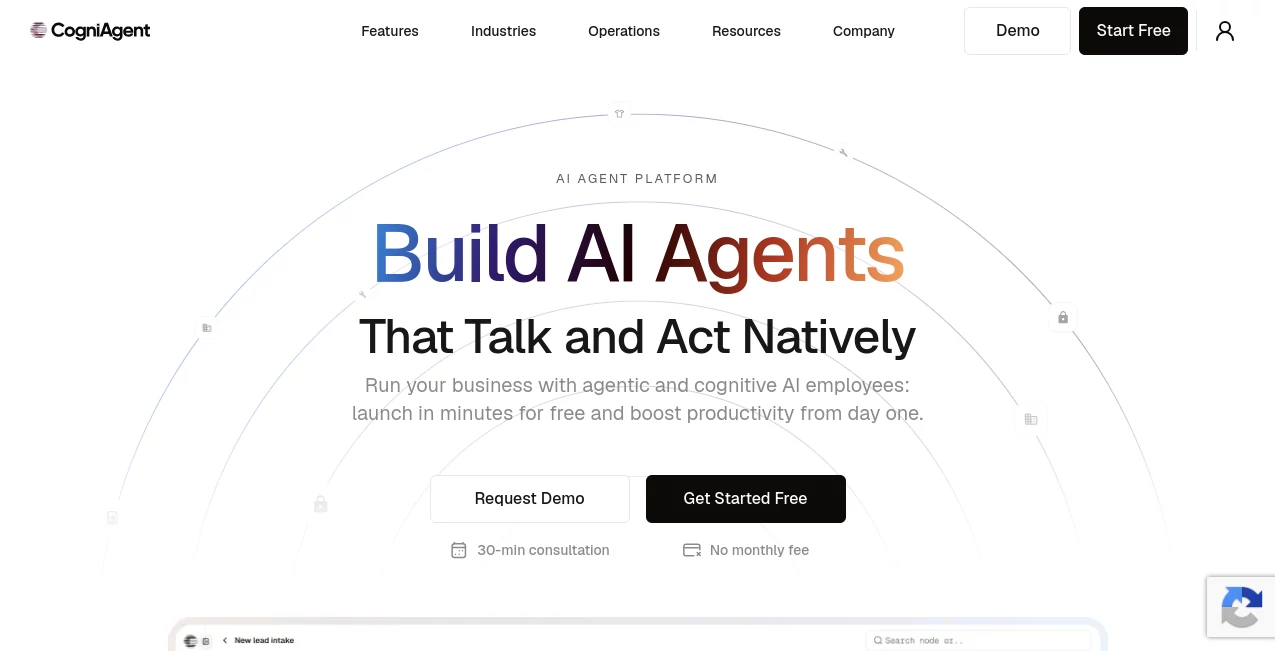
CogniAgent is an AI agent platform built for businesses that want to automate real operational work rather than simply generate answers. It brings conversational AI, autonomous agents, and structured workflow automation together in one environment, allowing teams to build agents that can communicate with customers, check business systems, trigger actions, and complete multi-step processes.
One of the most appealing aspects is that businesses do not necessarily need a dedicated engineering team to get started. The platform provides a low-code approach, ready-made agent templates, an AI Concierge, and human onboarding support. This makes it practical for teams that already know which repetitive processes they want to automate but do not want to build an automation system from scratch.
The platform is particularly well suited to operations involving customer conversations, lead qualification, appointment scheduling, support requests, recruiting, sales follow-ups, and internal business workflows.
Key Features
- Conversational AI agents for both voice and text interactions.
- Autonomous AI agents capable of running background tasks triggered by events or schedules.
- Structured workflow automation with triggers, conditions, branching logic, and multi-step actions.
- More than 2,700 integrations for connecting existing business software and services.
- Multi-agent workflows designed for cooperation between specialized agents.
- Voice agents with customizable voices, speaking styles, and personalities.
- AI agents that can check live business systems and act during an ongoing conversation.
- Templates for common business scenarios such as lead qualification, appointment booking, recruiting, and customer support.
- Deployment across chat, voice, email, WhatsApp, and SMS.
- Business analytics, activity logging, and workflow monitoring.
User Interface
The platform takes a visual approach to AI automation, making the workflow itself easier to understand than a collection of disconnected prompts. Users can begin with a template, generate a workflow with the AI Concierge, or create an automation from scratch.
The canvas-based approach is especially useful when a process contains several steps. Instead of treating an AI agent as a simple chatbot, users can map out what should happen after a customer responds, what information needs to be checked, which system should be updated, and when a human should take over.
For a business operator, this is an important distinction. The interface is designed around processes and outcomes rather than just conversations.
Accuracy & Performance
The platform is designed to maintain context during conversations and use information from connected business systems when completing tasks. Its cognitive agents can validate inputs, check live data, and make decisions within predefined workflows instead of relying entirely on a single generated response.
Performance will naturally depend on the quality of the connected data, workflow configuration, integrations, and AI models being used. Still, the combination of structured automation and conversational capabilities gives businesses more control than a basic chat interface.
A useful example is appointment booking. Rather than simply telling a customer that appointments are available, an agent can check connected availability, schedule the appointment, update the relevant system, and send confirmation as part of one workflow.
Capabilities
The platform covers a surprisingly broad range of business operations. Sales teams can use agents for inbound lead capture, qualification, appointment scheduling, quoting, and follow-ups. Customer support teams can automate common questions, order updates, warranty requests, and after-hours service.
Recruiting teams can use workflows for applicant intake, initial screening, interview scheduling, candidate follow-ups, and onboarding communication. Marketing teams can automate lead enrichment, CRM synchronization, campaign notifications, and recurring reports.
There are also applications for finance and accounting, including invoice processing, payment verification, reconciliation, collections follow-up, and approval routing. For larger organizations, multiple specialized agents can cooperate within a single workflow, allowing different departments to hand work from one agent to another without losing context.
Security & Privacy
Security is treated as an important part of the business platform. The service states that business information and customer interactions remain the customer's data and are only shared with trusted subprocessors when required to operate the service.
It also provides encrypted connections, role-based access controls, activity logging, and audit trails covering agent interactions, workflow executions, and system connections. These features are particularly relevant for organizations connecting AI automation to internal business systems.
Businesses evaluating the platform for sensitive workflows should still review the current privacy documentation, security policies, data-processing terms, and compliance requirements relevant to their industry before deploying production workloads.
Use Cases
Customer Service: Businesses can use AI agents to answer customer questions, provide order updates, handle routine requests, and escalate complicated cases to human staff.
Sales: Sales workflows can capture inbound leads, qualify prospects, schedule meetings, handle follow-ups, and keep CRM information synchronized.
Recruiting: Recruitment teams can automate candidate intake, initial screening, interview scheduling, and candidate re-engagement.
Marketing: Marketing workflows can connect lead forms with CRM systems, enrich lead information, distribute campaign notifications, and generate recurring reports.
eCommerce: Online businesses can automate order tracking, returns, inventory checks, payment verification, and customer communication.
Home Services: Service companies can use voice and chat agents to qualify callers, schedule jobs, handle after-hours inquiries, and coordinate follow-up tasks.
Business Operations: Teams can automate approval processes, scheduled data synchronization, vendor communication, exception alerts, and SLA monitoring.
Pros and Cons
- Pros: Combines conversational AI, autonomous agents, and workflow automation in one platform.
- Pros: Supports voice, chat, email, WhatsApp, and SMS workflows.
- Pros: Offers more than 2,700 integrations for connecting business systems.
- Pros: Provides templates and an AI-assisted canvas for faster setup.
- Pros: Supports multi-agent workflows for more complex operations.
- Pros: Pay-as-you-go pricing avoids a mandatory monthly subscription for the standard plan.
- Cons: Businesses with very simple chatbot requirements may find the platform more extensive than necessary.
- Cons: Advanced automation requires careful workflow design and integration configuration.
- Cons: Enterprise pricing is custom, so larger organizations need to contact the sales team for exact costs.
Pricing Plans
The pricing model is based primarily on usage rather than a traditional mandatory monthly subscription. The pay-as-you-go option allows customers to purchase credits starting from $10, with no monthly fee. The platform currently presents 5,000 credits loaded on signup, along with access to the canvas and AI features, integrations, templates, production deployment, and up to five user seats.
Credits do not expire, which is useful for businesses whose automation volume changes from month to month. The service also provides visibility into credit usage, helping teams understand how their workflows consume resources.
For larger organizations, the Enterprise plan uses an annual custom arrangement. It adds features such as custom user seats, SSO, extended usage logs, assisted onboarding, custom agents built by the platform team, premium support, and SLA options.
How to Use the Platform
Getting started is designed to be relatively straightforward. A new user can create an account and explore the platform without committing to a monthly subscription. From there, an automation can be created using an existing template, generated with the AI Concierge, or built manually on the visual canvas.
The next step is connecting the business systems required by the workflow. With more than 2,700 integrations available, businesses can connect CRM platforms, calendars, communication services, project systems, marketing tools, and other operational software.
After building the workflow, it can be tested against realistic scenarios and edge cases. Once the behavior is satisfactory, the agent can be deployed through the appropriate communication channels. For more complex projects, human onboarding support is available to help businesses get their first agent into production.
Comparison with Similar Tools
Many AI agent products focus primarily on conversations, while traditional automation platforms tend to concentrate on triggers, integrations, and predefined workflows. This platform takes a broader approach by putting conversational AI, autonomous task execution, and deterministic workflow automation together.
That combination is particularly useful when a business process begins with a conversation but continues into several backend actions. For example, a customer may ask about a service, provide information, schedule an appointment, and require a confirmation message. Instead of moving between separate chatbot and automation products, the entire sequence can be handled as one connected workflow.
The multi-channel capability is another practical advantage. Organizations can build an agent around the underlying business process and then make it available through different communication channels rather than maintaining completely separate systems for every channel.
Conclusion
For businesses looking beyond basic AI chatbots, this platform offers a more operational approach to artificial intelligence. Its strongest feature is not simply the ability to have an AI conversation, but the ability to connect that conversation with real business actions.
The combination of autonomous agents, structured workflows, voice and text communication, extensive integrations, and multi-agent coordination makes it a strong option for companies dealing with repetitive processes at scale. The pay-as-you-go model is also appealing for organizations that want to experiment before committing to a larger software subscription.
If the goal is to automate a process from the first customer interaction through the final backend action, rather than just generate an answer, this platform is worth exploring.
Frequently Asked Questions (FAQ)
What is this platform used for?
It is designed to build AI agents that can communicate with customers or employees and execute business workflows. Common applications include sales, customer support, recruiting, marketing, eCommerce, scheduling, and operational automation.
Can the AI agents handle voice conversations?
Yes. The platform supports conversational voice AI and allows businesses to customize agent voices, speaking styles, and personalities. Voice agents can also interact with connected business workflows while handling a conversation.
Does it support integrations?
Yes. The platform advertises more than 2,700 business integrations, allowing workflows to connect with existing CRM, communication, marketing, productivity, and operational systems.
Can multiple AI agents work together?
Yes. Multi-agent workflows allow specialized agents to share context, transfer conversations, and coordinate tasks across different business functions.
Is there a free way to try it?
Yes. New users can get started without a monthly fee, and the platform provides credits at signup. Paid usage follows a pay-as-you-go credit model, while larger organizations can request a custom Enterprise plan.
Does it require coding?
The platform is designed with a no-code or low-code approach, visual workflows, templates, and AI-assisted setup. Businesses can therefore create many automations without maintaining a dedicated engineering team.
How much does it cost?
The pay-as-you-go option starts with credit purchases from $10 and does not require a monthly subscription. Enterprise pricing is customized according to the organization's requirements.
Who can benefit most from it?
It is particularly useful for businesses with repetitive, high-volume processes involving customer conversations, lead management, appointment scheduling, support, recruiting, or coordination between multiple software systems.
AI Workflow Management , AI Sales Assistant , AI Customer Service Assistant , AI Voice Assistants .
These classifications represent its core capabilities and areas of application. For related tools, explore the linked categories above.

CogniAgent Alternatives Product
Gemini Omni
Wisegrid

ChatFlowchart

MindSnapz

Gpt Realtime

Gpt Realtime…
SpeechGen AI

Skygen AI

Jotform AI A…