
Evidano
What is Evidano?
Evidano is a qualitative data analysis platform built for researchers who need to turn interviews, documents, surveys, spreadsheets, audio, and video into structured findings. Instead of treating research data as a collection of disconnected files, the platform brings analysis, coding, comparison, visualization, and reporting into one workspace.
It is particularly useful for academic researchers, market researchers, educators, consultants, and research teams working with large amounts of qualitative information. The platform supports more than 100 languages and can handle different types of source material, making it practical for multilingual and mixed-data research projects.
One of its most useful ideas is keeping researchers close to the evidence. Findings can be explored through clickable quotes, citations, visualizations, and conversations with the underlying data. This makes the software more than a simple summarization tool.
Key Features
- AI-assisted thematic analysis and codebook development
- Content and frequency analysis
- Cross-segment analysis for comparing groups or datasets
- AI chatbot for asking questions about uploaded research material
- Support for PDF, DOCX, XLSX, CSV, audio, and video files
- Transcription and translation across more than 100 languages
- AI avatar interviewer for semi-structured research interviews
- Interactive visualizations and custom reports
- Clickable quotes and source-backed findings
- Social media and web data extraction
- Unlimited projects
- Encrypted data with information not used to train AI models
User Interface
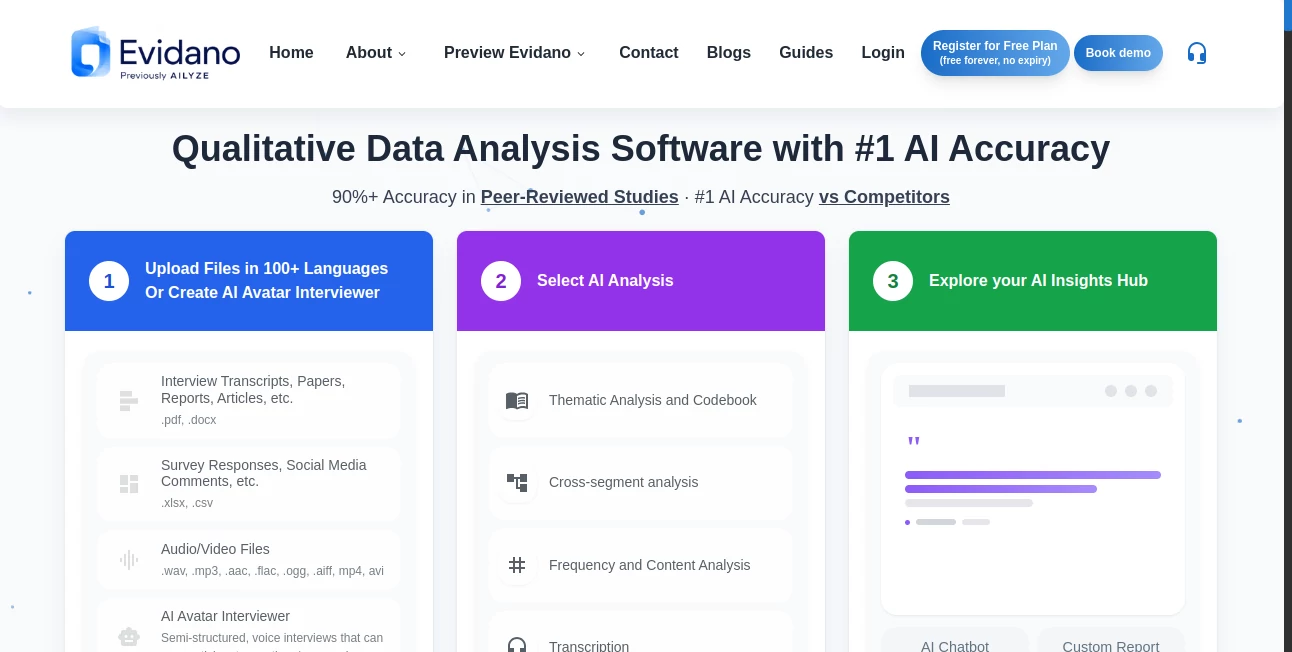
The workflow is organized around the actual research process rather than a collection of isolated AI features. Users can upload their material, select an analysis method, review the resulting themes or codes, and then explore the evidence through reports, visualizations, and an AI-powered chat interface.
This approach should feel familiar to researchers who already work with structured qualitative methods. The interface puts the analysis in context, which is important when a project contains hundreds or thousands of responses. Being able to move from a finding back to a supporting quote can also make reviewing AI-assisted results much easier.
Accuracy & Performance
The platform reports an average 94% accuracy benchmark for AI-generated qualitative coding and themes across 11 independent studies. Its published comparison places that figure above several general-purpose AI models and established qualitative research applications. These figures are directional benchmarks rather than a universal measure of performance, since the underlying studies use different datasets and evaluation methods.
That distinction matters in research. AI output should still be reviewed by the research team, especially when findings influence academic conclusions, policy decisions, or published work. The strongest use case is therefore not replacing the researcher, but speeding up repetitive analysis while leaving interpretation and final decisions in human hands.
Capabilities
The platform covers a surprisingly broad section of the qualitative research workflow. A researcher can begin with interview recordings or transcripts, bring in survey responses or documents, organize the material with a codebook, identify recurring themes, compare different segments, and turn the results into visual reports.
Its document support is also useful for projects that involve mixed sources. PDF and Word documents can sit alongside spreadsheets, CSV files, transcripts, and multimedia material. Audio and video can be transcribed, while multilingual material can be translated as part of the workflow.
The AI avatar interviewer adds another layer by allowing researchers to conduct semi-structured voice interviews. It can be particularly interesting for early-stage research when collecting consistent responses from participants is as important as analyzing them later.
Security & Privacy
Research data can contain sensitive interviews, unpublished findings, customer feedback, or confidential documents, so privacy is a major consideration. The platform states that uploaded data is encrypted and is not used to train AI models. It also emphasizes a private research workflow and transparent, evidence-linked analysis.
For organizations handling regulated or confidential material, it is still sensible to review the current privacy policy, security documentation, and institutional requirements before uploading sensitive datasets.
Use Cases
Academic Research: Researchers can analyze interview transcripts, focus groups, open-ended survey responses, and literature collections while using thematic analysis and codebooks to organize findings.
Market Research: Customer interviews, reviews, survey comments, and social media discussions can be examined to identify recurring opinions, motivations, frustrations, and emerging themes.
Education Research: Researchers and educators can process student evaluations, interviews, and narrative responses to discover patterns that might be difficult to identify manually.
Healthcare and Social Research: Large collections of participant interviews and qualitative responses can be organized and compared while keeping supporting quotes connected to the findings.
Mixed-Methods Studies: Teams combining quantitative spreadsheets with qualitative interviews can bring both types of information into the same research workflow.
Research Teams: Shared reports, structured analysis, and evidence-linked findings can make collaboration easier when several researchers need to review the same dataset.
Pros and Cons
Pros
- Designed specifically around qualitative research workflows
- Supports more than 100 languages
- Handles documents, spreadsheets, audio, and video
- Offers thematic, content, frequency, and cross-segment analysis
- Provides clickable quotes and citations for traceability
- Includes an AI chatbot for exploring research data
- Offers a free plan with no expiry
- Data is encrypted and not used to train AI models
- Can support both data collection and analysis
Cons
- The number of advanced analyses available on the free plan is limited
- Researchers still need to manually verify important findings
- Advanced research workflows may require the paid plan
- Some additional services, such as transcription and AI interviews, are charged separately
- Users coming from traditional qualitative analysis software may need some time to adapt to an AI-first workflow
Pricing Plans
The platform offers a free plan that is available indefinitely and does not require a credit card. It includes unlimited projects and allows users to analyze supported document and spreadsheet files, although advanced analysis features are subject to usage limits.
The Pro plan is listed at USD 50 per user per month and expands access to advanced AI analysis, including unlimited thematic analysis, content analysis, assisted coding, cross-segment analysis, data visualization, and AI chatbot functionality.
There is also an Institution option intended for research organizations and larger teams. The platform additionally offers several pay-as-you-go services, including an AI avatar interviewer at USD 0.60 per interview minute, audio and video transcription at USD 1 per hour after the included free hour, document translation after the included allowance, and website data extraction.
How to Use the Platform
- Create an account and start with the free plan if you want to evaluate the workflow.
- Create a research project and upload your source material.
- Choose the type of analysis you need, such as thematic analysis, content analysis, or assisted coding.
- Review the generated themes, codes, summaries, and supporting evidence.
- Use the chatbot to ask focused questions about your uploaded material.
- Compare segments when you need to identify differences between groups or datasets.
- Check important findings against the original quotes and source material.
- Use visualizations and custom reports to communicate the final results.
Comparison with Similar Tools
Traditional qualitative research applications such as NVivo, MAXQDA, and ATLAS.ti are well established, but they generally approach qualitative analysis from a conventional research-software perspective. This platform takes a more AI-native approach, combining automated analysis, conversational exploration, transcription, translation, and reporting.
Another notable difference is the emphasis on evidence-linked AI output. Rather than simply producing a polished summary, the workflow is designed to help researchers move between themes, quotes, citations, and source material. That can be valuable when the goal is not just to produce an answer, but to understand how that answer emerged from the dataset.
For researchers who already have a preferred manual coding methodology, the software can work as an additional analytical layer rather than a complete replacement. It can provide another perspective on the material, reveal patterns worth investigating, and reduce the amount of repetitive first-pass analysis.
Conclusion
For researchers dealing with interviews, surveys, documents, transcripts, and other qualitative material, this platform offers a well-rounded way to move from raw evidence to organized insight. Its combination of thematic analysis, codebooks, transcription, multilingual support, visual reporting, and evidence-linked AI exploration makes it especially appealing for research workflows that would otherwise require several separate applications.
The most compelling aspect is its focus on keeping evidence visible throughout the process. AI can help surface patterns quickly, but researchers remain responsible for deciding whether those patterns actually make sense. Used in that way, the platform can become a practical research partner: fast enough to handle large datasets, structured enough for serious analysis, and flexible enough to fit different research methods.
Frequently Asked Questions (FAQ)
What type of research is the platform designed for?
It is primarily designed for qualitative research involving interviews, focus groups, open-ended survey responses, documents, transcripts, and other unstructured or semi-structured data.
Can it analyze PDF and Word documents?
Yes. Supported document formats include PDF and DOCX, while spreadsheets can be provided through XLSX and CSV files.
Does it support audio and video?
Yes. Audio and video files can be transcribed, with support for more than 100 languages.
Can researchers create their own codebook?
Yes. Researchers can work with their own codebook or use AI-assisted codebook development as part of the analysis workflow.
Does the platform replace a qualitative researcher?
No. It is better viewed as an AI-assisted research tool. Researchers should review themes, codes, quotes, and interpretations before using them in academic publications or important research decisions.
Is there a free plan?
Yes. The free plan is available indefinitely, does not expire, and does not require a credit card.
Is research data used to train AI models?
The platform states that user data is encrypted and is not used to train its AI models.
Can I analyze survey responses?
Yes. XLSX and CSV files can be used for analyzing survey responses and other structured datasets, including frequency, content, and cross-segment analysis.
Can it conduct interviews?
Yes. An AI avatar interviewer can conduct semi-structured voice interviews and is offered as an additional pay-as-you-go feature.
AI Document Extraction , AI Knowledge Management , AI Research Tool , AI Transcription .
These classifications represent its core capabilities and areas of application. For related tools, explore the linked categories above.

Evidano Alternatives Product

Needle

Medical Scri…
Robux Tax Ca…

YTVidHub-you…

Linkflare

Arobis AI Vi…

Glanced

Whisper Web

SuperAI