
Facial Recognition
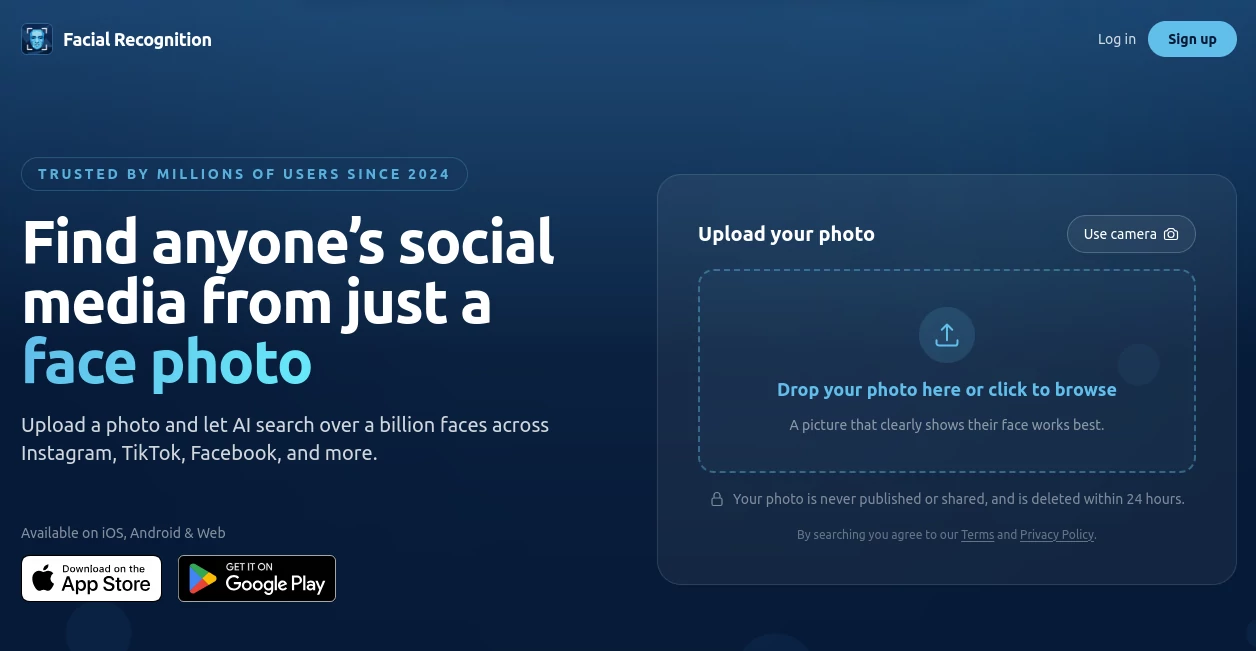
What is Facial Recognition?
Finding a person's public social media presence can be surprisingly difficult when you only have a photograph. A name may be unknown, a username may be different from one platform to another, and a traditional image search may fail when the same person appears in a completely different picture.
This facial recognition solution takes a different approach. Instead of looking only for an identical copy of an uploaded image, it analyzes the face and searches publicly indexed pages for visually matching faces. The result is a practical way to investigate an online profile, check whether a dating photo appears elsewhere, reconnect with someone, or discover where your own face is publicly visible.
The service can search across major social platforms and the wider web, making it particularly useful when a single photograph is the only piece of information available. It is available through the web as well as native mobile applications for iOS and Android.
Key Features
- Search for public online profiles using a face photo
- Searches more than one billion indexed faces
- Supports Instagram, TikTok, Facebook, X, Reddit, YouTube, Pinterest and other public websites
- Returns up to 100 matches for a search
- Ranks results according to similarity and confidence
- Allows photos to be uploaded from a device
- Supports camera capture on compatible devices
- Can work with older, angled and partially obscured faces
- Provides links to the public pages where matches were discovered
- Available on web, iOS and Android
User Interface
The experience is designed around a simple three-step process: add a photograph, let the system analyze it, and review the matches. There is no need to manually enter usernames or search through individual social networks one by one.
On mobile, the camera integration makes the process particularly convenient. A user can take a photograph directly or select one from the device. The interface keeps the central task clear, which is important for a tool that people may use while researching a profile or checking information on the go.
Accuracy & Performance
The system uses facial analysis rather than relying solely on an exact image match. That distinction matters. A photograph may have been cropped, taken from another angle, uploaded years earlier, or appear under completely different surroundings.
Search results are presented in a confidence-ranked order, with up to 100 matches available from a single search. The underlying service compares the submitted face against a large index of publicly available images, giving users a broader starting point than manually searching one website at a time.
As with any facial search technology, results depend on the quality and visibility of the face in the source image. A clear photograph with a visible face generally provides a better starting point than an extremely blurry or heavily obstructed image.
Capabilities
One of the strongest aspects of the service is its cross-platform reach. A single search can surface public profiles and pages from several social networks instead of forcing users to repeat the same investigation on Instagram, TikTok, Facebook, X, Reddit and other websites.
It can also be useful for reverse-searching photographs that are not exact copies of the original. For example, someone might use a screenshot from a profile and discover that the same face appears in other publicly indexed photographs. This can provide useful context when evaluating an unfamiliar online identity.
The service is also designed for mobile use. Native iOS and Android applications complement the web experience, while camera access makes it possible to start a search without first moving a photograph between different applications.
Security & Privacy
Facial photographs are sensitive information, so privacy is an important part of the experience. According to the service's published policy, uploaded photographs are not indexed, published or shared. The uploaded image is deleted within 24 hours, while temporary search material is retained only long enough to display the results.
Users should still use facial search responsibly and respect applicable privacy laws and the rights of people appearing in photographs. The most appropriate use is for legitimate research, identity verification, personal safety, or discovering where one's own publicly available images appear online.
Use Cases
- Checking a dating profile: Search a profile photograph before meeting someone in person to see whether the image appears elsewhere online.
- Spotting potential catfishing: A photograph appearing under different names or identities can be an important warning sign.
- Finding public social profiles: A face can sometimes reveal public accounts when a name or username is unavailable.
- Verifying an online contact: When dealing with an unfamiliar person or business contact, additional public information can help establish context.
- Reconnecting with someone: A photograph from a conference, event or trip may help locate a public profile when contact details were never exchanged.
- Monitoring your own online presence: Searching your own photographs can reveal public pages where your face appears without your knowledge.
Pros and Cons
Pros:
- Searches across multiple social networks and public websites
- Large index containing more than one billion faces
- Results are ranked by similarity
- Up to 100 matches can be returned from a search
- Works through web, iOS and Android
- Supports camera capture as well as uploaded photographs
- Uploaded photographs are not publicly indexed or shared
Cons:
- Search quality depends on the photograph and visibility of the face
- Private profiles and pages behind authentication cannot be directly searched
- Searches require a paid subscription
- A facial match should be treated as a lead rather than automatic proof of identity
Pricing Plans
The application can be downloaded for free, but running facial searches requires a paid subscription. Subscriptions are handled through standard payment methods, including the usual App Store and Google Play purchasing systems for mobile users. Additional credit top-ups may also be available for subscribers who need to perform more intensive searches.
The service does not require cryptocurrency for payment. This makes the purchasing process more familiar for users who prefer paying through their existing Apple or Google account rather than setting up a separate cryptocurrency wallet.
How to Use It
Start by selecting a photograph that clearly shows the face you want to investigate. You can upload an existing image or, on supported devices, capture a new photograph directly through the application.
After submitting the image, the facial analysis system examines the visible face and compares it against publicly indexed images. The search can cover social networks and other websites where relevant public images have been discovered.
Once processing is complete, review the matches presented in the results. Matches are ranked by confidence and include links to the pages where the corresponding image was found, allowing you to inspect the source yourself instead of relying solely on the facial similarity score.
Comparison with Similar Tools
Traditional reverse image search and facial search solve related but different problems. A conventional image search is often strongest when an identical or very similar copy of the uploaded picture exists online. Facial search focuses on the face itself, which can make it more useful when the same person appears in different photographs.
Compared with services focused primarily on image discovery, this solution places greater emphasis on finding public social profiles. Its support for platforms such as Instagram, TikTok, Facebook, X and Reddit gives it a practical advantage for users whose main goal is to understand someone's public online presence.
Another notable difference is accessibility. The service is available on the web and through native mobile applications, allowing users to perform searches without being tied to a desktop browser.
Conclusion
For anyone who needs to investigate a face across the public web, this tool offers a straightforward alternative to manually checking dozens of websites. Its combination of facial matching, broad platform coverage, ranked results and mobile access makes the process considerably easier.
It is particularly valuable for situations where a photograph is available but a person's name or username is not. Whether the goal is checking a suspicious dating profile, researching an unfamiliar online contact, finding public social accounts, or monitoring where your own face appears, the service provides a focused way to begin the search.
Most importantly, users should treat search results as useful evidence for further investigation rather than definitive proof of someone's identity. Used thoughtfully and responsibly, the technology can turn a single photograph into a much broader view of publicly available information.
Frequently Asked Questions (FAQ)
What does this tool do?
It analyzes a face in a photograph and searches publicly indexed images and pages for visually similar matches. Results can include public social media profiles and other pages across the web.
Can I find a social media profile from a photograph?
Yes. A suitable photograph can be used to search for publicly available profiles across platforms such as Instagram, TikTok, Facebook, X, Reddit and YouTube, as well as other indexed websites.
What type of photograph works best?
A clear image where the face is visible is generally the best starting point. The system can also work with older photographs, angled faces and partially obscured faces, although image quality can affect the results.
Are uploaded photographs stored publicly?
No. According to the published privacy information, uploaded photographs are not indexed, published or shared. The uploaded image is deleted within 24 hours, while temporary search data is removed after it is no longer needed to display results.
Can it search private social media accounts?
No. The search relies on publicly available and publicly indexed information. Profiles or pages that are protected behind authentication cannot be directly accessed through the search.
Is it free to perform searches?
The application is free to download, but facial searches require a paid subscription. Mobile purchases can be handled through the App Store or Google Play, while web users can use standard payment methods.
AI Image Recognition , AI Search Engine .
These classifications represent its core capabilities and areas of application. For related tools, explore the linked categories above.
Facial Recognition details
Website unavailable — View Alternatives
Pricing
- Free
Apps
- Web App
- iOS App
- Android App
Categories

Facial Recognition Alternatives Product

AyeWatch AI

Image Descri…

Face Shape D…

TextSharp | …

Image Descri…

Unblur Image

Image Descri…

Firefox

WhereWasTaken