
AIDO Cell
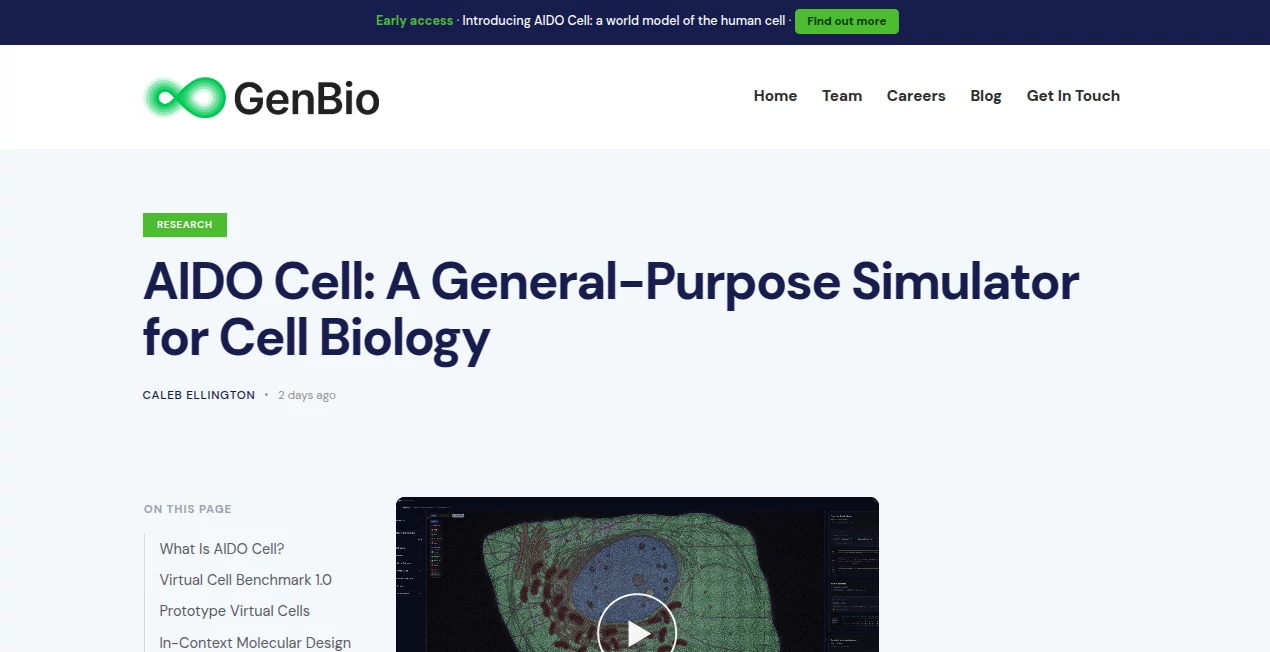
What is AIDO Cell?
Biology is full of interactions that are difficult to study one at a time. A change to a gene can influence expression, proteins, pathways, and eventually the behavior of an entire cell. Traditional computational tools often focus on one part of this chain, leaving researchers to connect separate predictions themselves. AIDO Cell takes a broader approach by treating the cell as a virtual system that can be manipulated, observed, and studied through repeated experiments.
The platform is designed as a general-purpose simulator for cell biology. Instead of producing a single isolated prediction, it maintains a shared cellular state and allows researchers to apply interventions, inspect different biological measurements, and continue experimenting from the resulting state. That makes the experience closer to planning a sequence of laboratory experiments than running disconnected AI predictions.
For researchers working in drug discovery, computational biology, genomics, or disease research, this approach offers an interesting way to explore biological hypotheses before committing every idea to a wet-lab experiment. It is not presented as a replacement for experimental validation, but as a powerful environment for narrowing questions and exploring possible cellular responses.
Key Features
- Virtual cell simulation: The system models how a cell may change after biological interventions and provides experimental readouts from the resulting state.
- Multimodal biological readouts: Researchers can examine information including gene expression, chromatin accessibility, protein-related measurements, localization, abundance, and cellular morphology from a shared underlying state.
- Multiscale modeling: The platform connects biological information ranging from DNA and RNA through regulatory networks and pathways to whole-cell behavior.
- Continuous experimentation: A resulting cellular state can become the starting point for another intervention, making multi-step experiments possible.
- Cell cloning and branching: Researchers can create different experimental trajectories from a shared cellular state and compare how separate interventions unfold.
- Genetic and small-molecule perturbations: The simulator supports exploration involving knockouts, knockdowns, overexpression, and small molecules.
- In-context molecular design: The system can work backward from a desired cellular state to explore candidate molecules whose effects may move a cell toward that state.
- Virtual Cell Benchmark: Its developers created a benchmark spanning small-molecule perturbation, genetic knockout, protein structure, RNA splicing, and genome regulation.
User Interface
The experience is designed around experimentation rather than a conventional chatbot or simple prediction dashboard. A world-model engine maintains the cellular state, while a control layer translates researcher commands into operations that can be executed and inspected. The broader ecosystem also includes an interface for browsing multimodal readouts, running sequential perturbations, and analyzing virtual cells.
This setup should feel particularly useful to researchers who want to ask a sequence of related questions. For example, rather than predicting the effect of one intervention and starting over, a researcher can examine a simulated state, branch it into multiple experimental paths, and compare subsequent outcomes.
Accuracy & Performance
The developers evaluated the first release using a Virtual Cell Benchmark covering 31 metrics across five task families. According to the published results, the system achieved state-of-the-art performance on 24 of the 31 metrics while spanning all five benchmark families.
The initial virtual-cell prototypes focus on two extensively studied human cell lines: K-562 and Hep-G2. The development team has also used these models to simulate large perturbation atlases, including one million randomized five-plex perturbations for each cell line.
There is an important distinction, however, between benchmark performance and experimental proof. Multi-scale cellular simulation remains an evolving research area, and the developers acknowledge that wet-lab validation of novel predictions is ultimately necessary. For researchers, that makes the platform most valuable as a hypothesis-generation and prioritization environment rather than a substitute for laboratory evidence.
Capabilities
One of the most compelling aspects is the ability to connect different biological scales through a common cellular state. A researcher can investigate a molecular intervention and then examine how its effects propagate through gene regulation, pathway activity, protein behavior, and cellular phenotype.
The system also supports a forward and backward workflow. In a forward experiment, a researcher can apply a drug or genetic perturbation and observe the predicted cellular response. In a backward workflow, a desirable cellular phenotype can serve as the target for exploring molecular designs.
A published example uses the K-562 model and imatinib as a reference perturbation for an ABL-related molecular design campaign. Candidate molecules were evaluated through several layers of information, including chemical structure, predicted protein interactions, transcriptional response, and predicted changes in cellular state.
The underlying architecture is also intended to be adaptable. AIDO Foundry is designed to customize virtual cells for new biological contexts as additional experimental data becomes available, while the research interface provides a way to interact with and analyze those customized models.
Security & Privacy
Because computational biology platforms can have dual-use implications, responsible access is an important part of the product design. The current system is explicitly scoped toward disease understanding, drug design, and disease treatment.
The developers state that the current version does not accept viral or bacterial inputs and does not support direct optimization of viral or bacterial designs. Its generative capabilities are limited to therapeutic molecule categories such as small molecules, antibodies, and nanobodies intended to address diseased cellular states.
Access is currently controlled on a case-by-case basis, with restrictions against applications intended to cause harm. Researchers considering the platform should therefore review the applicable access terms and responsible-use requirements before beginning a project.
Use Cases
- Drug discovery: Explore how candidate compounds may influence cellular states before selecting experiments for laboratory testing.
- Drug response research: Study potential cellular responses to small-molecule perturbations across multiple biological readouts.
- Genetic perturbation studies: Investigate simulated knockouts, knockdowns, and overexpression experiments.
- Disease research: Explore cellular mechanisms associated with disease-related states and potential interventions.
- Phenotypic molecular design: Search for candidate molecules based on desired effects within a cellular context rather than relying solely on a conventional target-binding objective.
- Experimental prioritization: Use simulations to narrow a large hypothesis space and decide which experiments may deserve laboratory resources.
- Computational biology: Study relationships between molecular changes and broader cellular outcomes using a shared model.
- Biotechnology research: Investigate how virtual-cell simulation could fit into future data-driven biological engineering workflows.
Pros and Cons
- Pros: General-purpose approach to cell simulation, multimodal readouts, multi-scale modeling, sequential perturbations, branching experiments, molecular design capabilities, and a benchmark covering several areas of biology.
- Pros: The focus on persistent cellular states makes it possible to explore chains of interventions rather than isolated predictions.
- Pros: The platform is designed to expand beyond its initial prototype cell lines through additional biological data and customization.
- Cons: The technology is still at an early stage and should not be treated as a replacement for wet-lab validation.
- Cons: The initial release is focused on K-562 and Hep-G2 rather than offering a universal library of human cell types.
- Cons: Access is currently limited, making it less suitable for casual users or researchers looking for an immediately available consumer tool.
Pricing Plans
There are no public self-service pricing plans listed for the current release. Access is presently being provided to the development team and a group of alpha collaborators, with an early-access program being prepared for academic, biotechnology, and pharmaceutical researchers.
Researchers interested in gaining access can join the waiting list or contact the company to learn more about availability, collaboration opportunities, and future access arrangements.
How to Use It
Because access is currently controlled, using the platform begins with obtaining access through the available early-access process. Once access is provided, researchers can work with supported virtual cell models and define the biological experiment they want to investigate.
- Select an available virtual cell, such as K-562 or Hep-G2.
- Define a biological intervention, such as a genetic perturbation or small molecule.
- Apply the intervention to the virtual cell.
- Inspect the resulting cellular state through available multimodal readouts.
- Clone the state when multiple experimental paths need to be compared.
- Apply additional interventions to create multi-step experimental trajectories.
- Compare the resulting states and identify hypotheses that may deserve experimental validation.
Comparison with Similar Tools
Many AI systems in computational biology are built around a specific task. Some focus on protein structure, others on gene regulation, single-cell data, or molecular interactions. Those tools can be extremely strong within their respective domains, but they generally address a narrower slice of biological behavior.
The main difference here is the attempt to place several biological measurements inside one persistent cellular state. Instead of asking separate models unrelated questions, the researcher can manipulate a virtual cell and examine multiple consequences of the same intervention.
This broader design does not mean that specialized models have become unnecessary. In fact, specialized systems can still provide advantages on individual tasks. The appeal of this approach is different: it aims to provide a common experimental environment where molecular, regulatory, structural, and cellular observations can be connected.
Conclusion
AIDO Cell represents an ambitious step toward treating biology as something that can be simulated and experimented with computationally. Its strongest idea is not simply predicting another biological measurement, but maintaining a virtual cellular state that can be changed, examined, cloned, and revisited across a sequence of interventions.
For drug discovery and advanced biological research, that opens an intriguing possibility: use computation to explore a much larger experimental space before deciding which questions should reach the laboratory. The technology is still developing, and real-world validation remains essential, but the combination of multimodal simulation, persistent states, and molecular design makes this a particularly interesting direction for AI-driven biology.
Frequently Asked Questions (FAQ)
What is this tool designed for?
It is designed as a general-purpose simulator for cell biology, allowing researchers to model cellular responses to interventions and inspect those responses across multiple biological measurements.
Which cell types are currently supported?
The first release focuses on two human cell lines: K-562 and Hep-G2. The platform is intended to expand to additional cell lines and primary cells as more biological data becomes available.
Can it simulate drug responses?
Yes. Small-molecule perturbations are part of the system's capabilities, allowing researchers to explore predicted cellular responses to compounds and compare different experimental trajectories.
Can it help with molecular design?
Yes. Its in-context molecular design workflow can explore candidate molecules according to a desired cellular phenotype and evaluate those candidates within the simulated cellular context.
Is it a replacement for laboratory experiments?
No. Computational simulation can help prioritize hypotheses and experiments, but novel predictions still require appropriate experimental validation.
Is there a free plan?
No public free or paid self-service plan is currently listed. Access is being provided through a controlled early-access process.
Who can benefit from this platform?
It is primarily aimed at researchers and organizations working in computational biology, drug discovery, biotechnology, pharmaceutical research, genomics, and disease research.
Can researchers use their own biological data?
The broader platform is designed to adapt virtual cells to new biological contexts using additional experimental or public data, although availability and access depend on the current research program.
Is access currently open to everyone?
No. Current access is controlled, with the early-access program being prepared for researchers in academic, biotechnology, and pharmaceutical settings.
AI Knowledge Management , AI Research Tool , AI Healthcare , AI Developer Tools .
These classifications represent its core capabilities and areas of application. For related tools, explore the linked categories above.

AIDO Cell Alternatives Product

Patches Answ…

Reverse Imag…

Preuve AI

TDEE Calcula…

UPDF AI

SciFig

BetterAntisp…

langextract.…

Devplan