
General Compute
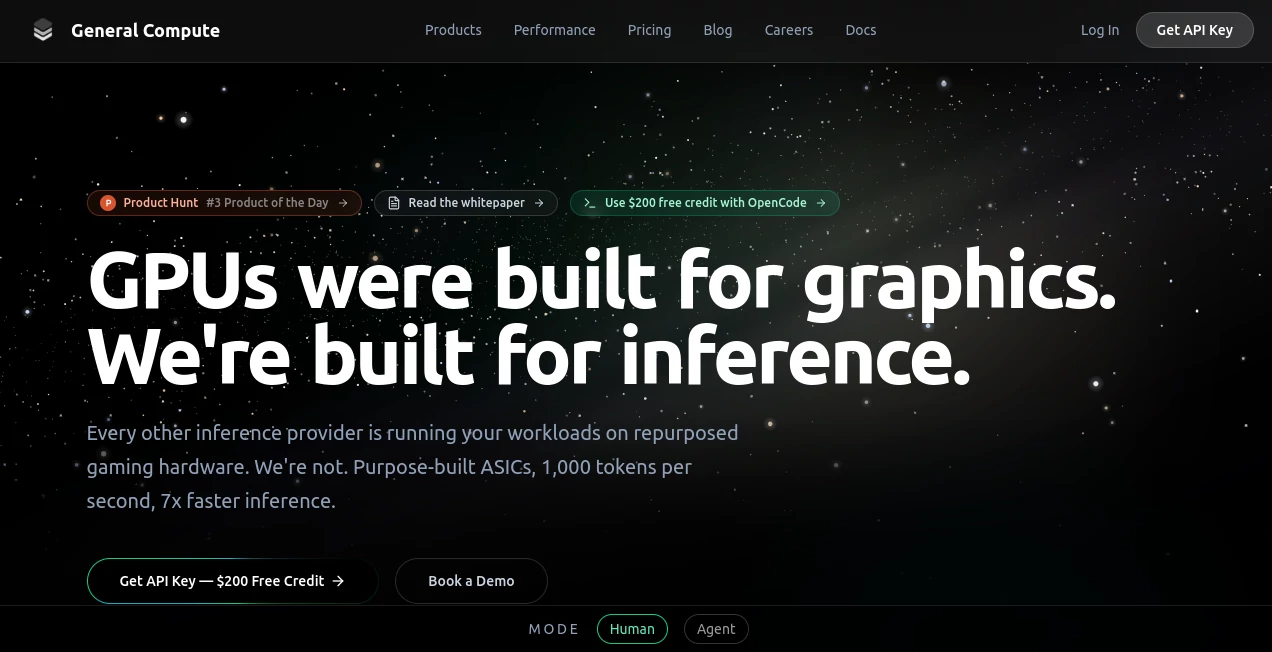
What is General Compute?
I still remember switching between different inference providers and constantly fighting latency. One second the response felt instant, the next it dragged like it was thinking through molasses. Then I tried this platform and the difference was immediate — sub-millisecond time to first token on serious models, with throughput that actually moves the needle for real applications. It doesn’t just feel faster; it lets you build things that weren’t practical before, like responsive voice agents or high-volume coding assistants that stay snappy even under load. For anyone tired of paying the GPU tax while waiting on hardware that was never truly built for inference, this feels like the future arriving early.
Introduction
Most inference providers take GPUs designed for graphics and training, then try to squeeze inference performance out of them. This platform took a different path. They built purpose-built AI accelerators from the ground up, optimized for one thing only: blazing-fast inference. The result is a service that delivers dramatically higher tokens per second, lower energy use, and response times that make real-time AI experiences actually feel real-time. Whether you’re running massive reasoning models or deploying agent workflows that make dozens of calls per interaction, the speed advantage is noticeable from the very first request. It’s not hype — the benchmarks speak for themselves, and developers who switch often say they’re never going back.
Key Features
User Interface
The developer experience is refreshingly straightforward. Sign up, grab an API key, swap your base URL, and you’re running on their infrastructure with almost zero code changes. The dashboard is clean and focused — usage stats, model selection, and billing are all easy to find without clutter. For those who want deeper control, custom deployment options and detailed monitoring tools are available. It feels like the platform respects your time instead of forcing you through unnecessary complexity.
Accuracy & Performance
The performance leap is the headline here. On comparable models, it regularly delivers 7–9x higher throughput than traditional GPU clouds, with time-to-first-token in the sub-millisecond range for many workloads. Energy efficiency is dramatically better too — lower power draw per rack means lower costs that get passed on to you. In real use, this translates to agents that can think and act quickly, voice applications that feel conversational, and high-volume services that stay responsive even during peaks. The hardware was purpose-built for this, and it shows.
Capabilities
OpenAI-compatible endpoints mean you can switch with minimal friction. It supports leading open models and gives you the option to bring your own weights for dedicated deployments. Features like tool calling, JSON mode, and streaming work exactly as expected. Whether you’re prototyping with a single API key or running production workloads at scale with custom SLAs, the same fast infrastructure powers everything. The focus on inference-first design makes it especially strong for latency-sensitive applications like AI agents and real-time systems.
Security & Privacy
Your workloads run on dedicated, optimized infrastructure with strong isolation. The platform follows enterprise-grade security practices, and you maintain full control over your data and models. For teams running sensitive applications or deploying custom weights, the transparent and dedicated nature of the setup provides real confidence.
Use Cases
Developers building AI coding agents love the low latency that lets models reason and use tools in near real-time. Voice AI teams create conversational experiences that don’t suffer from awkward pauses. Companies running high-volume inference workloads cut their costs significantly while improving response times for end users. Researchers experimenting with large open models get consistent performance without managing complex GPU clusters. Anyone frustrated with slow or expensive inference finds a practical, high-performance alternative that scales with their ambitions.
Pros and Cons
Pros:
- Dramatically faster inference than traditional GPU providers on the same models.
- Lower energy costs that translate into better pricing for heavy users.
- OpenAI-compatible API makes migration quick and painless.
- Purpose-built hardware designed specifically for inference workloads.
- Strong performance for agentic and real-time applications.
Cons:
- Still relatively new compared to established GPU cloud giants.
- Best value shines at higher usage volumes.
- Custom model deployments require planning for dedicated capacity.
Pricing Plans
Pricing is usage-based with very competitive rates thanks to the efficient hardware. New users often get meaningful free credit to test the speed difference themselves. For teams and production workloads, dedicated options and volume pricing make it even more attractive. Many users report significant savings compared to GPU clouds while getting noticeably better performance — a rare win-win in the inference space.
How to Use General Compute
Sign up, get your API key, and update your OpenAI client configuration with their base URL. That’s often all it takes. Run a few test prompts to see the speed difference, then integrate it into your application or agent workflow. For custom models or large-scale deployments, reach out to discuss dedicated options. The transition is intentionally smooth so you can focus on building rather than infrastructure headaches.
Comparison with Similar Tools
Traditional GPU inference providers are running general-purpose hardware that wasn’t optimized for this workload. This platform’s purpose-built accelerators deliver clear advantages in speed, efficiency, and cost at scale. While big cloud players offer convenience and ecosystem breadth, General Compute wins on raw inference performance for teams who prioritize latency and throughput. It’s not trying to be everything to everyone — it’s laser-focused on being the fastest option for serious inference needs.
Conclusion
When inference speed becomes a limiting factor, everything downstream suffers — slower agents, worse user experiences, higher costs. This platform removes that bottleneck with hardware and software designed specifically for the job. For developers and companies building the next generation of AI applications, especially those involving agents or real-time interactions, it offers a compelling alternative that delivers measurable improvements in both performance and efficiency. Sometimes the biggest leaps come from rethinking the fundamentals, and this feels like one of those moments.
Frequently Asked Questions (FAQ)
How much faster is it really?
Many users see 5–9x higher throughput on comparable models, with dramatically lower time-to-first-token.
Do I need to change my code?
Usually just the base URL and API key — fully OpenAI compatible.
Can I run my own models?
Yes, dedicated deployments are available for custom weights.
Is it suitable for production workloads?
Absolutely — with SLAs and dedicated capacity options for serious use.
What about cost savings?
Significant for medium-to-high volume users thanks to superior energy efficiency.
AI Research Tool , AI API Design , AI Developer Tools .
These classifications represent its core capabilities and areas of application. For related tools, explore the linked categories above.
General Compute details
Website unavailable — View Alternatives
Pricing
- Free
Apps
- Web App
Categories

General Compute Alternatives Product

MiniValuator

GTM API

SearchSpot

Schema Synth

Diploria AI

LocalRAG!

globalize.now

Tooladda

Chrome Sidek…