
Silico
What is Silico?
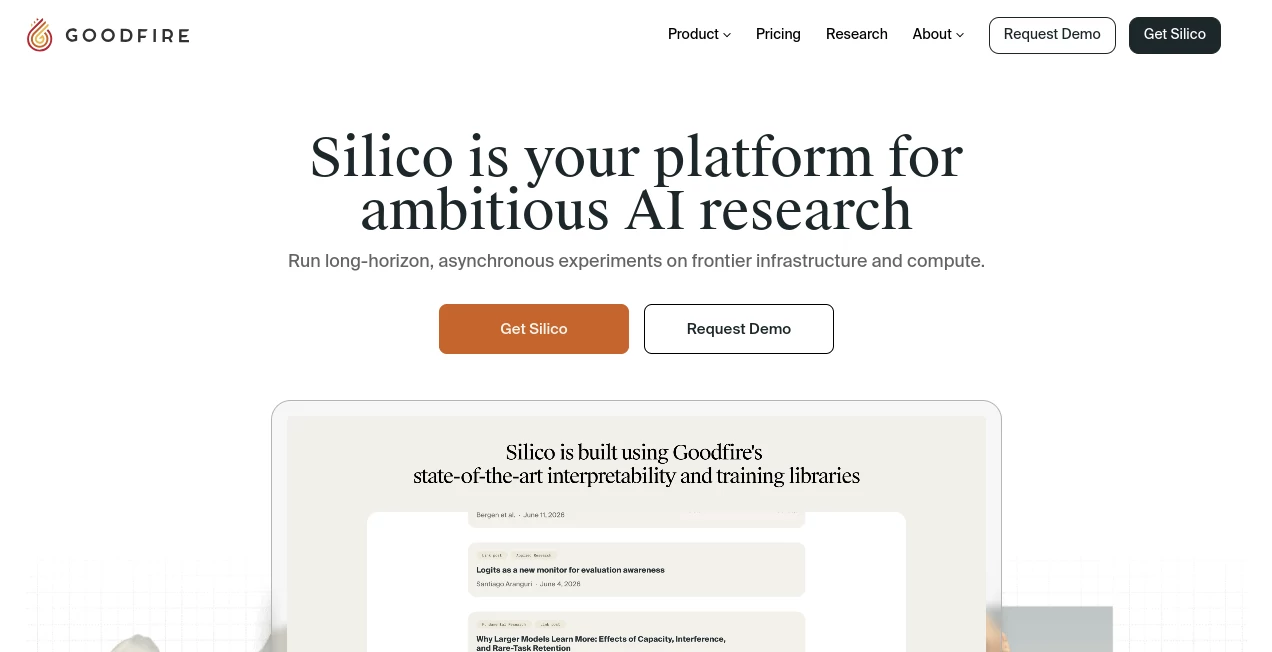
Silico is a research platform built for AI teams that want to understand, test, and improve sophisticated machine learning models without spending most of their time managing experiments and infrastructure. Instead of treating model research as a collection of disconnected scripts and manual jobs, it provides an environment for running long-horizon experiments, coordinating research tasks, and examining what a model has actually learned.
One of its most interesting ideas is the research agent. Researchers can provide a goal, and the system can develop an experimental plan, run work in parallel, monitor progress, and return results that can be inspected and extended. That makes it particularly useful for projects where experiments take hours or longer and require several rounds of investigation.
The platform is also closely tied to mechanistic interpretability. Researchers can investigate internal representations, train sparse autoencoders and probes, examine neural geometry, and test hypotheses about model behavior. For teams working on foundation models, language models, biology, robotics, or computer vision, this can turn model analysis from guesswork into a much more structured research process.
Key Features
- Long-running autonomous research experiments
- Research planning and experiment coordination
- Parallel experiment execution and monitoring
- Model architecture visualization
- Support for sparse autoencoders and probes
- Neural geometry analysis
- Mechanistic interpretability workflows
- Model failure diagnosis
- Training and post-training experiments
- Checkpoint comparison
- SFT, DPO, and reinforcement learning experiments
- Targeted model interventions
- Research replication and extension
- Support for different models and modalities
- Ability to use Goodfire infrastructure or connect a researcher's own cluster
User Interface
The interface is designed around research workflows rather than simple chatbot interactions. Researchers can give the system a high-level objective and let the research agent organize the work into experiments. Results can then be inspected and used as the starting point for additional investigation.
This approach is especially appealing when a project contains many moving parts. Instead of repeatedly checking individual jobs, switching between notebooks, and keeping track of experiment states manually, researchers can work from a more centralized environment.
The platform is also available for macOS, while teams can discuss bringing it into their own infrastructure. That flexibility is useful for researchers who need to combine managed computing with existing clusters and internal workflows.
Accuracy & Performance
For research tooling, performance is not simply about how quickly a single prompt receives an answer. The more important question is whether researchers can run meaningful experiments repeatedly and gather enough evidence to understand what changed.
The platform is built for this type of work. It can coordinate long-running experiments, monitor jobs across compute infrastructure, compare checkpoints, and help researchers investigate specific changes in model behavior.
Its interpretability capabilities are particularly valuable when standard evaluation metrics do not explain why a model succeeds or fails. Researchers can investigate internal features and representations instead of relying only on final outputs. This provides a deeper layer of analysis for difficult machine learning problems.
Capabilities
The platform covers several stages of advanced AI research. Researchers can explore how a model works by visualizing architecture, training SAEs and probes, mapping neural geometry, and testing causal hypotheses about learned representations.
It can also be used for diagnosing failures. Issues such as undertraining, information bottlenecks, feature collapse, spurious correlations, and dataset artifacts can be investigated at the model-internals level. This can help teams understand whether a disappointing result is caused by the data, the training process, or a particular learned feature.
For model improvement, the environment supports supervised fine-tuning, direct preference optimization, reinforcement learning experiments, checkpoint comparisons, and targeted interventions. Researchers can therefore move from identifying a problem to testing a potential fix without completely changing their workflow.
Another useful capability is research replication. A published paper can be provided as a starting point, after which experiments can be planned and executed to compare new findings with the original results. For research groups, this can make reproducing and extending existing work considerably more practical.
Security & Privacy
Security matters considerably when researchers are working with proprietary models, internal datasets, or commercially sensitive experiments. The platform offers an enterprise option with organization-level billing and seat management, as well as the availability of Zero Data Retention for enterprise customers.
Organizations can also discuss using their own compute infrastructure rather than relying exclusively on managed infrastructure. Teams evaluating the platform for sensitive research should review the provider's current security and privacy documentation and confirm the appropriate data-handling configuration before bringing confidential workloads into production.
Use Cases
Foundation model research: Research teams can inspect internal representations, investigate learned features, compare checkpoints, and test hypotheses about how a model behaves.
LLM development: Language-model teams can investigate failure modes, experiment with post-training methods, and examine whether internal representations correspond to the behaviors they expect.
AI interpretability: Researchers interested in understanding neural networks can use probes, sparse autoencoders, neural geometry analysis, and targeted experiments to investigate model internals.
Life sciences: The platform can help researchers investigate biological representations inside AI models and distinguish meaningful biological signals from artifacts or spurious correlations.
Robotics and vision: Teams can investigate whether models have learned useful physical concepts or brittle shortcuts, then use those findings to guide further development.
Research replication: Academic and industrial research groups can reproduce published experiments and extend them with modified datasets, models, or experimental conditions.
Pros and Cons
Pros
- Designed specifically for advanced AI research
- Strong focus on model interpretability
- Supports long-running autonomous experiments
- Can coordinate multiple experiments in parallel
- Useful for investigating model failures beyond standard benchmarks
- Supports training and post-training workflows
- Can work across different AI models and modalities
- Supports both managed infrastructure and customer clusters
- Useful for reproducing and extending research
Cons
- Designed primarily for professional AI researchers rather than casual users
- The learning curve may be significant for teams unfamiliar with interpretability research
- The individual plan costs $1,000 per month
- Enterprise pricing requires a custom arrangement
- Its advanced capabilities may be unnecessary for simple machine learning projects
Pricing Plans
The Individual plan costs $1,000 per month and is aimed at AI researchers. It includes full access to interpretability and training capabilities, the research agent for long-horizon experiments, weekly refreshed usage, and the ability to run work on the provider's infrastructure or connect an existing cluster.
The Enterprise plan uses custom pricing and is intended for teams and organizations. It includes the Individual features along with pooled team usage, organization-level billing and seat management, Zero Data Retention availability, dedicated researcher support, and structured pilots.
The pricing structure makes the platform much more suitable for professional research environments than for casual experimentation. Teams considering enterprise adoption can request a demonstration and discuss their infrastructure and research requirements directly with the provider.
How to Use
Getting started is aimed at researchers rather than beginners looking for a simple prompt-and-response tool. First, define the research objective or model behavior you want to investigate. The research agent can then turn that goal into an experimental plan.
Next, experiments can be executed across available compute infrastructure while progress is monitored. Depending on the project, researchers can inspect internal representations, train probes or sparse autoencoders, compare checkpoints, run post-training experiments, or investigate a suspected failure.
Once results are available, the findings can be reviewed and used to design the next experiment. This creates a continuous research loop: define a question, run experiments, inspect the evidence, and use what was learned to decide what should happen next.
Comparison with Similar Tools
Traditional machine learning notebooks and experiment-management systems are useful for running code and tracking results, but they generally leave researchers responsible for designing and coordinating the research process themselves. This platform takes a more research-agent-oriented approach by helping plan and execute longer experimental workflows.
Open-source interpretability libraries can also provide valuable low-level capabilities, particularly for researchers who want complete control over their implementation. The difference here is the combination of interpretability research, experiment orchestration, training workflows, compute management, and an autonomous research agent in one environment.
For a researcher who only needs a straightforward explanation of individual model predictions, a lightweight explainability library may be a better fit. For teams investigating the internal structure and behavior of advanced models, however, a more integrated research environment can save substantial time and make complex investigations easier to organize.
Conclusion
For advanced AI research teams, understanding what a model has learned can be just as important as measuring how well it performs. This platform addresses that problem by combining model interpretability with autonomous experimentation, training workflows, compute orchestration, and research replication.
Its strongest appeal is the ability to move beyond isolated evaluations. Researchers can investigate internal representations, diagnose failures, test interventions, and use the results to guide subsequent experiments. The combination is particularly compelling for teams working on foundation models, LLMs, biology, robotics, and computer vision.
The $1,000 monthly individual price places it firmly in the professional research category, but for teams where complex experiments, model debugging, and interpretability are central to the work, the investment can be easier to justify. It is not a general-purpose AI assistant; it is a specialized environment for people who want to understand and actively shape sophisticated AI systems.
Frequently Asked Questions (FAQ)
What is this platform used for?
It is designed for advanced AI research, including model interpretability, failure diagnosis, training experiments, post-training, checkpoint comparison, and research replication.
Can it run long AI experiments?
Yes. The platform is designed for long-horizon asynchronous experiments and can coordinate, monitor, and keep research jobs moving without requiring constant manual supervision.
Does it support LLM research?
Yes. It supports research involving large language models, including interpretability investigations, post-training experiments, failure analysis, and targeted model improvements.
Can researchers use their own computing infrastructure?
Yes. The individual offering allows researchers to run experiments on the provider's infrastructure or connect their own cluster.
How much does it cost?
The Individual plan is listed at $1,000 per month. Enterprise pricing is custom and includes additional team-oriented capabilities and support.
Is it suitable for beginners?
It is primarily aimed at AI researchers and teams working with advanced machine learning systems. Users without experience in model training or interpretability may find its capabilities more complex than those of general-purpose AI tools.
Does it offer enterprise privacy features?
Yes. Enterprise customers receive additional organizational controls, and Zero Data Retention is available as part of the enterprise offering.
Can it help reproduce academic research?
Yes. Researchers can provide a paper as a starting point and use the research workflow to plan experiments, run them, and compare the results with the original work.
AI Research Tool , Large Language Models (LLMs) , AI Developer Tools .
These classifications represent its core capabilities and areas of application. For related tools, explore the linked categories above.

Silico Alternatives Product

LocalRAG!

Jasper

JSON to TOON…
Website Clon…

Lessie AI

Claude and C…

DeepSeek V4

CtrlOps

Standard Com…