GPT Image 2
What is GPT Image 2?
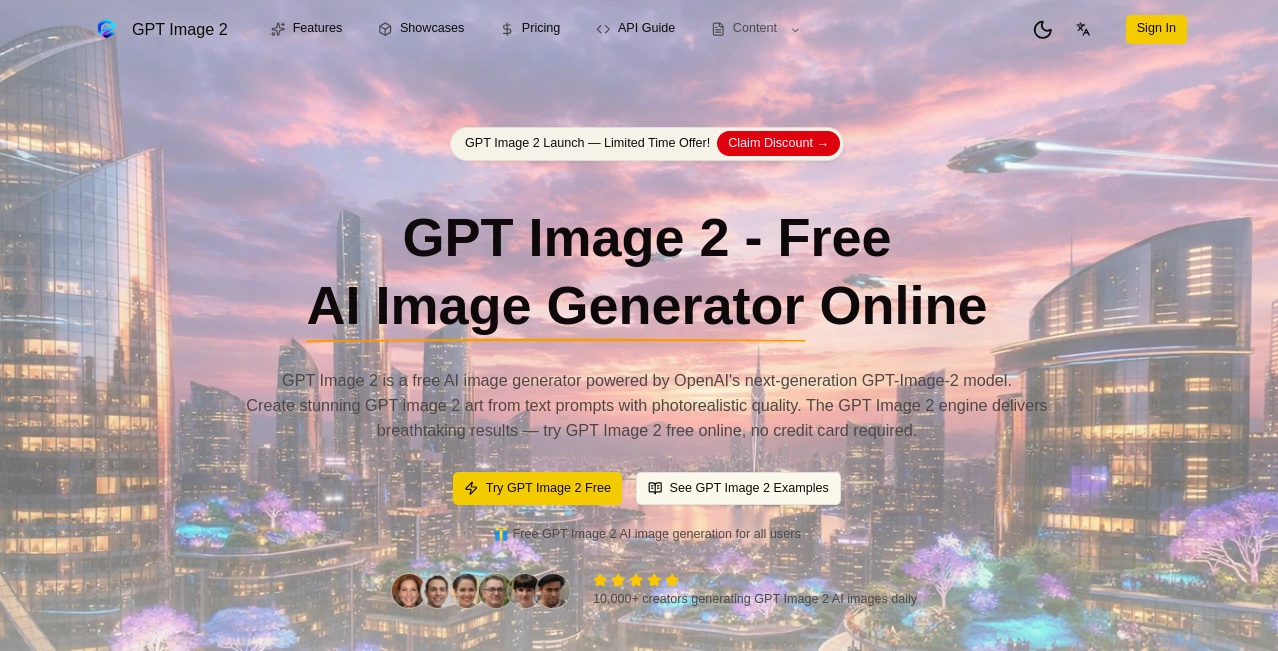
Let’s be honest for a second. For years, we have been told that seeing is believing. But what happens when the "seeing" part becomes completely unreliable? You stare at a screenshot of a product, a magazine cover, or even a government ID, and you have absolutely no idea if a human or a machine made it. That sounds a little terrifying, right? Well, welcome to the new standard. This isn't just another filter or an upscaler. This is the first time a tool has stopped acting like a robot and started thinking like an art director. It doesn't just splash colors on a canvas. It reads your mind, checks the facts online, and fixes its own mistakes before you even notice them. If you have ever felt frustrated by AI that couldn't spell your brand name correctly or got confused when you asked for "three cups on a red table," that frustration ends here. This is the upgrade we have all been waiting for, and honestly, it feels like magic.
Key Features
Most tools on the market promise speed or resolution. This one delivers something entirely different: intelligence. It is the first image model equipped with genuine reasoning capabilities. It doesn't just generate; it thinks, plans, and double-checks its work . The difference is night and day when you start pushing it with complex requests.
User Interface
If you have used a standard chat interface before, you already know how to use this. There are no confusing sliders, no technical jargon about diffusion steps, and no need to learn a secret language of prompts. You simply type what you want, like you are texting a very talented designer friend. The magic lies in the "Thinking Mode." You flip a switch, and suddenly, the tool takes a breath. It pauses, searches the internet for context, and plans the layout before drawing a single pixel . For those who just want a quick meme or a simple icon, the "Instant Mode" is blazing fast, but the real fun starts when you let it cook in the background.
Accuracy & Performance
This is where the competition gets absolutely crushed. Historically, AI could not write text to save its life. Logos looked like alien gibberish, and Chinese or Japanese characters were just squiggly lines. That problem is solved. Permanently. Whether you need a dense legal document scanned into a graphic or a street sign in downtown Tokyo, the text rendering is pixel-perfect . In fact, tests show it has jumped from a shaky 90% accuracy to nearly 99% . It can handle massive infographics with hundreds of data points without mixing up the numbers. It even nails the tiny micro-text on a product box, the stuff you usually need a magnifying glass to read.
Capabilities
Here is a feature that will save you hours of editing: Visual Consistency. Have you ever tried to generate a comic strip or a storyboard? Usually, the character's face changes completely from one panel to the next. This tool can generate up to eight images at once where the main subject, the lighting, and the vibe stay perfectly locked in . You can ask for a recipe card, a matching Instagram story, a Facebook post, and a LinkedIn banner, all in one go, and they will look like they came from the same professional photoshoot. It supports massive 2K resolution and weird aspect ratios like 3:1 for those long panoramic shots.
Security & Privacy
We need to talk about the elephant in the room. Power like this comes with responsibility. The tool has raised some serious questions about deepfakes and misinformation. We have all seen the fake "Tim Cook joining Xiaomi" images that went viral . Because this tool is so good at mimicking reality, it has some safety rails. It blocks obvious copyright infringements like asking for specific living artists in the style of a specific movie scene. However, the community is still learning how to handle the ethical side of photorealistic fake IDs and news headlines . Always use this power for good—like marketing and design—not for fooling grandma.
Use Cases
Who actually needs this level of quality? Pretty much anyone who communicates visually. Marketing teams can generate entire ad campaigns in minutes instead of weeks. Small business owners can create professional packaging mockups without hiring a studio. Teachers can turn boring Excel sheets into colorful, engaging infographics that students actually want to look at . Even developers are using it to generate UI wireframes and icons that are ready to ship. If your job involves Canva, Photoshop, or Powerpoint, this tool just became your new best friend.
Pros and Cons
Pros:
The text rendering is revolutionary—no more fixing typos in post-production. The ability to search the web means the images can include real-time data and facts. The multi-image generation keeps your branding consistent across all formats. It handles non-Latin languages like Arabic, Hindi, and Chinese with shocking grace.
Cons:
The "Thinking Mode" is slower than the instant mode because it is doing so much work in the background. There are valid concerns about how easily it can be used to create misleading content or fake documents. Plus, the API pricing is token-based, which can get expensive if you are generating massive 4K wallpapers all day long .
Pricing Plans
Access comes in a few flavors depending on how deep you want to dive. Casual users can test the waters on the free tier, but you will hit the daily limit pretty fast (roughly 2 images). For most creators, the ChatGPT Plus subscription at $20/month is the sweet spot. It unlocks the full Thinking Mode and significantly raises the usage limits . For developers and businesses, the API is pay-as-you-go based on tokens. Output tokens cost roughly $30 per million, which translates to about 8 to 19 cents per high-quality image, depending on the size . There are also third-party routes that offer "reverse APIs" for as low as 3 cents per image if you are bulk generating .
How to Use GPT Image 2
Getting started is straightforward. First, head over to the standard ChatGPT interface on the web or mobile app. Make sure the model selector is set to "GPT-Image-2" (don't pick the old default one). Start a new chat and describe your vision. Do not just say "a cat." Say, "A wet orange tabby cat sitting inside a vintage coffee cup, photographed on a rainy Seattle morning, 4k, cinematic lighting." Hit enter. If you want the advanced reasoning, toggle on the "Think" button before sending your prompt. Watch as it analyzes the request, plans the objects, and renders the text perfectly on the first try. That is it. No complex workflows.
Comparison with Similar Tools
How does it stack up against the giants? Stable Diffusion is still the king of the hill for developers who want open-source freedom and local installation. It gives you total control, but you need a powerful GPU and patience. Midjourney offers stunning artistry and mood, but it famously struggles with text and specific UI layouts. This tool beats them both in "utility." It is less about creating art for art’s sake and more about creating functional assets—posters, charts, logos, and UI. For example, while others struggle to place 50 words neatly on a poster, this one treats text as a primary design element, not an afterthought.
Conclusion
We are at a turning point. The old phrase "pics or it didn't happen" is officially dead. This tool proves that AI can now mimic reality so closely that the difference is invisible to the naked eye. But beyond the controversy, what we have here is an incredible productivity booster. It removes the friction between having an idea and seeing it rendered perfectly. Whether you are a solo entrepreneur making flyers or a developer building the next big app, the ability to generate precise, text-accurate images instantly is a game-changer. It is smart, it is fast, and it finally listens to what you actually mean. Go try the Thinking Mode just once. You will be hooked.
Frequently Asked Questions (FAQ)
Q: Is it really free?
A: There is a very limited free tier available for light testing, but to unlock the "Thinking Mode" and high-resolution exports, you will need a Plus subscription or API credits.
Q: Can I generate logos with specific fonts?
A: Absolutely. It is one of the only models that can reliably replicate specific font styles and alignments, making it perfect for branding mockups.
Q: Does it have content filters?
A: Yes. It blocks violent, hateful, and explicit NSFW content. It also tries to block direct copyright infringement, like generating a character specific to a Disney movie.
Q: Can I edit an image I already have?
A: Yes. You can upload a reference image and ask it to change the background, alter the colors, or add elements to the existing scene.
Q: Why are my images taking 30 seconds to generate?
A: You likely have "Thinking Mode" on. The model is performing web searches and internal logic checks to ensure accuracy. Turn on "Instant Mode" if you need speed over quality.
AI Photo & Image Generator , AI Art Generator , AI Design Generator , AI Image to Image .
These classifications represent its core capabilities and areas of application. For related tools, explore the linked categories above.

GPT Image 2 Alternatives Product
Z-Image

Nano Banana …

Carouzel AI

Image to Thr…
Nano Banana 2

Nano Banana …

Muse AI
Seedream 5.0

Gpt Image 1.5