


















IronClaw
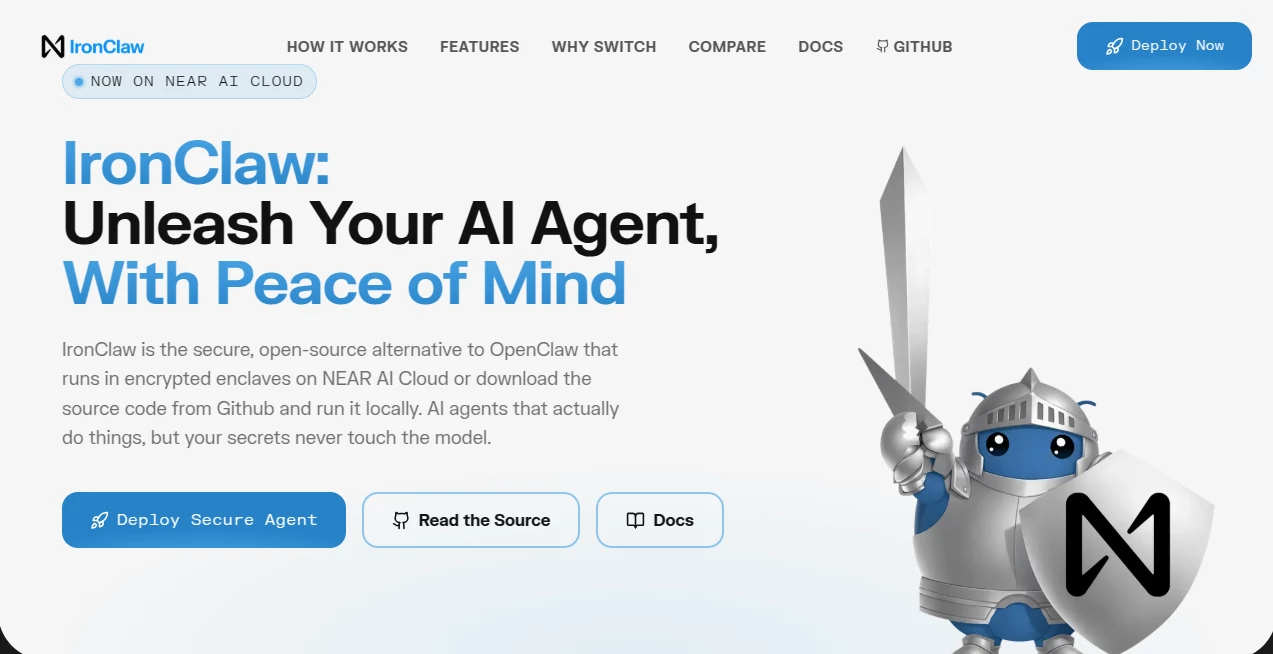
What is IronClaw?
As AI agents become more capable, security and control have become just as important as intelligence. This platform was built to solve a challenge many businesses, developers, and technology enthusiasts face: how to deploy powerful AI agents without exposing sensitive credentials, data, or workflows.
Unlike many agent frameworks that prioritize convenience over protection, this solution was designed with security at its core. It enables users to create autonomous AI agents that can interact with tools, services, APIs, and workflows while maintaining strict safeguards around secrets, permissions, and execution environments.
Whether the goal is workflow automation, research assistance, task orchestration, or long-term AI memory, the platform provides a flexible foundation that balances functionality with trust. Its open-source nature also gives users greater transparency and confidence in how their systems operate.
Key Features
User Interface
The platform offers a clean and developer-friendly experience that makes deployment and management straightforward. Users can access their agents through web interfaces, messaging platforms, terminal environments, and webhook integrations. The dashboard simplifies monitoring, configuration, and agent management without overwhelming users with unnecessary complexity.
Its multi-channel accessibility allows teams to interact with AI assistants from the tools they already use daily, reducing adoption barriers and improving workflow continuity.
Accuracy & Performance
Performance is enhanced through support for multiple leading language model providers. Users can choose the model that best matches their requirements for reasoning, speed, privacy, or cost efficiency.
The architecture supports parallel task execution, enabling agents to handle multiple jobs simultaneously. Persistent memory systems help maintain context across sessions, allowing agents to deliver more relevant responses and better long-term assistance.
For organizations managing complex workflows, this combination of memory, automation, and parallel processing significantly improves operational efficiency.
Capabilities
The platform goes beyond simple chat interactions. It enables AI agents to perform meaningful actions through controlled access to external tools and services.
- Autonomous task execution
- Workflow automation
- Persistent memory and context retention
- Multi-provider language model support
- Tool and API integrations
- Multi-channel communication
- Parallel job processing
- Extensible skill framework
- Webhook-based automation
- Research and information gathering
These capabilities make it suitable for personal productivity, technical operations, business workflows, and advanced automation projects.
Security & Privacy
Security is arguably the strongest aspect of the platform. Rather than treating protection as an afterthought, it incorporates multiple layers of defense directly into its architecture.
Sensitive credentials are stored in encrypted vaults and are never directly exposed to AI models. Sandboxed execution environments limit tool access and reduce the potential impact of compromised integrations. Additional safeguards such as isolated runtimes, permission controls, encrypted secret management, and secure execution environments provide strong protection for both individuals and organizations.
This approach is particularly valuable for users handling confidential business data, financial operations, customer information, or proprietary workflows.
Use Cases
- Building secure autonomous AI assistants for personal productivity
- Automating business operations and recurring workflows
- Managing long-term projects with persistent AI memory
- Conducting research and information analysis
- Creating AI-powered customer support systems
- Connecting multiple applications through intelligent automation
- Developing secure enterprise AI environments
- Managing infrastructure and operational monitoring tasks
- Supporting compliance-sensitive industries
- Creating custom AI workflows for teams and organizations
Pros and Cons
Pros
- Security-first architecture
- Open-source and transparent development model
- Support for multiple AI providers
- Persistent memory capabilities
- Flexible deployment options
- Multi-channel access and communication
- Powerful workflow automation features
- Strong credential protection mechanisms
- Extensible tool ecosystem
- Suitable for both individuals and enterprises
Cons
- Some advanced security concepts may require technical understanding
- Enterprise-grade functionality can introduce a learning curve
- Certain integrations may require configuration effort
- Advanced deployments are better suited to experienced users
Pricing Plans
The platform provides flexible deployment options depending on user requirements. Since it supports open-source deployment and cloud-based environments, pricing can vary based on hosting choices, infrastructure requirements, and usage levels.
Users should review the latest pricing information directly from the official platform to determine the most suitable plan for their needs.
How to Use IronClaw
Getting started is relatively straightforward:
- Deploy an agent through the cloud environment or local installation.
- Configure language model providers and authentication settings.
- Add tools, integrations, and workflow capabilities.
- Store credentials securely within the encrypted vault.
- Define permissions and execution policies.
- Access the agent through supported channels such as web interfaces or messaging platforms.
- Monitor activity and continuously refine workflows.
Within a short period, users can have a secure AI assistant capable of handling real-world tasks while maintaining strong security controls.
Comparison with Similar Tools
Many AI agent frameworks focus heavily on autonomy and rapid deployment but often rely on broad system permissions and direct credential exposure. This platform takes a different approach by emphasizing security boundaries and controlled execution.
Compared to general-purpose AI assistants, it offers stronger protection for secrets, better governance over agent actions, and greater flexibility for self-hosted or enterprise deployments.
While some competitors may provide simpler onboarding experiences, few offer the same combination of open-source transparency, secure architecture, multi-provider support, and advanced agent orchestration capabilities.
Conclusion
For users who want more than a chatbot, this platform delivers an impressive foundation for building intelligent, secure, and capable AI agents. Its focus on privacy, credential protection, extensibility, and autonomous workflows makes it particularly appealing for businesses and professionals who require reliability and control.
The combination of open-source flexibility, enterprise-grade security principles, persistent memory, and workflow automation creates a powerful environment where AI can move beyond conversations and become a genuine operational assistant.
Anyone seeking a security-focused AI agent platform with long-term scalability and practical real-world applications will find significant value in what this solution offers.
Frequently Asked Questions (FAQ)
What is this platform used for?
It is used to create secure AI agents capable of automation, research, workflow management, task execution, and long-term contextual assistance.
Can it work with different AI models?
Yes. The platform supports multiple language model providers, giving users flexibility in performance, privacy, and cost considerations.
Does it store credentials securely?
Yes. Credentials are protected through encrypted storage mechanisms and are not directly exposed to AI models.
Is it suitable for businesses?
Absolutely. Its security controls, automation capabilities, and governance features make it suitable for both small teams and large organizations.
Can it be self-hosted?
Yes. Users can deploy the platform in environments that match their privacy, compliance, and infrastructure requirements.
AI Developer Tools , AI Research Tool , AI Productivity Tools , AI Workflow Management .
These classifications represent its core capabilities and areas of application. For related tools, explore the linked categories above.

IronClaw Alternatives Product

Linkflare

Creget

Chatref

ace.me

Nimbalyst

hd image con…

David One

Nova AI

Claude and C…
