
Labrynth
What is Labrynth?
Regulatory work can be one of the slowest parts of running a complex business. Teams may spend weeks gathering documents, checking requirements, coordinating reviewers, and making sure an application is ready for the right jurisdiction. A small oversight can lead to another review cycle and push an important project further down the road.
Labrynth approaches this problem as a regulatory intelligence and execution platform built for organizations operating in highly regulated environments. Instead of treating compliance as a collection of disconnected tasks, it brings regulatory knowledge, workflow automation, document preparation, and ongoing monitoring into one system.
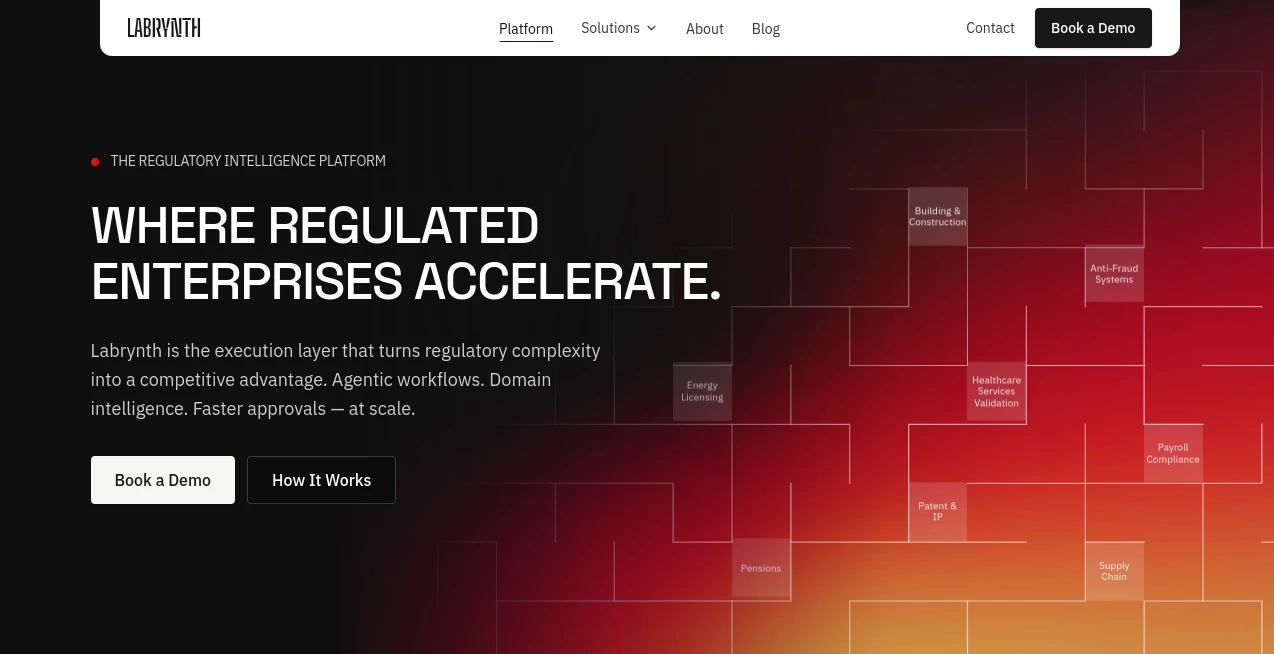
The platform is designed for enterprises and regulators working across areas such as construction, energy, healthcare, payroll, pensions, intellectual property, anti-fraud systems, and supply chain compliance. Its focus is practical: help teams understand what is required, prepare better submissions, identify gaps earlier, and move approval processes forward with less manual coordination.
For an organization where a delayed approval can affect an entire project, that difference can be substantial.
Key Features
- Regulatory intelligence built around rules, precedents, requirements, and emerging changes.
- Domain-specific compliance workflows designed for different regulated industries.
- Intelligent preparation of application packages and supporting documentation.
- Compliance checklists tailored to the relevant requirements and jurisdiction.
- Continuous monitoring of regulatory changes.
- Alerts when requirements shift and existing submissions may need attention.
- Workflows designed to reduce preparation time and improve submission quality.
- Support for complex approval and licensing processes.
- Integration capabilities across enterprise software and data environments.
- An intelligence layer that becomes more useful as deployments generate additional workflow knowledge and exceptions.
User Interface
The product is positioned less like a conventional consumer AI application and more like an enterprise operating layer for regulatory work. That distinction matters. Users dealing with permits, licensing, compliance reviews, or other regulated processes need information organized around the work they are actually trying to complete.
Rather than simply presenting a conversational interface, the platform connects regulatory intelligence with structured workflows and document preparation. This makes the experience particularly relevant to teams that already have established approval processes and need technology that can fit into those processes rather than replace them overnight.
For larger organizations, the emphasis on dedicated onboarding and domain-specific implementation can also make the transition more practical than adopting a generic AI assistant and attempting to configure everything internally.
Accuracy & Performance
Regulatory AI needs a different standard of usefulness from a general-purpose chatbot. A confident but incorrect answer can create expensive problems when the information is connected to permits, compliance filings, licensing, or audits.
The platform addresses this challenge through its regulatory intelligence layer, which tracks rules, precedents, case outcomes, and emerging requirements. Its workflows are built around specific regulatory domains rather than treating every compliance question as a generic search task.
The company also highlights real-world results from its deployments. One plan reviewer cited a reduction in review time from five to seven hours to roughly one to two hours. These results will naturally vary by organization, workflow, and regulatory environment, but they illustrate the type of operational improvement the platform is designed to pursue.
Another important feature is continuous monitoring. Regulations do not remain static, so keeping an approval workflow current can be just as important as preparing the original submission.
Capabilities
The platform currently covers multiple high-stakes regulatory environments. These include building and construction approvals, healthcare services validation, anti-fraud compliance, energy licensing, payroll compliance, patent and intellectual property work, pensions, and supply chain regulation.
For construction teams, the system can help review documents against permitting requirements and identify gaps before submission. In energy and nuclear environments, it can help map requirements across complex regulatory frameworks. Healthcare organizations can use domain-specific workflows for licensing and validation, while payroll teams can review pay-related processes against applicable requirements.
A notable part of the offering is the Red Tape Index. It acts as an intelligence layer that continuously tracks regulatory rules, precedents, outcomes, and emerging requirements. Organizations can also commission a dedicated index for a specific regulatory domain, turning accumulated regulatory intelligence into a more structured business resource.
The platform is also designed to integrate with a broad enterprise technology environment, including business applications, cloud platforms, data systems, collaboration tools, and AI infrastructure.
Security & Privacy
Security is especially important when software is used for regulatory documents, business processes, licensing information, and other sensitive enterprise data.
The company presents the platform as having enterprise-grade security by default and highlights ISO 27001 and AICPA SOC credentials on its website. Organizations evaluating the product should still review the current security documentation, contractual terms, data handling practices, retention policies, and access controls before deploying it with sensitive information.
For regulated enterprises, that evaluation is an important part of implementation rather than an afterthought.
Use Cases
- Construction permitting: Review project documentation against permitting requirements and identify missing information before submission.
- Energy compliance: Navigate complex requirements involving energy, utilities, nuclear, and other regulated environments.
- Healthcare licensing: Support provider licensing, credentialing, validation, and regulatory approval workflows.
- Payroll compliance: Review payroll processes against applicable wage and employment requirements.
- Patent and IP compliance: Assist with intellectual property filing, prosecution, and portfolio-related compliance work.
- Anti-fraud operations: Support regulatory frameworks for fraud detection, reporting, remediation, and investigation.
- Pension compliance: Review retirement and pension documentation against relevant regulatory requirements.
- Supply chain compliance: Help organizations manage trade, customs, and regulatory requirements across supply chains.
- Regulatory monitoring: Keep track of changing requirements that could affect existing workflows and submissions.
Pros and Cons
Pros
- Built specifically for complex regulatory environments rather than general-purpose productivity.
- Combines regulatory intelligence with execution-oriented workflows.
- Supports multiple regulated industries.
- Continuous monitoring can help teams respond to changing requirements.
- Intelligent document preparation can reduce repetitive manual work.
- Designed for enterprise-scale deployments and complex workflows.
- Offers integration with a broad range of enterprise and technology platforms.
Cons
- It is primarily designed for enterprises and regulated organizations, so it may be excessive for simple compliance tasks.
- Pricing is not publicly listed.
- Implementation may require domain-specific onboarding and collaboration with the vendor.
- The platform is most valuable when an organization has substantial regulatory complexity to manage.
Pricing Plans
No standard public pricing plans are listed on the website. Instead, the company uses a business-focused sales model centered around demonstrations and domain-specific deployments.
This approach makes sense for an enterprise regulatory platform because the scope of an implementation can vary considerably. A construction company managing permits across several jurisdictions will have very different requirements from a healthcare organization handling licensing or an energy company dealing with multi-agency approvals.
Organizations interested in the platform can request a demo and discuss their regulatory environment, workflows, integrations, and deployment requirements before determining the appropriate commercial arrangement.
How to Use Labrynth
- Identify the regulatory workflow or approval process that creates the biggest operational bottleneck.
- Contact the provider and arrange a product demonstration.
- Explain the relevant industry, jurisdictions, documents, systems, and compliance requirements.
- Work with the implementation team to map the existing workflow into a domain-specific process.
- Connect relevant data sources and enterprise systems where appropriate.
- Use the platform to prepare documentation, check requirements, and identify potential gaps.
- Monitor regulatory changes that could affect ongoing applications or compliance processes.
- Review the resulting workflow with the appropriate legal, compliance, regulatory, or operational teams.
Comparison with Similar Tools
Traditional compliance software often focuses on storing documents, managing checklists, or recording completed tasks. Generic AI assistants, on the other hand, can answer questions and summarize information but may lack the domain-specific workflow structure needed for complex regulatory operations.
This platform sits between those approaches. Its value comes from connecting regulatory intelligence with the actual execution of approval and compliance workflows. That makes it particularly interesting for organizations where regulatory work is not an occasional administrative task but a recurring operational process.
For a small business that only needs to check a single regulation once in a while, a simpler compliance application may be sufficient. For an enterprise managing thousands of requirements, multiple jurisdictions, large document packages, or repeated approval cycles, a specialized regulatory intelligence platform can provide a much stronger operational fit.
Conclusion
Regulatory complexity is rarely caused by one difficult form or one complicated rule. The real challenge comes from the combination of changing requirements, large document sets, multiple stakeholders, jurisdiction-specific processes, and the consequences of getting something wrong.
This platform takes a practical approach to that problem by combining regulatory intelligence, domain-specific workflows, document preparation, and continuous monitoring. Its focus on regulated industries makes it more specialized than the typical AI productivity product, but that specialization is also its main strength.
For enterprises working through construction approvals, licensing, healthcare validation, energy regulation, payroll compliance, intellectual property, pensions, fraud systems, or supply chain requirements, it offers an interesting way to move regulatory work from a largely manual process toward a more structured and intelligent workflow.
The strongest fit will be organizations where regulatory delays have a measurable impact on revenue, project schedules, operational capacity, or growth. In those environments, reducing friction in the approval process can be much more than a productivity improvement—it can directly affect how quickly a business can move forward.
Frequently Asked Questions (FAQ)
What is Labrynth used for?
It is designed to help enterprises and regulators manage complex regulatory, compliance, licensing, and approval workflows using regulatory intelligence and AI-powered automation.
Which industries does it support?
The platform currently highlights building and construction, healthcare services, anti-fraud systems, energy licensing, payroll compliance, patent and intellectual property, pensions, and supply chain regulation.
Can it help with construction permitting?
Yes. Construction permitting is one of its highlighted use cases. The platform can review construction documents against applicable permitting requirements and help identify gaps before submission.
Does it monitor regulatory changes?
Yes. Its regulatory intelligence layer is designed to continuously track changes in rules, precedents, case outcomes, and emerging requirements so teams can keep their workflows current.
Does it have public pricing?
No standard pricing plans are publicly listed. The service is positioned for enterprise deployments, with prospective customers encouraged to book a demonstration and discuss their specific requirements.
Is it suitable for small businesses?
It can be considered by smaller organizations with significant regulatory complexity, but its strongest use case is enterprise-scale work involving complex approval processes, multiple requirements, or regulated industries.
Does it integrate with other software?
Yes. The platform lists integrations and compatibility across enterprise applications, cloud infrastructure, data platforms, collaboration systems, AI providers, and business software.
What makes it different from a general AI chatbot?
Its primary focus is regulatory execution. Instead of simply answering questions, it combines domain-specific intelligence with structured compliance workflows, document preparation, and ongoing regulatory monitoring.
AI Workflow Management , AI Documents Assistant , AI Contract Management , AI Legal Assistant .
These classifications represent its core capabilities and areas of application. For related tools, explore the linked categories above.

Labrynth Alternatives Product

Zapier

FINIITE AI

AIDeckly

AI Agent Ski…

The #1 Compa…

PDF to MD

Neurohelper

Odysseus AI

onuml