
LettsGroup
What is LettsGroup?
LettsGroup is an AI-native venture building platform designed for founders who want to turn an idea into a structured, operating business without stitching together dozens of disconnected tools. Instead of treating strategy, product development, marketing, finance, fundraising, and operations as separate jobs, it brings them together inside one connected workspace.
The platform is built around a simple idea: business building is often slowed down not by a lack of ideas, but by execution chaos. Founders can use the system to work through a structured venture roadmap, understand the current health of their business, and get practical next steps for moving forward.
What makes the approach particularly interesting is its combination of AI agents, business intelligence, and a step-by-step framework. A founder starting from a rough concept can work toward market validation, product planning, go-to-market execution, fundraising preparation, and ongoing operations in the same environment.
Key Features
The platform combines several business-building functions into a single system. Its core experience revolves around a structured venture framework, real-time intelligence, and AI co-founders that can assist with execution.
- AI-powered venture building from idea to exit
- Structured venture roadmap with sequenced business-building steps
- Real-time venture health scoring and next-action guidance
- Multi-agent AI co-founders for product, marketing, finance, and operations
- Product Builder for prototypes, roadmaps, specifications, and backlogs
- Growth Engine for go-to-market activities, campaigns, and business development
- Finance OS for burn rate, runway, financials, and forecasts
- Legal and IP tools for business entities, contracts, and intellectual property
- Fundraising tools for pitch narratives, decks, and investor connections
- Venture Assets data room for keeping important business outputs and uploads together
- Agent Store for extending the platform with additional AI agents
- Integrations and analytics on higher-tier plans
User Interface
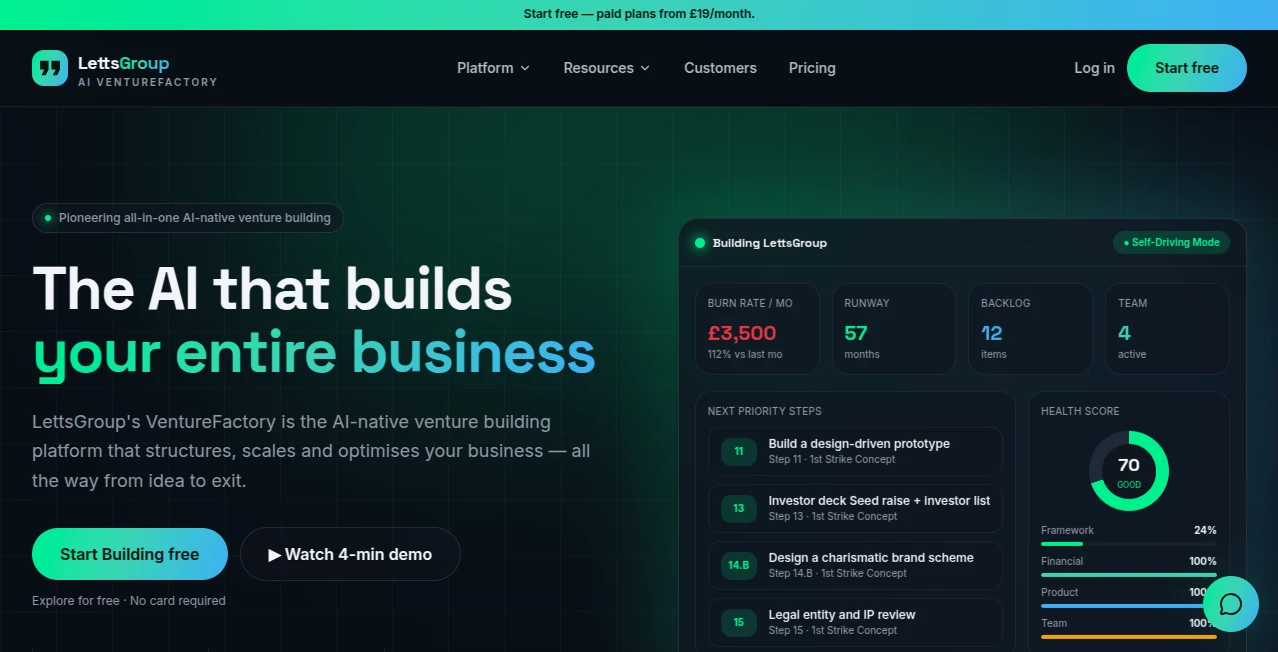
The interface is designed around a centralized venture dashboard rather than a collection of isolated AI utilities. Important business indicators such as burn rate, runway, backlog, team activity, health scores, and priority actions can be viewed from the same workspace.
This approach is especially useful for founders who normally move between spreadsheets, project management software, AI chat tools, presentation builders, financial documents, and investor materials. Having those activities connected can make the daily workflow feel considerably less fragmented.
Accuracy & Performance
The platform focuses less on producing isolated AI answers and more on keeping business decisions connected to the venture context. Venture Intelligence can assess the current state of a business, provide health scoring, and recommend next-best actions based on the information available inside the workspace.
The company also states that users can produce a company snapshot, market opportunity analysis, product roadmap, pitch narrative or landing page, and a seven-day execution plan within the first 30 minutes. That makes the initial experience particularly useful for turning an early idea into something more concrete.
Actual results will naturally depend on the quality of the information supplied, the stage of the business, and how actively the founder works with the generated outputs. The strongest value comes from using the platform as an ongoing operating system rather than as a one-time idea generator.
Capabilities
Its capabilities cover a broad section of the startup lifecycle. Product-focused work can include prototypes, specifications, roadmaps, backlogs, and connections with GitHub. Growth features cover go-to-market planning, campaigns, and business development. Financial workflows can track burn, runway, and forecasts, while fundraising tools help prepare investor-facing materials.
The multi-agent architecture is another notable part of the product. Different AI roles can work alongside the founder across product, marketing, finance, and operations, making the system feel closer to an AI-assisted business team than a conventional chatbot.
For example, a founder preparing a new SaaS product could start with market analysis, move into product definition, create a roadmap, prepare a landing page, develop a fundraising narrative, and then continue tracking operational priorities without rebuilding the context in another application.
Security & Privacy
Business information can be highly sensitive, particularly when it involves financial forecasts, investor materials, contracts, product plans, or intellectual property. The platform provides a dedicated Venture Assets environment described as a secure company data room, with the company stating that its venture data is protected from AI leakage.
For organizations with more demanding requirements, the Enterprise plan also includes a bring-your-own-key option. Businesses should still review the current privacy policy, terms, and contractual documentation before placing confidential information into any business platform.
Use Cases
The platform can be useful across several stages of company building. Early-stage founders can use it to turn an initial concept into a structured venture plan, clarify their ideal customer profile, analyze market opportunities, and establish product priorities.
For startups already operating in the market, it can bring product, growth, finance, legal, and fundraising activities into a shared workflow. Instead of maintaining separate planning systems for every department, teams can use one venture workspace to connect strategic decisions with execution.
Investors, accelerators, and corporate incubators can also benefit from the broader venture-management approach. Higher-tier functionality is designed to support multiple ventures, analytics, investor workflows, integrations, and portfolio-related activities.
Pros and Cons
- Pros: Combines strategy, product, growth, finance, legal, fundraising, and operations in one environment.
- Pros: AI agents can assist with execution rather than only answering questions.
- Pros: The structured framework gives founders a clearer sequence of business-building activities.
- Pros: A free plan is available without requiring a credit card.
- Pros: Higher plans provide more ventures, AI credits, analytics, integrations, and collaboration features.
- Cons: The breadth of features may take some time for new users to fully understand.
- Cons: AI-generated business outputs still require founder judgment, validation, and review.
- Cons: The more advanced capabilities are reserved for paid plans.
Pricing Plans
The pricing structure is designed to let users start without an upfront commitment. The Free plan costs £0 per month and includes one user, one venture, four steps per month, 20 AI credits, core applications, Venture Intelligence, AI Co-Founders, and the first Self-Driving Modes.
The Build plan costs £19 per month and increases the allowance to two users, ten steps per month, and 100 AI credits. It also adds advanced core tools, additional Self-Driving Modes, and Investor-Connect.
The Scale plan costs £69 per month and is aimed at more established businesses. It includes three ventures, unlimited steps per venture, 500 AI credits per month per venture, venture asset exports, all Self-Driving Modes, an Agent Store, analytics, online support, and basic integrations.
The Enterprise plan costs £239 per month and expands the platform to ten ventures, 2,000 AI credits per month per venture, advanced analytics, additional integrations, an account manager, and bring-your-own-key functionality.
Annual billing is available with an 8.33% discount, while paid subscriptions can be cancelled at any time and remain active until the end of the billing period.
How to Use It
Getting started is straightforward. Create a free account and begin by defining the venture you want to build. The system can then guide you through the relevant stages of the venture-building framework.
Start with the company snapshot and market opportunity analysis. From there, develop the product roadmap, define priorities, prepare your go-to-market direction, and create useful business assets. As the venture develops, use the intelligence layer to monitor business health and identify the next actions that deserve attention.
The best results come from treating the workspace as a living business system. Update it as your company changes, review AI-generated recommendations, and use the resulting outputs as working documents rather than final answers that should never be questioned.
Comparison with Similar Tools
Traditional AI assistants are excellent for individual tasks, but they generally require users to provide context again whenever they move from one activity to another. Project management platforms, meanwhile, are good at organizing tasks but are not necessarily designed to build a company from its earliest idea through fundraising and scaling.
This platform takes a different approach by connecting those activities around the venture itself. Its combination of a structured framework, real-time venture intelligence, AI co-founders, and business-specific tools makes it more comparable to an AI-powered venture operating system than a single-purpose writing, productivity, or project management application.
That distinction matters for founders who are tired of maintaining a stack of separate tools. Someone who only needs help writing an email or generating a few ideas may find a simpler AI application sufficient. A founder looking for a broader system to coordinate the actual business-building process may find the integrated approach considerably more valuable.
Conclusion
Building a company involves far more than coming up with a promising idea. Product decisions, customer research, marketing, financial planning, operations, legal work, and fundraising all compete for attention. The real challenge is often keeping those pieces connected while moving quickly.
This platform addresses that challenge with an ambitious AI-native approach. Its structured venture framework provides direction, Venture Intelligence adds ongoing business guidance, and its AI co-founders bring execution support across several important functions.
The free plan makes it easy to explore the system without a financial commitment, while the paid tiers provide room for growing teams and more complex ventures. For founders who want fewer disconnected tools and a more unified way to plan, build, operate, and scale a business, it offers a compelling alternative to assembling a large collection of separate software products.
Frequently Asked Questions (FAQ)
Is there a free plan?
Yes. The Free plan costs £0 per month, is available indefinitely, and does not require a credit card to start.
Can it help build a business from an idea?
Yes. The platform is designed around a venture-building process that can take users from an initial idea through product development, market entry, growth, fundraising, and scaling.
Does it include AI agents?
Yes. AI Co-Founders use a multi-agent approach to support areas such as product, marketing, finance, and operations.
How much does the paid version cost?
Paid plans currently start at £19 per month for the Build plan. Scale costs £69 per month, while Enterprise costs £239 per month.
Can multiple people work together?
Yes. Paid plans increase the number of users available per venture, with larger plans supporting multiple ventures and additional collaboration capabilities.
Can it be used for fundraising?
Yes. Fundraising capabilities include pitch narratives, investor decks, Investor-Connect, and an end-to-end fundraising agent for supported workflows.
Does it provide financial management tools?
Yes. Its Finance OS is designed to keep information such as burn rate, runway, financials, and forecasts connected to the wider venture.
Is it suitable for investors and accelerators?
Yes. The higher-tier offering includes functionality intended for corporate incubators, venture capital firms, accelerators, and other organizations managing multiple ventures.
Can a subscription be cancelled?
Yes. Paid plans can be cancelled at any time and remain active until the end of the current billing period.
Can annual billing save money?
Yes. Annual billing currently provides an 8.33% discount compared with monthly pricing.
AI Project Management , AI Accounting Assistant , AI Research Tool , AI Consulting Assistant .
These classifications represent its core capabilities and areas of application. For related tools, explore the linked categories above.

LettsGroup Alternatives Product

YTVidHub-you…

Sourcetable

ChatterSift

FeatureShark

Diploria AI

DidYouSEO

SearchSpot

UPDF AI

LocalRAG!