


















Maced AI
What is Maced AI?
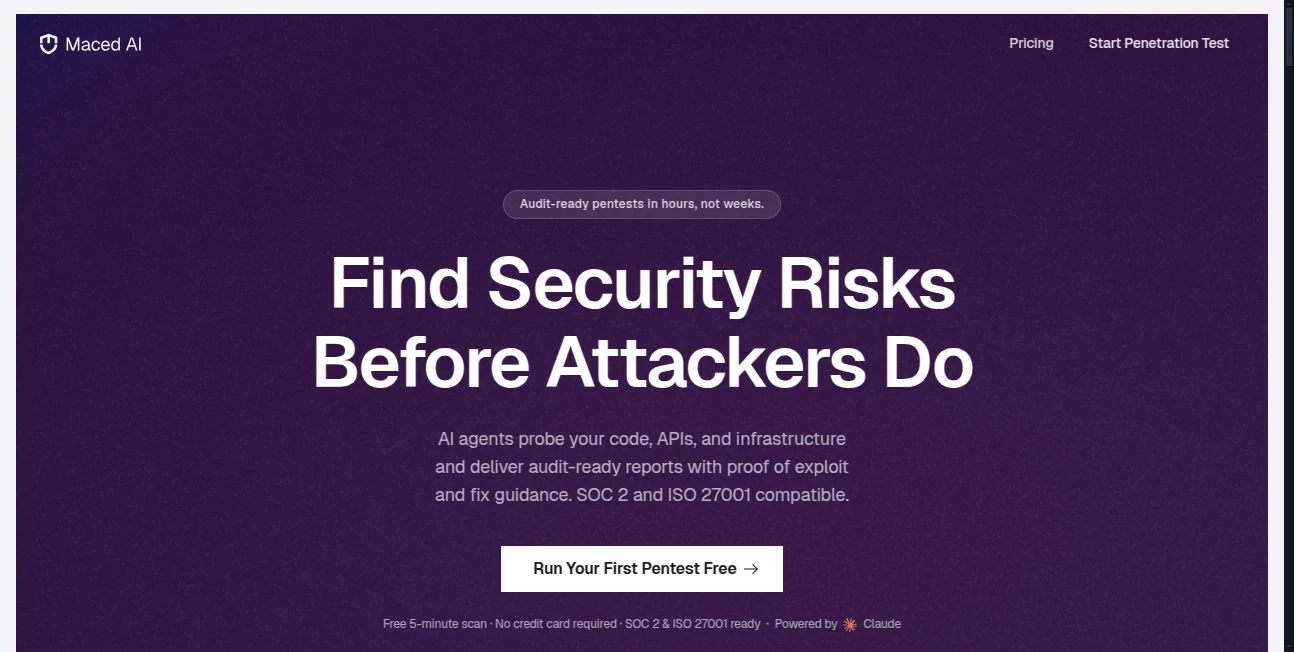
Application security has become one of the biggest challenges for modern development teams. Fast release cycles, growing cloud infrastructures, and complex APIs leave little room for manual security testing alone. This platform introduces a fresh approach by automating penetration testing with intelligent AI agents capable of discovering, validating, and explaining security vulnerabilities in hours rather than weeks.
Instead of overwhelming security teams with endless alerts, it focuses on verified findings backed by proof of exploitation. The result is a practical workflow that helps engineering teams prioritize real risks while reducing false positives. Whether protecting web applications, APIs, cloud environments, or source code, the platform delivers comprehensive security assessments that are suitable for organizations preparing for compliance audits such as SOC 2 and ISO 27001.
Key Features
User Interface
The dashboard is designed for technical teams that need immediate visibility into their security posture. Projects, repositories, domains, and testing targets are organized in a clean workspace where vulnerabilities, reports, and remediation suggestions are easy to navigate. Security findings are presented with clear severity ratings, reproduction steps, and evidence, making collaboration between developers and security professionals much simpler.
Accuracy & Performance
One of the strongest advantages is its validation process. Every reported vulnerability is automatically verified before appearing in the final report, significantly reducing unnecessary alerts. AI agents actively test attack paths, reproduce exploits, and prioritize issues based on real business impact rather than theoretical risk. Security scans that traditionally require several weeks can often be completed within only a few hours.
Capabilities
- Autonomous penetration testing for web applications.
- Comprehensive API security assessments.
- Source code analysis using white-box testing.
- Infrastructure and cloud security validation.
- Proof-of-exploit generation for every verified issue.
- Automatic vulnerability prioritization.
- Attack path visualization.
- Merge-ready remediation suggestions.
- Continuous security monitoring.
- Audit-ready reporting for compliance programs.
- Integration with development workflows and CI/CD pipelines.
- Support for both black-box and white-box testing methodologies.
Security & Privacy
Security is deeply integrated into every stage of the platform. Penetration tests execute inside isolated environments that are removed after each assessment. Connected source code is processed only during analysis, while generated reports include detailed remediation guidance without exposing unnecessary sensitive information. Enterprise capabilities such as role-based access, audit logs, deployment flexibility, and compliance-focused reporting make it suitable for organizations handling critical infrastructure and confidential applications.
Use Cases
- Continuous security testing for SaaS products.
- Preparing applications for SOC 2 or ISO 27001 certification.
- Finding vulnerabilities before production deployments.
- Protecting REST APIs and web services.
- Reviewing source code for hidden security flaws.
- Monitoring cloud infrastructure for emerging risks.
- Supporting DevSecOps teams with automated testing.
- Reducing manual penetration testing costs.
- Accelerating vulnerability remediation workflows.
- Generating professional audit reports for clients and stakeholders.
Pros and Cons
Pros
- Fast penetration testing completed in hours.
- Verified findings reduce false positives.
- Supports applications, APIs, infrastructure, and source code.
- Detailed remediation guidance for developers.
- Continuous monitoring keeps systems protected.
- Audit-ready compliance reports.
- Developer-friendly integrations.
- Scalable for startups and enterprise organizations.
Cons
- Primarily designed for technical security teams.
- Advanced enterprise features may require higher subscription tiers.
- Organizations new to automated security testing may need time to adapt existing workflows.
Pricing Plans
A free introductory security scan is available for new users. Paid subscriptions begin with a Starter plan for smaller teams and a Professional plan that includes additional monthly penetration tests, priority support, API access, and expanded reporting capabilities. Enterprise deployments offer customized infrastructure, advanced integrations, and flexible deployment options for organizations with larger security requirements.
How to Use Maced AI
Begin by connecting your repository, application, API, or target domain. Choose between black-box testing for external security validation or white-box analysis for deeper source code inspection. Launch a penetration test and allow the autonomous agents to analyze your environment. After completion, review validated findings, examine proof-of-exploit evidence, prioritize vulnerabilities, and apply the recommended fixes. Teams can then rerun assessments to confirm that vulnerabilities have been successfully eliminated.
Comparison with Similar Tools
Compared with traditional penetration testing services, this solution dramatically shortens delivery times while providing continuous testing rather than one-time assessments. Unlike many vulnerability scanners that generate thousands of potential issues, it focuses on validated findings with reproducible evidence. Its combination of AI-driven testing, automated remediation guidance, compliance-ready reporting, and integration into modern DevSecOps workflows creates a more efficient experience for engineering teams that require both speed and accuracy.
Conclusion
Organizations can no longer rely solely on occasional manual security assessments. Continuous testing has become an essential part of secure software development, especially as cloud applications and APIs continue to evolve. This platform combines intelligent automation with practical security expertise, allowing teams to identify genuine risks, understand their impact, and resolve them efficiently. For businesses seeking faster penetration testing, stronger compliance readiness, and developer-friendly security workflows, it represents an impressive advancement in AI-powered cybersecurity.
Frequently Asked Questions (FAQ)
What types of assets can be tested?
The platform supports web applications, APIs, cloud infrastructure, repositories, and other software assets using both black-box and white-box testing methods.
Does it generate compliance reports?
Yes. Reports are designed to support compliance initiatives including SOC 2 and ISO 27001 by providing detailed evidence, remediation guidance, and verified findings.
Can developers fix vulnerabilities directly from the reports?
Yes. Every validated issue includes technical details, reproduction steps, and practical remediation guidance that developers can use to resolve problems quickly.
Is continuous monitoring supported?
Yes. Security assessments can run on a recurring schedule or integrate into deployment pipelines to identify new vulnerabilities as software changes.
Who benefits the most from this platform?
Development teams, DevSecOps engineers, cybersecurity professionals, SaaS companies, and enterprises that require automated penetration testing and continuous application security monitoring will benefit the most.
AI Testing & QA , AI Code Assistant , AI Developer Tools , AI DevOps Assistant .
These classifications represent its core capabilities and areas of application. For related tools, explore the linked categories above.

Maced AI Alternatives Product

Bitbucket

UpMocker

KaneAI

VercelAPP

FurWall
HostFinder

EasyRouterAI

Defapi

Simple Dev T…
