


















Miravoice
What is Miravoice?
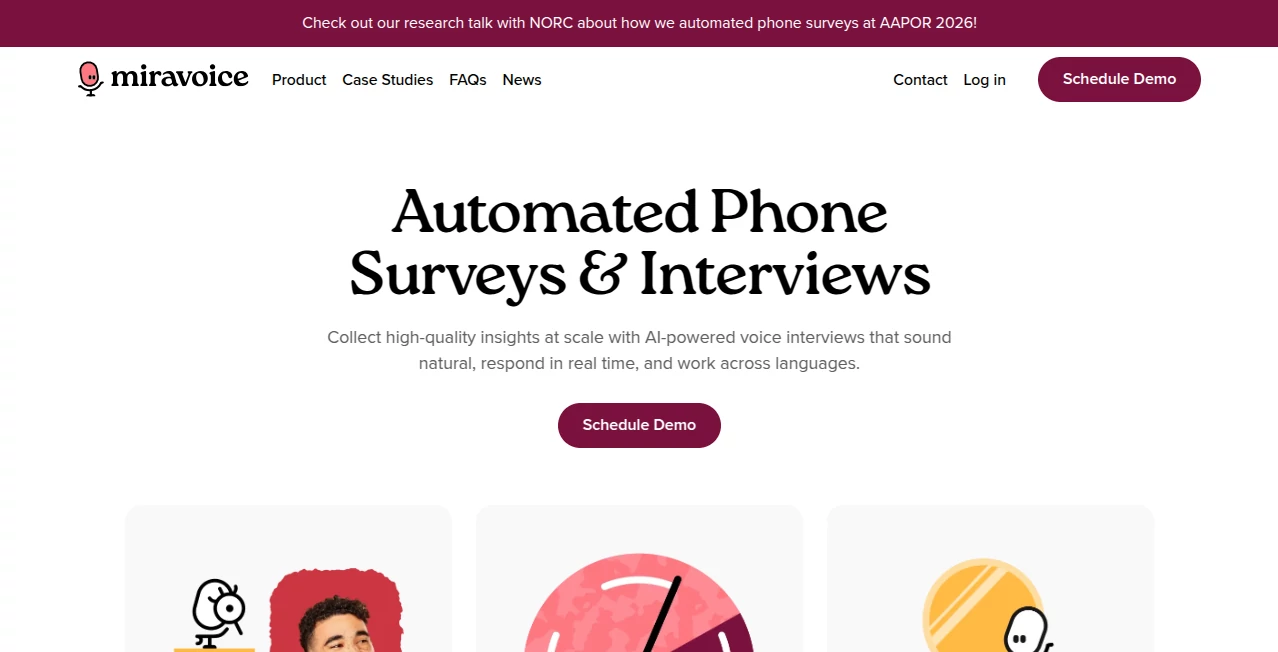
Miravoice is an AI-powered platform designed to conduct phone surveys and voice interviews at scale. Instead of relying entirely on human interviewers or rigid IVR systems, it uses natural language processing to hold real-time conversations, understand responses, and turn spoken answers into structured research data.
The platform is particularly interesting for organizations that need to reach large groups of respondents in a short period. It can place thousands of calls at once, accept inbound calls outside traditional working hours, and support interviews in 14 languages. For research teams dealing with expensive call centers or slow manual interviewing, this approach can make large-scale data collection considerably easier.
Key Features
- AI-powered phone surveys and voice interviews
- Real-time conversational responses
- Support for 14 languages
- Outbound calling at large scale
- Inbound interviews at any time of day
- Automatic transcripts and audio recordings
- Structured response data for analysis
- Branching logic and skip patterns
- Open-ended, multiple-choice, and rating-scale questions
- Export options including CSV, Microsoft Excel, Qualtrics, Forsta Decipher, and Voxco
User Interface
The experience is built around creating and managing interview projects rather than forcing users to operate a complicated call center system. Interview designs can be customized with branching logic, skip patterns, follow-up questions, and randomized answer choices.
This flexibility is useful when a survey cannot simply follow a fixed list of questions. For example, a respondent who gives a particular answer can be directed into a different sequence of questions without requiring an interviewer to manually manage the conversation.
Accuracy & Performance
One of the strongest aspects of the platform is its focus on real-world voice conversations. The system is designed to interpret vague or imprecise speech, deal with pauses and interruptions, and respond when respondents ask questions during an interview.
Its published research also provides useful evidence beyond a typical product demonstration. Research presented at AAPOR, MAPOR, and other research venues has examined AI interviewing with real respondents, including large-scale calling experiments. One AAPOR study evaluated 12 AI voices across providers including Rime, ElevenLabs, and Google using nearly 100,000 calls.
That research-oriented approach gives the product a more practical foundation than simply presenting an AI voice as a replacement for a human interviewer.
Capabilities
The platform is built for more than basic automated questionnaires. It can conduct quantitative phone interviews, interpret conversational answers, categorize responses, and transform conversations into structured datasets.
Organizations can also use different interview structures depending on their research goals. Consumer surveys, public opinion polling, customer feedback, employee experience studies, intake interviews, and applicant screening can all benefit from conversational phone automation.
Another useful capability is its handling of inbound calls. Respondents can call back outside standard business hours, which can be valuable when participants are more comfortable completing an interview on their own schedule.
Security & Privacy
Because phone interviews can contain sensitive research information, privacy should be considered when designing a project. The platform provides transcripts and audio recordings as part of its data workflow, so organizations should establish appropriate retention, access, consent, and data-handling practices for their particular research environment.
Its terms identify the service as an AI phone calling system provided by VKL Research, Inc., and describe separate responsibilities for participants and customers. Teams handling regulated or sensitive information should review the current legal and privacy documentation before launching a large campaign.
Use Cases
Market research is one of the most natural applications. A research team can use automated phone interviews to collect consumer opinions, test perceptions, or conduct large-scale surveys without coordinating a large group of interviewers.
Public opinion research is another strong fit. Political polling and other population-level surveys can require thousands of completed interviews, making automation particularly attractive when speed and consistency matter.
Customer and employee feedback can also be collected through conversational calls. Rather than sending another email questionnaire, organizations can reach respondents by phone and allow them to answer naturally.
The platform can also support screening and qualification workflows. Insurance intake, eligibility interviews, job applicant screening, and survey panel recruitment are examples where an initial conversation can determine what should happen next.
Pros and Cons
- Pros: Large-scale calling, natural conversational handling, multilingual support, customizable survey logic, structured data output, inbound and outbound calling, and integrations with established research platforms.
- Pros: The company publishes research examining AI interviewers with real respondents, which is valuable for organizations evaluating the technology seriously.
- Pros: The company states that automated interviewing can cost 70–90% less than traditional call centers, depending on the project.
- Cons: Pricing is usage-based, so there is no simple public monthly plan that lets every customer immediately calculate the final cost.
- Cons: The strongest fit is currently quantitative research and structured interviewing; highly nuanced qualitative conversations may still benefit from experienced human interviewers.
- Cons: Organizations must carefully consider consent, recording, privacy, and regulatory requirements when conducting automated phone interviews.
Pricing Plans
Pricing is usage-based rather than organized around publicly listed fixed plans. The final cost depends on factors such as the country where calls are made, the number of calls, and the length of those calls.
The company states that its service is typically 70–90% less expensive than traditional call centers, although the actual savings will depend on the requirements of each project. Organizations interested in using the platform can schedule a demo and request a quote based on their expected calling volume and research needs.
How to Use It
Getting started begins with scheduling a demo and working with the team to establish the first project. This is a sensible approach for a platform intended for research teams rather than casual individual use.
Once a project is defined, the interview can be designed around the required questions, answer choices, branching logic, follow-ups, and skip patterns. Different question formats can be combined to create a survey that responds appropriately to what each participant says.
After interviews are conducted, the resulting conversations can produce transcripts, audio recordings, and structured response data. The information can then be exported to common formats and research platforms for further analysis.
Comparison with Similar Tools
Traditional call centers offer the advantage of human judgment but can become expensive and difficult to scale when thousands of interviews are required. Automated IVR systems are generally easier to scale, but their fixed menu-style interactions can feel restrictive when respondents speak naturally or interrupt with questions.
This platform sits between those approaches by combining automated calling with conversational AI. It is designed to understand spoken language instead of simply asking respondents to press numbered buttons. For quantitative research projects where consistency, volume, and speed are priorities, that distinction can be significant.
It is also worth noting that the platform is backed by a research-focused team that has published studies on AI voice interviewing. For buyers comparing emerging voice technologies, that research activity provides additional context when assessing whether an automated interviewer is suitable for a particular project.
Conclusion
AI-powered phone interviewing is becoming a practical alternative for organizations that need large amounts of research data without building a traditional call center operation. This platform makes a strong case for the approach by combining conversational voice technology, large-scale calling, multilingual interviews, customizable survey logic, and structured data collection.
Its biggest advantage is the combination of scale and flexibility. A respondent can speak naturally, ask a question, pause, or give an imprecise answer without necessarily breaking the interview flow. At the same time, the resulting information can be organized into data that research teams can analyze.
For market researchers, polling organizations, customer insight teams, and businesses running large screening or feedback programs, it is a compelling option to consider when manual phone interviewing has become too slow or costly.
Frequently Asked Questions (FAQ)
What does the platform do?
It uses AI voice technology to conduct automated phone surveys and interviews. It can communicate with respondents in real time, interpret their answers, and produce structured research data alongside transcripts and recordings.
How many languages are supported?
The platform currently supports 14 languages, including English, Spanish, French, Portuguese, German, Chinese, Japanese, Hindi, Italian, Korean, Dutch, Polish, Russian, and Swedish.
Can it handle interruptions?
Yes. The system is designed to handle interruptions, pauses, questions, and vague or imprecise spoken responses during interviews.
Can I customize the survey?
Yes. Interview designs can include branching logic, skip patterns, follow-up questions, randomized question or answer-choice order, multiple-choice questions, open-ended questions, and rating scales.
Can respondents call back?
Yes. The platform supports inbound interviewing, allowing respondents to call back and complete interviews outside traditional business hours.
Where can the collected data be exported?
Collected information can be exported to formats and research platforms including CSV, Microsoft Excel, Qualtrics, Forsta Decipher, and Voxco. The company also indicates that other tools can be supported on request.
How much does it cost?
Pricing is usage-based and depends on factors such as call location, number of calls, and call duration. The company states that the service is typically 70–90% less expensive than traditional call centers, with final pricing provided according to project requirements.
Is it suitable for qualitative research?
It can be used for voice interviews, but the company's published research indicates that AI interviewers are currently a stronger fit for quantitative research than highly qualitative interviewing. Teams requiring deep exploratory conversations should evaluate the technology against their specific research methodology.
How can I get started?
The standard starting point is to schedule a demo. The team can help configure the first project, set up the interview workflow, and provide onboarding and training.
AI Forms & Surveys , AI Speech Recognition , AI Speech to Text , AI Voice Assistants .
These classifications represent its core capabilities and areas of application. For related tools, explore the linked categories above.

Miravoice Alternatives Product

Elispeak

Fine Voice

ModelsLab
Voza Transcr…

SuperAI

Maestra

TryApplyNow

Whisper AI

Peanut AI
