


















NaN Builders
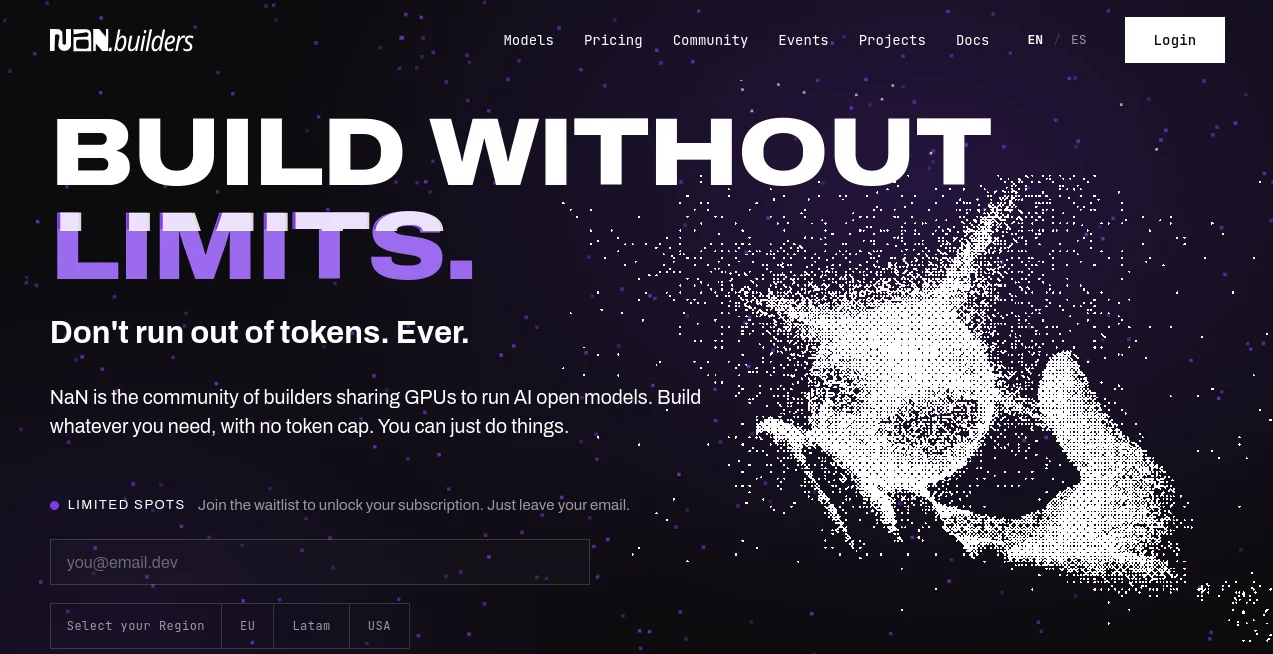
What is NaN Builders?
NaN is a community-driven AI inference platform built for developers, indie hackers, makers, and teams who want serious access to open models without having to purchase or maintain their own GPU infrastructure. Its core idea is refreshingly practical: share dedicated computing resources among builders, spread the infrastructure cost, and make powerful open-model inference easier to access.
Rather than positioning itself as another general-purpose chatbot, the platform focuses on the infrastructure behind AI applications. Members can connect their own agents, applications, scripts, and development tools through an OpenAI-compatible API. This makes the service particularly interesting for people already building with AI and looking for predictable access to capable open models.
The community aspect is equally important. Members communicate through private Discord channels, participate in model discussions, workshops, hackathons, and quarterly votes that help determine which models should be added to the shared cluster.
Key Features
- Shared GPU infrastructure designed for open-model inference.
- OpenAI-compatible API for straightforward integration with existing clients and SDKs.
- Access to multiple language, embedding, reranking, speech-to-text, and text-to-speech models.
- Large-context models suitable for demanding development and agent workflows.
- Tool calling, reasoning, vision, and audio capabilities on supported models.
- Personal API keys for members.
- EU-based processing with no prompt or response logging.
- Community voting on models every quarter.
- Private Discord channels, events, workshops, and hackathons.
- Month-to-month memberships with no long-term commitment.
User Interface
The public website keeps the experience deliberately simple. Instead of presenting a complicated cloud dashboard, it primarily handles membership, access, documentation, model information, and community entry. Developers who need to connect an application can use the documentation and point compatible software toward the provided API base URL.
The actual development experience happens largely inside the user's existing tools. That is a strong choice for technically minded users: there is less need to learn another proprietary interface, and existing OpenAI-compatible workflows can generally be adapted with minimal changes.
Accuracy & Performance
Performance depends on the selected model, but the underlying cluster is designed specifically for inference rather than training. The available stack includes models with large context windows, reasoning capabilities, tool calling, vision, and audio support. Some models are also available without a token counter, while frontier models have clearly published monthly or billing-period allowances.
The API documentation lists a limit of 60 requests per minute and up to five concurrent requests. For developers running agents or production experiments, that combination can be useful, particularly when the workload needs several requests to be active at the same time.
Capabilities
The platform goes well beyond ordinary text generation. Its model lineup includes general-purpose language models, embedding and reranking models, text-to-speech, and speech-to-text services. Supported API endpoints also cover chat completions, text completions, embeddings, reranking, speech generation, transcription, responses, image generation, image editing, web search, and MCP connectivity.
Developers can work with models such as DeepSeek V4-Flash, MiMo v2.5, Qwen3.6, and Gemma 4, while premium members can access GLM 5.2. Depending on the model, features include reasoning, vision, audio input, tool calling, streaming, and very large context windows.
Security & Privacy
Privacy is one of the platform's clearest selling points. It states that prompts, model responses, and user code are not logged. Processing takes place within the European Union, while server-side metrics are limited to operational information such as tokens per second and requests per minute for cluster maintenance.
API keys are personal and non-transferable, and the service states that user code is not used to train models. For developers working with private projects or sensitive application logic, this approach is worth considering when choosing an inference provider.
Use Cases
- AI application development: Connect custom applications to open models through an OpenAI-compatible API.
- AI agents: Build agents that use reasoning, tool calling, web search, and large context windows.
- Indie hacking: Experiment with AI-powered products without purchasing dedicated GPU hardware.
- Coding workflows: Use capable reasoning and coding-oriented models inside development environments and automated workflows.
- Document and knowledge systems: Combine embeddings and reranking models with language models for search and retrieval pipelines.
- Voice applications: Build applications that need speech recognition or text-to-speech capabilities.
- AI experimentation: Test different open models without setting up and maintaining an inference cluster.
- Production side projects: Give small teams access to shared inference infrastructure while they focus on building the product itself.
Pros and Cons
Pros
- OpenAI-compatible API makes integration familiar for developers.
- Access to a range of modern open models through one infrastructure layer.
- Large context windows on several supported models.
- No prompt or response logging according to the platform's privacy policy.
- EU-based processing.
- Community involvement in model selection.
- Useful combination of inference infrastructure and developer community.
- Month-to-month membership without a long-term commitment.
Cons
- Membership availability is limited and may require joining a waitlist.
- The service is primarily aimed at builders rather than casual AI users.
- Some frontier models have token allowances rather than unlimited usage.
- It is an inference platform, not a model-training or fine-tuning service.
- Users who only need occasional AI prompts may find a developer-focused infrastructure service unnecessary.
Pricing Plans
The community membership is offered in several tiers. The community-only option costs €14.99 per month and provides Discord access, member channels, discussions, events, workshops, hackathons, and a reserved place in the inference queue.
The inference membership costs €70 per month, including VAT. It adds access to the shared inference cluster, a personal OpenAI-compatible API key, open models, community participation, and access to the available inference allowances. The listed DeepSeek V4-Flash allowance is 2 billion tokens per month, while other cluster models may have unmetered access.
A premium GLM 5.2 membership is listed at €200 per month including VAT. It includes GLM 5.2, a 3 billion token allowance per billing period, a 400 million token rolling four-hour limit, a 500K context window, and up to five concurrent requests.
Memberships are billed monthly, and the platform states that members can cancel at any time. Availability is limited because the community's capacity is tied to the available GPU infrastructure.
How to Use NaN
- Join the waitlist or community through the platform.
- Choose the membership level that matches your needs.
- After gaining inference access, create a personal API key from the account settings.
- Use the OpenAI-compatible API base URL in your existing client, SDK, agent, or application.
- Select an available model according to the capabilities and limits documented for that model.
- Build, test, and deploy your AI workflow while monitoring the applicable usage limits.
For developers already familiar with OpenAI-compatible APIs, the transition is particularly straightforward because the integration approach is based around an API key and base URL rather than requiring an entirely new development framework.
Comparison with Similar Tools
Traditional closed-model API providers tend to offer convenience and polished infrastructure, but they can also introduce usage-based costs and dependence on proprietary models. Running open models independently provides more control, yet requires GPUs, deployment expertise, maintenance, and considerable infrastructure spending.
This service sits between those two approaches. It provides access to open models while taking care of the underlying inference hardware. The result is an appealing option for developers who want the flexibility of open models but do not want to operate their own GPU cluster.
Its community model also sets it apart from conventional inference providers. Members have a role in deciding which models enter the cluster, while Discord, workshops, events, and hackathons create a collaborative environment around the infrastructure.
Conclusion
NaN takes a focused approach to AI infrastructure: give builders access to serious GPU-powered open-model inference, keep the API familiar, and build a community around the technology rather than treating inference as just another cloud commodity.
For someone experimenting with an occasional chatbot prompt, this is probably more infrastructure than necessary. For an indie hacker, AI engineer, agent builder, or developer shipping a real project, the proposition is considerably more compelling. The combination of open models, large contexts, an OpenAI-compatible API, privacy-focused inference, and an active builder community makes it a noteworthy option for developers who want to build with open AI without running the hardware themselves.
Frequently Asked Questions (FAQ)
What is NaN?
It is a community and shared inference infrastructure for builders who want to run open AI models without maintaining their own GPU hardware.
Is it an AI chatbot?
No. It is primarily an inference infrastructure service. Developers connect applications, agents, clients, and custom tools to its API.
Does it offer an OpenAI-compatible API?
Yes. The API is designed to work with clients and SDKs that accept an API key and configurable base URL.
Are the tokens unlimited?
Several cluster models are offered without a token counter, while certain frontier models have published usage allowances. The exact limit depends on the model and membership tier.
Does it store prompts?
The platform states that it does not log prompts, model responses, or user code. Processing is performed in the European Union, with operational server metrics retained for cluster maintenance.
Can I train or fine-tune models?
No. The infrastructure is designed for inference rather than model training or fine-tuning.
Who is it designed for?
It is aimed mainly at indie hackers, developers, AI builders, makers, agent developers, and teams that want to use open models without managing their own inference infrastructure.
How do I access the service?
Membership availability is limited. Users can join the waitlist, and access is provided as capacity becomes available.
Can I cancel my membership?
Yes. The listed memberships are month-to-month, with no long-term commitment, and the platform states that members can cancel at any time.
Does it support speech and audio models?
Yes. The infrastructure includes speech-to-text and text-to-speech models, alongside language, embedding, and reranking models.
AI Code Assistant , AI API Design , Large Language Models (LLMs) , AI Developer Tools .
These classifications represent its core capabilities and areas of application. For related tools, explore the linked categories above.
NaN Builders details
Website unavailable — View Alternatives
Pricing
- Freemium
Apps
- Web App
Categories

NaN Builders Alternatives Product

JSON to TOON…

AI Agent Ski…

freellm.net

AI Complianc…

MidJourney

EasyRouterAI

ModelsLab

Sourcetable

NetlifyAPP
