
PatentSolve
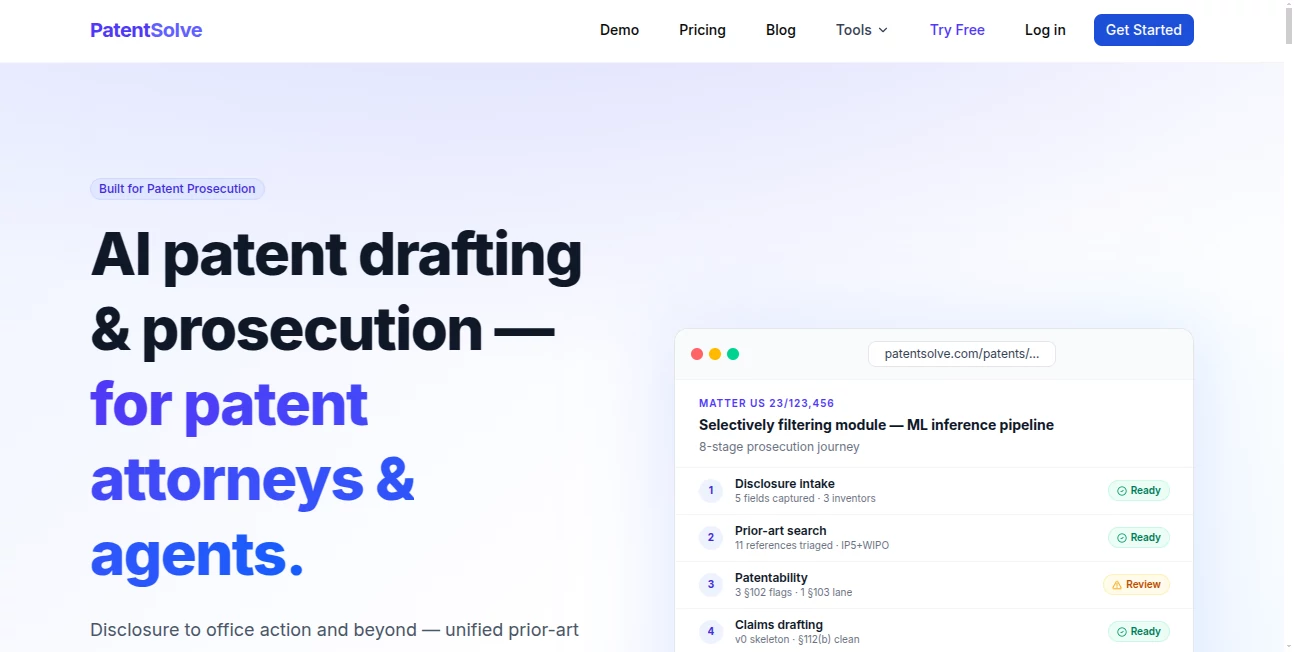
What is PatentSolve?
Preparing a response to a patent office action often demands hours of careful review, legal research, and document drafting. This platform streamlines that workflow by analyzing office actions, identifying every rejection, reviewing cited prior art, and creating a structured draft that professionals can review before filing. Instead of replacing legal expertise, it removes repetitive work so attorneys can focus on strategy and stronger arguments.
Key Features
User Interface
The workspace is clean and easy to navigate. Users simply upload an office action PDF, and the system organizes rejections, examiner information, cited references, and draft responses into a logical workflow. The layout makes reviewing complex cases much less overwhelming.
Accuracy & Performance
One of its strongest qualities is citation verification. References are checked against original documents to reduce mistakes, while AI-generated arguments are supported by verified legal sources. The analysis is completed within minutes, saving significant preparation time.
Capabilities
- Automatic office action analysis
- Prior art mapping and comparison
- Patent examiner insights
- AI-generated response drafts
- Claim amendment formatting
- OCR support for scanned PDFs
- Word document export
Security & Privacy
Uploaded files are protected with modern encryption during storage and transfer. The platform also states that customer data is not used to train AI models, making it suitable for handling confidential intellectual property documents.
Use Cases
- Preparing USPTO office action responses
- Reviewing prior art references
- Supporting patent attorneys during prosecution
- Reducing repetitive legal drafting tasks
- Improving productivity for patent law firms
Pros and Cons
- Pros
- Very fast document analysis
- Verified legal citations
- Useful examiner intelligence
- Well-organized response drafts
- Supports scanned documents
- Cons
- Designed mainly for USPTO practice
- Professional review is still required before filing
Pricing Plans
A free trial is available for first-time users. Additional options include pay-per-use pricing, a monthly Pro subscription, and Team plans for firms that manage larger patent workloads.
How to Use PatentSolve
Upload a patent office action PDF, allow the system to analyze the document, review the identified rejections and generated arguments, edit the response where needed, and export the completed document for filing.
Comparison with Similar Tools
Unlike general AI writing assistants, this solution focuses specifically on patent prosecution. It combines document analysis, examiner research, citation verification, and response drafting in one workflow, making it particularly valuable for intellectual property professionals.
Conclusion
For patent practitioners looking to reduce repetitive work without sacrificing quality, this platform offers an impressive balance of automation and professional control. It accelerates office action preparation while leaving final legal judgment where it belongs—with the attorney.
Frequently Asked Questions (FAQ)
Who is this platform designed for?
It is primarily intended for patent attorneys, agents, and intellectual property professionals.
Can it process scanned PDF files?
Yes. OCR technology allows scanned office actions to be analyzed automatically.
Are generated citations verified?
Yes. The platform validates citations against available source documents to improve reliability.
Does it replace legal review?
No. It creates a high-quality draft that should always be reviewed and finalized by a qualified professional.
Is there a free trial?
Yes. New users can test the service with a free analysis before choosing a paid plan.
AI Documents Assistant , AI Productivity Tools , AI Research Tool , AI Legal Assistant .
These classifications represent its core capabilities and areas of application. For related tools, explore the linked categories above.

PatentSolve Alternatives Product

MeetAssist

PDFgear

Speech Text

Futurwise

Creget

Luffy

YouTube Thum…

Odysseus AI

CtrlOps