
Penti
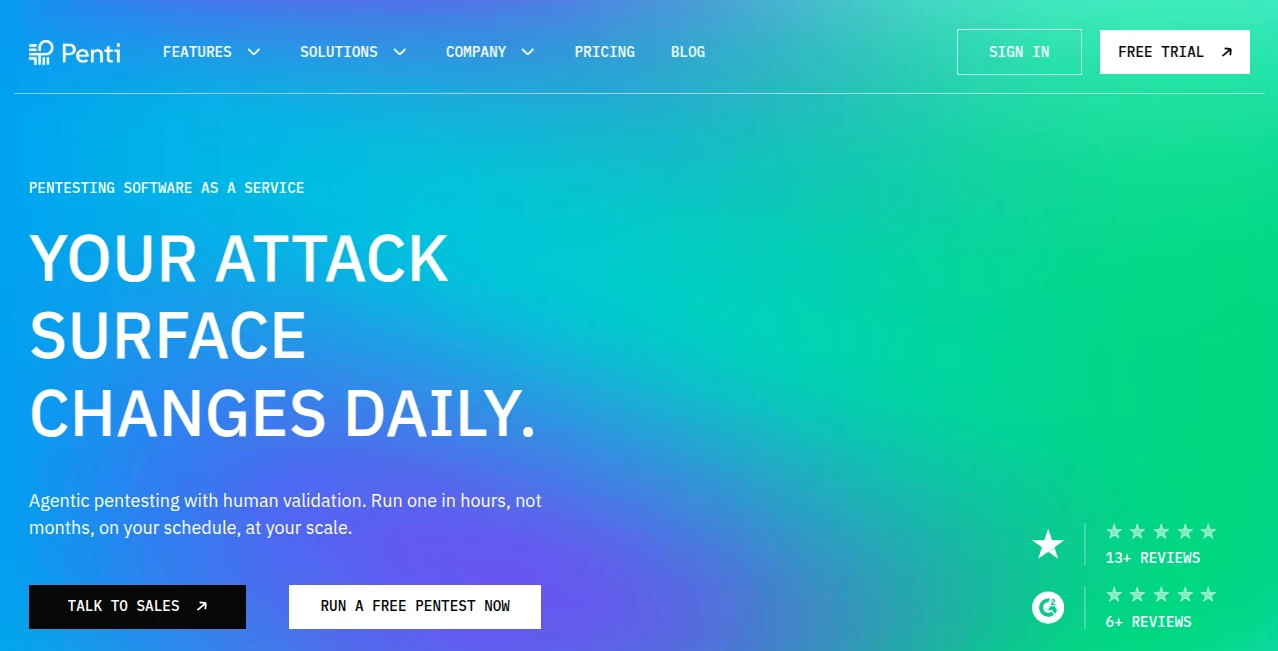
What is Penti?
Penti is an AI-powered penetration testing platform designed for companies that need to find real security weaknesses without waiting weeks for a traditional pentest. Its approach combines agentic AI with human security expertise, allowing teams to test web applications, APIs, cloud environments, networks, and other parts of their attack surface on a much more continuous basis.
The platform is particularly useful for SaaS companies, engineering teams, CISOs, CTOs, and organizations working toward security certifications or enterprise contracts. Instead of treating penetration testing as a once-a-year exercise, it brings security testing closer to the development and deployment process.
One of the most appealing aspects is the speed. Security tests can be launched within minutes, while findings can be prioritized and followed through remediation and retesting. For a growing company trying to close an enterprise deal, that difference can be significant.
Key Features
The platform brings several parts of the penetration testing process into one workflow. AI agents help map the attack surface, perform security tests, identify vulnerabilities, and prioritize the results. Certified security professionals can then validate important findings and provide additional context.
- Agentic AI penetration testing
- AI-driven vulnerability scanning
- Automated attack surface discovery and scoping
- Risk-based vulnerability prioritization
- Human validation of selected findings
- Video evidence for discovered vulnerabilities
- Remediation guidance
- Unlimited retesting on supported plans
- Audit-ready security reports
- Support for web applications, APIs, cloud environments, and networks
- Integration with development and security workflows
User Interface
The interface is designed around the concept of scope and assets rather than simply presenting users with a long vulnerability report. Assets can be organized according to their testing state, helping security and engineering teams understand what has already been tested, what is currently being tested, and what still needs attention.
This approach can make a noticeable difference for teams managing large environments. Instead of digging through several separate reports, users can maintain a clearer view of the assets that form their attack surface and track security testing as an ongoing process.
Accuracy & Performance
Automated security tools can sometimes produce large numbers of findings without making it clear which issues deserve immediate attention. The platform addresses this problem with AI-powered prioritization and false-positive verification designed to narrow large volumes of scan results down to more actionable security issues.
Its agentic testing model also goes beyond simply checking whether a vulnerability exists. AI agents can attempt exploits across the attack surface, while human security experts can validate important findings. This combination gives teams a more practical understanding of whether a reported issue represents a meaningful security risk.
The platform reports millions of findings processed and hundreds of endpoints tested, along with a reported reduction in false positives. These figures are presented by the provider and should be viewed as platform-reported performance metrics rather than independent benchmarks.
Capabilities
The platform is built to cover several stages of a modern penetration testing workflow. It can help discover and scope assets, test applications and infrastructure, prioritize vulnerabilities, provide remediation guidance, and verify fixes through retesting.
Another useful feature is video evidence for vulnerabilities. Rather than forcing developers to interpret a technical description alone, visual proof of an exploit can help demonstrate how an issue works and why it deserves attention.
For organizations preparing for compliance requirements, audit-oriented reporting is another important capability. Reports can be mapped to standards and frameworks including SOC 2, ISO 27001, HIPAA, and PCI DSS, depending on the service and plan selected.
Security & Privacy
Security testing naturally requires careful consideration of where testing takes place and how infrastructure is handled. The available plans include different deployment models, with higher-tier options supporting on-premises and hybrid testing. Enterprise environments can also be configured for more specialized infrastructure, including air-gapped environments.
The platform also supports integrations with security and development workflows, including Jira, GitHub, Vanta, MCP, API and CI/CD hooks, with additional options available depending on the subscription level.
Organizations should still review the provider's current security documentation, contractual terms, deployment requirements, and data-handling policies before connecting production infrastructure or sensitive environments.
Use Cases
A major use case is continuous security testing for SaaS companies. Rather than waiting for a scheduled annual penetration test, engineering teams can repeatedly test their changing attack surface and verify whether recently introduced changes created new risks.
It can also be valuable when a company is preparing for SOC 2, ISO 27001, HIPAA, or similar compliance requirements. Audit-ready reports and security evidence can help teams demonstrate that security testing is an active part of their operational process.
Another practical scenario is enterprise sales. When a prospective customer asks for penetration testing evidence or a security assessment before signing a contract, having current testing results can remove one of the common delays in the sales cycle.
For development teams, the remediation and retesting workflow is particularly useful. A developer can address a vulnerability and then have the affected asset tested again instead of relying solely on the original report.
Pros and Cons
- Pros: Fast deployment and testing, agentic AI penetration testing, human validation options, continuous security workflows, attack surface monitoring, detailed reporting, remediation guidance, and unlimited retesting on supported plans.
- Pros: Multiple deployment options make the service suitable for organizations with more demanding infrastructure requirements.
- Pros: Integrations with tools such as Jira, GitHub, Vanta, MCP, and CI/CD workflows can make security testing easier to fit into existing operations.
- Cons: Advanced capabilities are concentrated in higher-priced plans, which may make the platform less suitable for very small teams with limited security budgets.
- Cons: Automated penetration testing still requires careful configuration and review, especially when testing sensitive or production environments.
- Cons: Organizations looking specifically for a completely human-led penetration test may prefer the separate manual testing services instead of relying primarily on AI-driven testing.
Pricing Plans
The platform currently offers several subscription levels based on testing credits, AI model access, deployment requirements, integrations, and human validation.
- Starter – $20/month: Includes 20 credits per month, access to the budget AI model, cloud-based external testing, and agentic AI pentests.
- Launch – $300/month: Includes 300 credits per month, budget and standard model access, integrations such as Jira, GitHub, Vanta, and MCP, plus audit-grade reporting and a Cyber Success Team.
- Plus – $1,000/month: Includes 1,200 credits per month, on-premises and hybrid testing, three human-verified findings per year, and compliance readiness features.
- Advanced – $2,000/month: Includes 2,600 credits per month, access to budget, standard, and premium models, six human-verified findings per year, and dedicated support.
- Enterprise – Custom: Designed for complex infrastructure, air-gapped environments, customized integrations, larger credit requirements, advanced compliance needs, SAML/SSO, dedicated support, and SLA-based service.
Annual billing is available with a reported 10% saving on the standard subscription plans. Separate human-led penetration testing services are also available for organizations that require a fully scoped manual engagement.
How to Use It
Getting started is relatively straightforward. Begin by defining the assets or environments that need to be tested. The platform can then help discover and organize the reachable attack surface and establish the testing scope.
Once the scope is ready, launch a penetration test and allow the AI agents to investigate the selected assets. The resulting findings can be reviewed according to their severity and relevance rather than simply treating every scan result equally.
After vulnerabilities are identified, use the remediation guidance to determine the appropriate fix. Once changes have been implemented, retest the affected assets to confirm whether the vulnerability has actually been resolved.
For teams integrating security into their existing development process, connecting supported tools such as GitHub, Jira, Vanta, or CI/CD workflows can make the testing process more closely aligned with everyday engineering operations.
Comparison with Similar Tools
Traditional penetration testing services usually depend heavily on scheduled engagements, manual scoping, and dedicated testing periods. Automated vulnerability scanners, on the other hand, can operate continuously but may not provide the same depth of exploit validation or contextual analysis.
This platform sits between these approaches. Its agentic AI is designed to perform active penetration testing rather than simply scanning for known weaknesses, while human security professionals can validate important findings when required.
The biggest distinction is therefore the combination of automation, continuous testing, remediation workflows, reporting, and optional human involvement. For a company that needs frequent security verification without repeatedly organizing a large manual engagement, this model can be particularly attractive.
Conclusion
For organizations that have outgrown basic vulnerability scanners but do not want every security assessment to become a lengthy manual project, Penti offers a compelling alternative. Its combination of agentic AI, active penetration testing, human validation, remediation guidance, and compliance-focused reporting creates a practical workflow for modern security teams.
The strongest value comes from treating penetration testing as an ongoing process rather than an isolated event. Teams can test their changing attack surface, investigate meaningful vulnerabilities, fix them, and verify the results again. That makes the platform especially relevant to SaaS companies and businesses that need to demonstrate security maturity while continuing to move quickly.
Frequently Asked Questions (FAQ)
What is Penti used for?
It is used for AI-driven penetration testing, vulnerability discovery, attack surface assessment, security validation, remediation guidance, and compliance-oriented security reporting.
Does it use AI for penetration testing?
Yes. Agentic AI agents perform active security testing and attempt exploits across defined assets. Selected findings can also receive validation from certified security professionals.
Can it test web applications and APIs?
Yes. The platform supports security testing across web applications and APIs, along with cloud and infrastructure environments depending on the selected service and plan.
Does it support continuous security testing?
Yes. The service supports ongoing automated scanning, on-demand testing, attack surface monitoring, and retesting rather than limiting security assessments to a single annual engagement.
Are human penetration testers involved?
Human involvement is available through human-verified findings and separate expert pentesting services. Higher-tier plans include a defined number of human-verified findings, while fully scoped manual engagements are available separately.
Does it provide compliance reports?
Yes. Supported reporting can be aligned with frameworks and standards such as SOC 2, ISO 27001, HIPAA, and PCI DSS, depending on the selected plan and engagement.
Is there an enterprise option?
Yes. Enterprise plans are custom-sized for organizations with complex infrastructure, specialized deployment requirements, air-gapped environments, custom integrations, advanced compliance needs, and dedicated support.
Does it offer retesting?
Yes. Retesting is an important part of the workflow, allowing teams to verify whether vulnerabilities have been properly addressed after remediation.
What type of companies can benefit from it?
SaaS companies, technology businesses, engineering organizations, security teams, compliance-focused companies, and businesses selling to enterprise customers can benefit from continuous penetration testing and security validation.
Business , AI Testing & QA , AI Developer Tools , AI DevOps Assistant .
These classifications represent its core capabilities and areas of application. For related tools, explore the linked categories above.

Penti Alternatives Product

Mythx AI

Project Mela

Gemini Omni

AI Complianc…

DeepSeek

Tooladda

Fugte

DDS Gub

FurWall