
rctrl
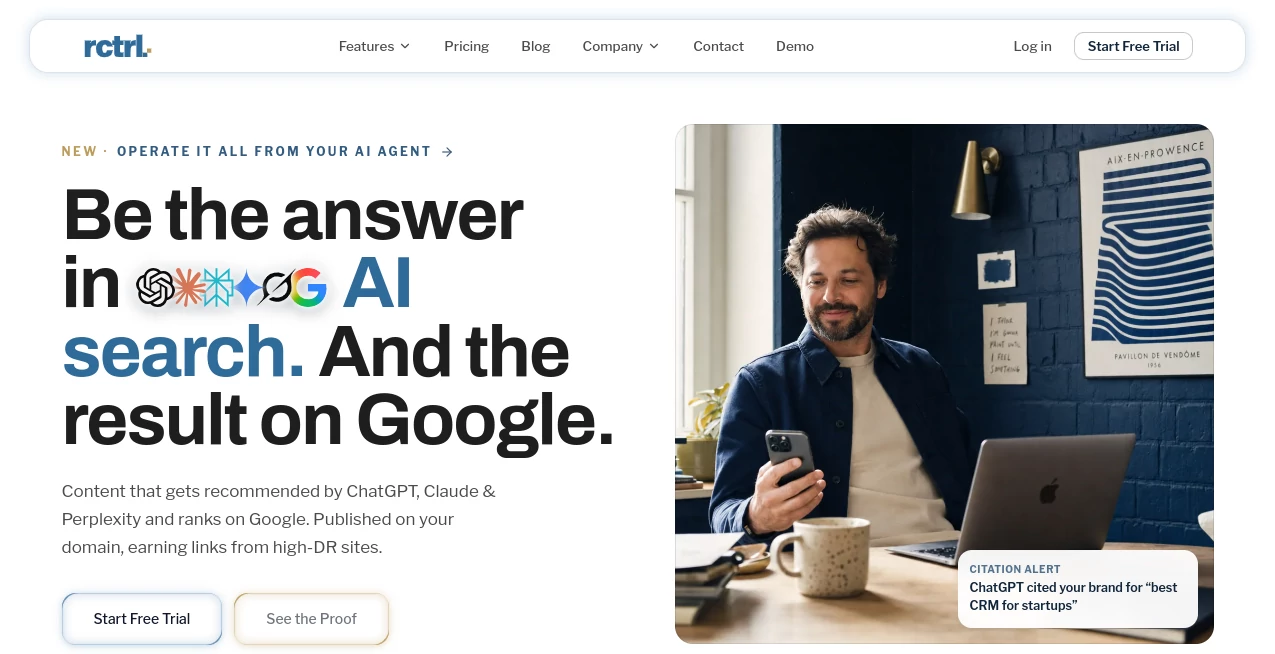
What is rctrl?
Search is changing quickly. People no longer rely only on traditional search results when researching products, comparing services, or looking for recommendations. AI assistants are increasingly becoming part of that journey, which means businesses need to think about visibility in both conventional search and AI-generated answers.
This platform is built around that shift. It combines SEO, AI search visibility, content creation, citation monitoring, competitor research, and publishing into one workflow. Instead of simply producing articles and hoping they perform, businesses can discover the questions their audiences ask, create content around those opportunities, publish it directly on their own domain, and monitor how AI systems respond.
The approach is particularly interesting for SaaS companies, agencies, startups, and growing brands that want their content to do more than attract traditional search traffic. The system is designed to help businesses become sources that AI search engines can discover, understand, and potentially cite.
For a growing company, this can remove a lot of the repetitive work normally involved in researching topics, planning content, publishing articles, monitoring competitors, and checking whether the brand is appearing in AI-generated answers.
Key Features
- AI search visibility monitoring across major AI search platforms
- Content research based on real buyer questions and search opportunities
- Seven specialized AI agents for research, planning, writing, publishing, and monitoring
- Brand-matched content based on the company's existing website
- Competitor tracking across AI search results
- Real-time citation and mention alerts
- Native content publishing directly to the company's domain
- 27 supported content formats
- AI-assisted outreach for link-building opportunities
- Lead attribution from AI and traditional search
- Analytics for traffic, rankings, and AI crawler activity
- Approval workflows before content is published
User Interface
The interface is designed around a workflow rather than a collection of disconnected SEO reports. Users can move from setup and competitor research to content creation, approval, publishing, and monitoring without constantly switching between separate services.
One particularly useful element is the visibility into what the AI agents are doing. Instead of hiding the automation behind a single button, the platform provides an audit trail so users can see the activity taking place throughout the content pipeline.
The approval process also gives teams control over what reaches their website. Drafts can be reviewed before publication, which is valuable for companies that have specific editorial standards or need human approval for brand-sensitive content.
Accuracy & Performance
The platform takes a broader approach to search performance than simply watching keyword positions. It monitors mentions and citations across AI search environments while also keeping an eye on conventional Google performance.
Its research process looks at the questions potential customers are asking and identifies topics with stronger opportunities. The content engine can then turn those findings into longer-form guides designed around the information AI systems and search engines may use when forming answers.
Performance is also easier to evaluate because traffic, rankings, AI crawling activity, and citation data can be viewed together. The platform states that customers can begin seeing AI mentions within a few weeks, while Google traffic can begin developing over a longer period as published content and authority accumulate.
Capabilities
The system covers several stages of an organic growth strategy. It can analyze a company's website to understand its brand identity, products, tone, and competitors. It can track up to 10 competitors and organize topics according to their potential opportunity.
Once topics are selected, the content workflow can produce brand-matched articles in multiple formats. Approved content can then be published as native posts on supported content management systems, helping businesses retain the SEO value of their own domain rather than placing articles on an external subdomain.
There is also a dedicated monitoring layer for AI visibility. Users can track how their brand appears across ChatGPT, Perplexity, Claude, Gemini, Grok, and Google AI Mode, while citation signals can highlight when an AI engine mentions the company or one of its competitors.
For teams focused on growth, integrations with platforms such as WordPress, HubSpot, Webflow, Slack, Google Analytics, Search Console, Salesforce, Zapier, n8n, Meta, and Make can connect the workflow with an existing marketing and sales stack.
Security & Privacy
Businesses often hesitate to automate content because they want to retain control over what is published. The approval workflow addresses part of that concern by keeping publication under human control rather than automatically sending every generated article live.
The platform also provides an audit trail of agent activity, giving teams greater visibility into the actions performed throughout the automated workflow. For companies connecting analytics, CRM, or publishing systems, it is still sensible to review the permissions and data access of each integration before connecting a production environment.
Use Cases
SaaS companies: SaaS teams can use the platform to identify buyer questions, create educational content, monitor competitor visibility, and discover where their brand is being cited by AI search systems.
Startups: Early-stage companies often have limited marketing resources. Automating research, content planning, publishing, and monitoring can help a small team maintain a consistent search strategy without building a large internal SEO operation.
Marketing teams: Established marketing departments can use the centralized workflow to combine traditional SEO reporting with AI visibility data and content production.
Agencies: Agencies managing several brands can benefit from brand-specific content workflows, competitor monitoring, approval processes, and integrations with common marketing platforms.
Businesses entering AI search: Companies that already perform reasonably well on Google but rarely appear in AI-generated recommendations can use the additional visibility layer to understand where the gap exists.
Pros and Cons
- Pros: Combines SEO and AI search visibility in one platform.
- Pros: Content is published directly on the customer's domain.
- Pros: Provides monitoring for several major AI search platforms.
- Pros: Human approval remains part of the publishing workflow.
- Pros: Competitor citation tracking can reveal missed opportunities.
- Pros: Multiple integrations make it easier to fit into an existing marketing stack.
- Cons: The platform is primarily aimed at businesses with an ongoing content and SEO strategy.
- Cons: Companies looking only for a simple keyword tracker may find the wider feature set unnecessary.
- Cons: The strongest results depend on publishing useful content consistently rather than simply activating the automation.
Pricing Plans
The platform currently promotes a single all-inclusive subscription rather than several complicated software tiers. The listed standard price is $400 per month, and a 30-day free trial is available with no payment due at the start of the trial.
The subscription includes seven AI agents, up to 100 published pages per month, two content hubs per month, tracking for 50 queries, monitoring across six AI search environments, intent-scored lead capture, and white-glove setup.
Businesses that want additional strategic support can also add a dedicated strategist for $1,500 per month. Pricing and included limits can change, so users should verify the current offer before subscribing.
How to Use the Platform
Getting started follows a relatively straightforward process. First, connect the website and provide the information needed to establish the company's brand profile. The system can then analyze the site's tone, products, and competitive landscape.
Next, the research process identifies questions and topics that matter to potential customers. Competitors can be tracked at the same time, making it easier to see which subjects represent opportunities.
After the content plan is prepared, the writing agents create drafts based on the selected opportunities. Users can review, comment on, and approve the material before anything is published.
Approved articles are published as native posts through the connected CMS. From there, the monitoring tools track search performance, AI citations, competitor mentions, and incoming leads.
A practical workflow might look like this: a SaaS company discovers that potential customers repeatedly ask AI assistants for recommendations in its category. The team identifies those queries, builds useful guides around the underlying questions, reviews the drafts, publishes them on its own domain, and then watches to see whether AI systems begin referencing the brand.
Comparison with Similar Tools
Traditional SEO platforms generally focus on keyword rankings, backlinks, technical issues, and organic traffic. AI visibility platforms take a different angle by examining how brands appear inside AI-generated answers and citations.
This platform sits between those two approaches. It does not treat AI search as a completely separate marketing channel. Instead, it connects AI visibility with content creation, traditional SEO, backlinks, analytics, and lead attribution.
Another distinction is the publishing model. Some content platforms host material separately or provide content without directly managing the publishing workflow. Here, approved articles can be delivered as native posts on the customer's existing website, allowing the company to keep its domain and associated SEO value.
The result is more suitable for teams looking for an end-to-end content growth system than for users who only need a standalone keyword research or rank-tracking application.
Conclusion
AI search has created a new visibility challenge for businesses. Ranking well on Google is still important, but it is no longer the only place where potential customers discover brands. Being mentioned, recommended, and cited inside AI-generated answers can become an important part of the customer journey.
This platform offers a practical response to that change by bringing research, content production, publishing, AI visibility monitoring, competitor analysis, link outreach, and lead attribution into one workflow.
Its biggest strength is the connection between these pieces. Instead of checking rankings in one dashboard, writing content somewhere else, publishing manually, and searching AI answers by hand, teams can manage much of the process from a single system while retaining control over publication.
For businesses serious about building long-term visibility across both traditional and AI-driven search, it is a compelling option worth exploring, particularly if the goal is to turn content into a repeatable acquisition channel rather than simply maintain a company blog.
Frequently Asked Questions (FAQ)
What does this platform do?
It helps businesses improve visibility across traditional search engines and AI search platforms by researching opportunities, creating content, publishing it on their own domain, and monitoring rankings and AI citations.
Which AI search platforms are monitored?
The platform states that it monitors ChatGPT, Perplexity, Claude, Gemini, Grok, and Google AI Mode, alongside traditional Google search performance.
Can I approve content before it is published?
Yes. Content passes through an approval workflow, allowing users to review and approve drafts before they become live posts.
Does the content appear on my own website?
Yes. Approved articles can be published as native posts on the customer's domain through supported CMS integrations rather than being hosted on a separate subdomain.
How many competitors can be tracked?
The setup process supports tracking up to 10 competitors, allowing businesses to compare their AI visibility and identify citation gaps.
Is there a free trial?
Yes. The current offer includes a 30-day free trial, with no payment due at the beginning of the trial.
Does it work with WordPress?
Yes. WordPress is one of the supported integrations, and the platform states that its plugin setup can be completed in approximately five minutes without requiring code changes.
AI SEO Assistant , AI Content Generator , AI Analytics Assistant , AI Marketing Plan Generator .
These classifications represent its core capabilities and areas of application. For related tools, explore the linked categories above.

rctrl Alternatives Product

SnapVee Stud…

Liftburst

Domain Rank …

KoloQR

Japanese Nam…

PostingCat

SocialRails

InspiroBot

Meev