
Salt Agentic AI
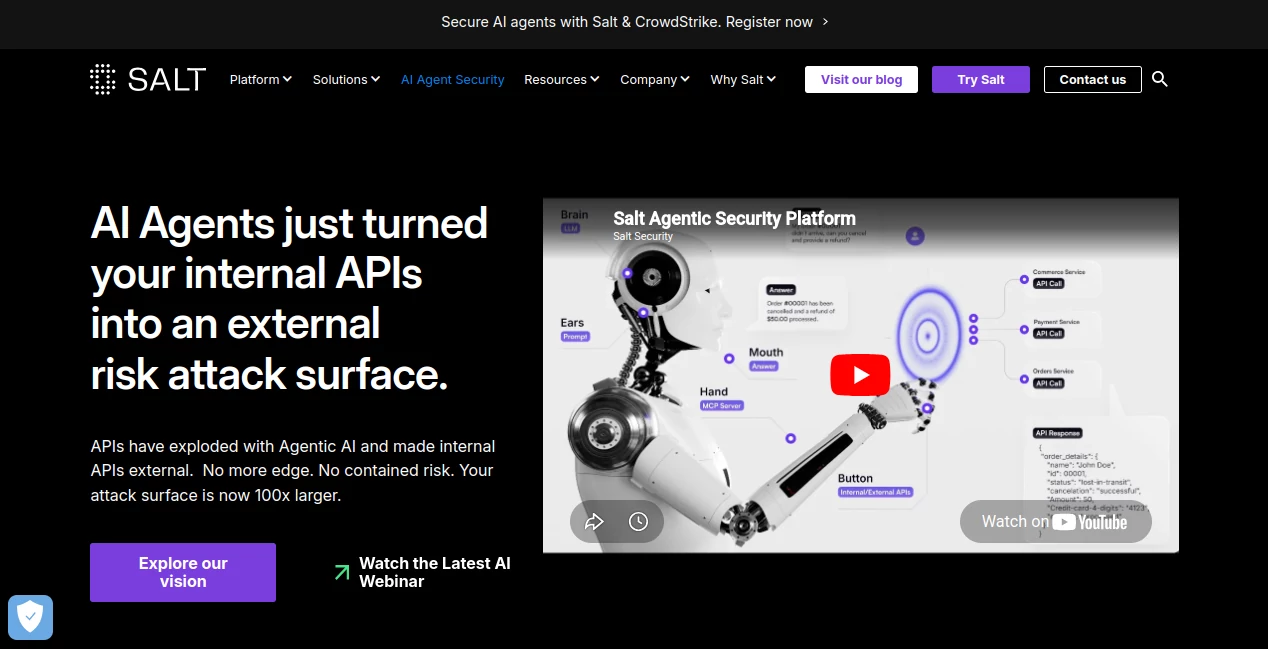
What is Salt Agentic AI?
The rise of autonomous AI systems has transformed how businesses automate workflows, access data, and connect applications. As organizations deploy increasingly capable agents, a new challenge emerges: understanding and controlling what these systems can actually do inside enterprise environments. Traditional security tools were designed for human users and external threats, but modern AI-driven interactions often operate deep within internal networks, creating risks that are difficult to detect.
This platform addresses that challenge by focusing on the operational layer of AI. Instead of concentrating solely on language models and prompts, it provides visibility into the APIs, integrations, workflows, and infrastructure that power autonomous systems. By helping organizations discover, govern, and protect their expanding AI ecosystem, it offers a practical path toward safer AI adoption at scale.
Many enterprises struggle to map the growing network of agents, APIs, MCP servers, and connected services operating behind the scenes. This solution brings those components together into a unified security framework, enabling teams to understand how AI systems interact with sensitive data and critical business processes.
Key Features
User Interface
The platform delivers a centralized dashboard designed for security teams, cloud architects, and compliance professionals. Visual mapping capabilities help organizations understand relationships between AI agents, APIs, connected tools, and enterprise systems. Instead of navigating multiple monitoring tools, users can access a consolidated view of their entire AI-driven infrastructure.
Interactive visualizations make it easier to identify hidden connections, shadow services, and previously unknown integrations. This visibility significantly reduces the complexity of managing rapidly expanding AI deployments.
Accuracy & Performance
Continuous discovery mechanisms automatically identify APIs, MCP servers, AI-driven integrations, and autonomous workflows operating across enterprise environments. Real-time monitoring ensures that security teams receive timely insights into emerging risks, abnormal behavior, and policy violations.
The platform excels at analyzing behavioral patterns rather than relying solely on signature-based detection. This approach enables more accurate identification of misuse, unauthorized access attempts, and business logic abuse that might bypass conventional security controls.
Capabilities
Organizations gain access to a broad range of security and governance capabilities designed specifically for AI-powered environments.
- Automatic discovery of AI agents and connected APIs
- Mapping of relationships across enterprise AI infrastructure
- Detection of shadow, rogue, and dormant APIs
- Posture management for AI-driven systems
- Risk analysis across agent interactions
- Real-time threat detection and response
- Governance and compliance monitoring
- Visibility into sensitive data exposure pathways
- Behavioral analysis of AI-generated activity
- Runtime protection against misuse and abuse
Security & Privacy
Security is the core foundation of the platform. Rather than treating AI as a standalone technology, it examines the broader ecosystem that allows agents to access enterprise resources. This includes monitoring API activity, tracking permissions, evaluating configurations, and identifying excessive privileges.
Continuous posture management helps organizations discover vulnerabilities before attackers exploit them. Runtime protection further enhances security by monitoring interactions in real time and identifying suspicious actions that may indicate data exfiltration, unauthorized access, or compromised workflows.
For enterprises operating in regulated industries, governance capabilities provide additional confidence by supporting compliance efforts and improving accountability across AI-driven operations.
Use Cases
- Securing enterprise AI agent deployments
- Monitoring API activity generated by autonomous systems
- Managing AI governance and compliance requirements
- Discovering shadow APIs and forgotten integrations
- Protecting sensitive business data from exposure
- Reducing risks associated with MCP server configurations
- Improving visibility across AI-powered workflows
- Supporting large-scale AI adoption initiatives
- Detecting unusual behavior across connected systems
- Strengthening enterprise cybersecurity programs
Pros and Cons
Pros
- Purpose-built for emerging AI security challenges
- Excellent visibility into complex AI ecosystems
- Strong API discovery and monitoring capabilities
- Real-time detection and response features
- Useful governance and compliance tools
- Scales effectively for enterprise environments
- Comprehensive posture management functionality
Cons
- Primarily designed for enterprise organizations rather than small teams
- Advanced security concepts may require specialized expertise
- Custom deployment requirements can vary by environment
- Pricing information is not publicly transparent
Pricing Plans
Pricing details are not publicly listed. Organizations interested in implementation typically need to request a demonstration and consult with the sales team to receive customized pricing based on infrastructure size, deployment complexity, and security requirements.
How to Use Salt Agentic AI
Getting started generally begins with connecting enterprise environments to the platform. Once integrated, automated discovery scans identify APIs, AI agents, MCP servers, and related services across the organization.
After discovery is complete, security teams can review the generated infrastructure map, analyze risk exposure, and establish governance policies. Continuous monitoring then tracks activity in real time, while posture management tools identify misconfigurations and excessive permissions.
As AI adoption expands, teams can use the platform to maintain visibility, enforce security controls, and respond quickly to suspicious behavior before incidents escalate.
Comparison with Similar Tools
Many AI security products focus primarily on model protection, prompt security, or content filtering. While these capabilities are valuable, they often overlook the broader operational environment where AI agents interact with business systems.
This platform differentiates itself by concentrating on the entire ecosystem surrounding autonomous AI operations. It combines API security, governance, discovery, posture management, and runtime protection into a unified framework. For organizations seeking visibility beyond the model layer, this broader perspective provides a significant advantage.
Compared to traditional API security solutions, the platform introduces AI-specific context that helps security teams understand how autonomous systems interact with enterprise resources and where risks may emerge over time.
Conclusion
As autonomous AI systems become deeply integrated into business operations, security strategies must evolve beyond conventional approaches. Organizations need visibility into the infrastructure, APIs, workflows, and permissions that empower AI agents to act.
This platform delivers a comprehensive approach to securing modern AI ecosystems. By combining discovery, governance, posture management, and real-time protection, it helps enterprises adopt AI confidently while maintaining control over critical systems and sensitive data.
For security-conscious organizations planning large-scale AI deployments, it represents a forward-thinking solution built specifically for the realities of agent-driven environments.
Frequently Asked Questions (FAQ)
What is the primary purpose of this platform?
Its primary goal is to secure AI-driven environments by providing visibility, governance, and protection across agents, APIs, MCP servers, and connected enterprise systems.
Who is the ideal user?
Enterprise security teams, cloud architects, compliance professionals, and organizations deploying autonomous AI systems can benefit the most.
Does it monitor API activity?
Yes. API discovery, monitoring, risk analysis, and runtime protection are among its core capabilities.
Can it identify shadow APIs?
Yes. The platform continuously discovers hidden, forgotten, and unmanaged APIs operating within enterprise environments.
Is it suitable for compliance-focused organizations?
Yes. Governance and posture management features help organizations strengthen compliance efforts and improve operational oversight.
Does it provide real-time threat detection?
Yes. Behavioral analysis and runtime monitoring help identify suspicious activities, misuse, and potential attacks as they occur.
AI API Design , AI Developer Tools .
These classifications represent its core capabilities and areas of application. For related tools, explore the linked categories above.
Salt Agentic AI details
Website unavailable — View Alternatives
Pricing
- Free
Apps
- Web App
Categories

Salt Agentic AI Alternatives Product

LocaFlow

Sendmux

Workik

cznull

GOLANG COLLE…

Layven

LPM 1.0

Empiriolabs …

Standard Com…