
Pokex
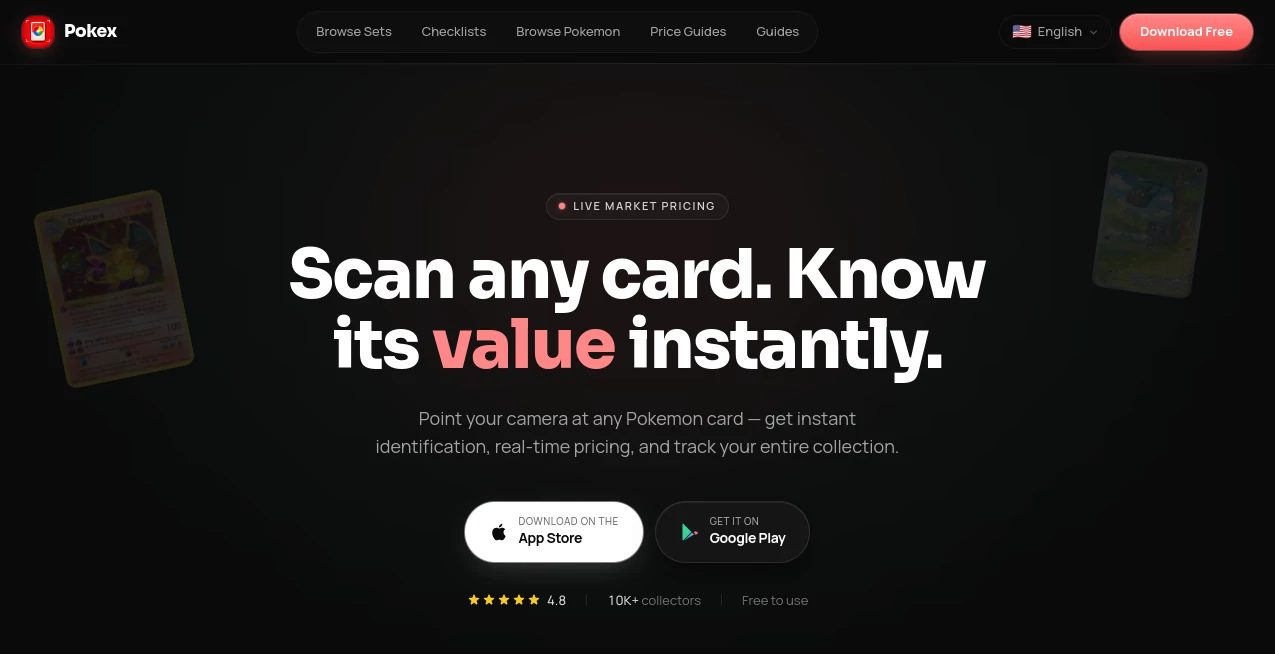
What is Pokex?
Pokex makes collecting Pokémon cards much easier by turning a phone camera into a fast card identification and price-checking tool. Instead of typing a card name, searching through set lists, and trying to match different versions manually, collectors can simply point their camera at a card and let the AI identify it.
The app is designed for both experienced collectors and people who have recently rediscovered an old binder. It can recognize cards from more than 100 Pokémon sets and provides information such as the card name, set, variant, rarity, and current market value. With more than 10,000 collectors and a reported 4.8-star rating, it offers a convenient way to turn a pile of cards into an organized digital collection.
One particularly useful feature is the combination of identification and pricing. After finding a card, users can immediately check its market value and decide whether it is worth keeping, trading, selling, or adding to a collection.
Key Features
- AI-powered Pokémon card recognition.
- Identification in seconds using a phone camera.
- Support for more than 100 Pokémon card sets.
- Recognition of cards with dust, fingerprints, or some glare.
- Live market pricing information.
- Pricing for different card variants, including normal, foil, and reverse holo versions.
- Seven-day and 30-day price trends.
- Unlimited collection organization with the Pro upgrade.
- Collection value tracking.
- Set completion tracking.
- Camera scanning and gallery photo imports.
- Support for cards ranging from the original Base Set to newer expansions.
User Interface
The experience is built around a simple scanning workflow rather than a complicated collection-management dashboard. Users can take a picture of a card or select an existing image from their gallery, wait for the recognition process, and then review the result.
This straightforward approach is particularly useful when working through a large binder. There is no need to remember set symbols or card numbers before starting. The app handles the identification process and presents the relevant information in one place.
Accuracy & Performance
Speed is one of the strongest parts of the experience. Card recognition generally takes less than a second, making it practical to work through several cards in a short session. The recognition system is designed to handle everyday imperfections such as fingerprints, dust, and moderate glare.
Lighting can still affect any camera-based recognition system, especially when photographing holographic cards. A small change in the camera angle can help when reflections make details difficult to see. For collectors cataloging hundreds or thousands of cards, the ability to scan repeatedly without manually entering card information can save a considerable amount of time.
Capabilities
Recognition is only the starting point. Once a card has been identified, users can view its name, Pokémon, set, card number, rarity, variant information, and current market value. Pricing data is sourced from TCGPlayer and other trusted sources, with different versions of a card taken into account.
The collection tools add another useful layer. Cards can be saved into collections, while total collection value can be monitored over time. Set tracking also gives collectors a quick way to see which cards they already own and how close they are to completing a particular expansion.
For someone sorting through an old childhood collection, this can be especially helpful. A forgotten binder can quickly become a searchable inventory, making it easier to spot duplicates, valuable cards, and incomplete sets.
Security & Privacy
The service states that collection data is securely stored and synchronized across devices and that personal information is not shared. This is useful for collectors who want their inventory available on more than one device while keeping their collection information connected to their account.
As with any digital collection service, users should still review the current privacy policy and app permissions before adding personal information or granting camera and storage access.
Use Cases
- Cataloging large collections: Scan cards one after another instead of entering card names manually.
- Checking old collections: Quickly identify cards from childhood binders and older collections.
- Price checking: See current market values before buying, selling, or trading.
- Card shows and trading events: Identify unfamiliar cards and check their market values while browsing.
- Collection management: Keep scanned cards organized and monitor the overall value of a collection.
- Set completion: Track progress across individual Pokémon expansions.
- Sorting duplicates: Identify duplicate cards and decide which ones to trade or sell.
- Photo-based identification: Import existing card photographs instead of using the camera directly.
Pros and Cons
Pros
- Very fast card recognition.
- Simple camera-first workflow.
- Supports more than 100 Pokémon sets.
- Provides market pricing alongside identification.
- Recognizes multiple card variants.
- Collection value tracking is useful for serious collectors.
- Supports both live camera scans and gallery images.
- Free to download and available on iOS and Android.
Cons
- Strong reflections on holographic cards can still make scanning more difficult.
- Advanced features such as unlimited scanning and full collection value tracking require the Pro upgrade.
- Market prices can change, so displayed values should be treated as current estimates rather than guaranteed selling prices.
Pricing Plans
The app is free to download and offers free scans so new users can test the experience without committing to a subscription. The Pro upgrade adds unlimited scanning, price trends, and full collection value tracking.
The free option makes it easy for casual collectors to try the recognition system first, while the Pro plan is more appropriate for people who regularly catalog large collections or want deeper tracking features. Since market values change frequently, the pricing information shown inside the app is best used as a reference when evaluating cards.
How to Use
- Download the mobile app on iOS or Android.
- Open the scanning feature.
- Point the phone camera at a Pokémon card or select an existing card photo from the gallery.
- Allow the AI to process the image and identify the card.
- Review the card name, set, variant, rarity, and market information.
- Check the current price and available price trends.
- Add the card to a collection if you want to keep track of it.
- Continue scanning additional cards to build a complete digital inventory.
Comparison with Similar Tools
Traditional card databases are useful when you already know exactly what you are looking for, but manual searching can become tedious when dealing with a large collection. A dedicated scanning solution takes a different approach: the physical card becomes the starting point.
Compared with manually entering card names and set numbers, camera recognition is considerably faster for bulk cataloging. The combination of identification, market pricing, collection tracking, and set progress also means collectors do not necessarily need to switch between several different resources for every card.
For casual collectors, the biggest advantage is convenience. For serious collectors, the real value comes from being able to turn thousands of physical cards into an organized inventory without spending hours entering information by hand.
Conclusion
Pokex is a practical choice for anyone who wants a faster way to identify Pokémon cards and understand what their collection may be worth. Its strongest feature is the simple scan-and-check workflow: take a picture, identify the card, review its market value, and save it to a collection.
The combination of AI recognition, current pricing, collection management, and set tracking gives the app a useful role beyond basic card identification. Whether someone is sorting through an old binder, preparing cards for a trade, or maintaining a large collection, the ability to scan cards in seconds can remove much of the repetitive work involved in cataloging.
For collectors who have ever looked at a card and wondered, “What is this one worth?”, this is the kind of tool that can make finding the answer considerably easier.
Frequently Asked Questions (FAQ)
Is the app free to use?
Yes. The app is free to download and provides free scans for trying the service. A Pro upgrade is available for unlimited scanning, price trends, and full collection value tracking.
How quickly can a Pokémon card be identified?
Card recognition generally takes less than a second in normal conditions, making the service suitable for scanning multiple cards in succession.
Can I scan cards from existing photos?
Yes. In addition to using the phone camera, users can import card photographs from their device gallery. This is useful when cards have already been photographed for listings or personal records.
Does it show the current value of a card?
Yes. The app provides market pricing sourced from TCGPlayer and other trusted sources. It also supports different variants such as normal, foil, and reverse holo cards and provides seven-day and 30-day price trends.
Which Pokémon sets are supported?
The service supports more than 100 Pokémon sets, covering cards from the original Base Set through newer expansions, with additional sets continuing to be supported.
Can I track the value of my entire collection?
Yes. Users can create collections, add identified cards, and monitor the total collection value. The full collection value tracking functionality is included with the Pro upgrade.
Does it work with cards that have some wear or glare?
The recognition system is designed to work with common imperfections such as dust, fingerprints, and some glare. Strong reflections, particularly on holographic cards, can still interfere with image recognition, so changing the viewing angle may help.
Is my collection data secure?
The service states that collection data is securely stored and synchronized across devices and that personal information is not shared.
These classifications represent its core capabilities and areas of application. For related tools, explore the linked categories above.
Pokex details
Website unavailable — View Alternatives
Pricing
- Freemium
Apps
- iOS App
- Android App
Categories

Pokex Alternatives Product

Reverse Imag…

Image Descri…

FaceSwaply

labgen

Where Is Thi…

ImgEnhancer

AI Image Enh…

Denoisr

Instantly Id…