
Neogenio
What is Neogenio?
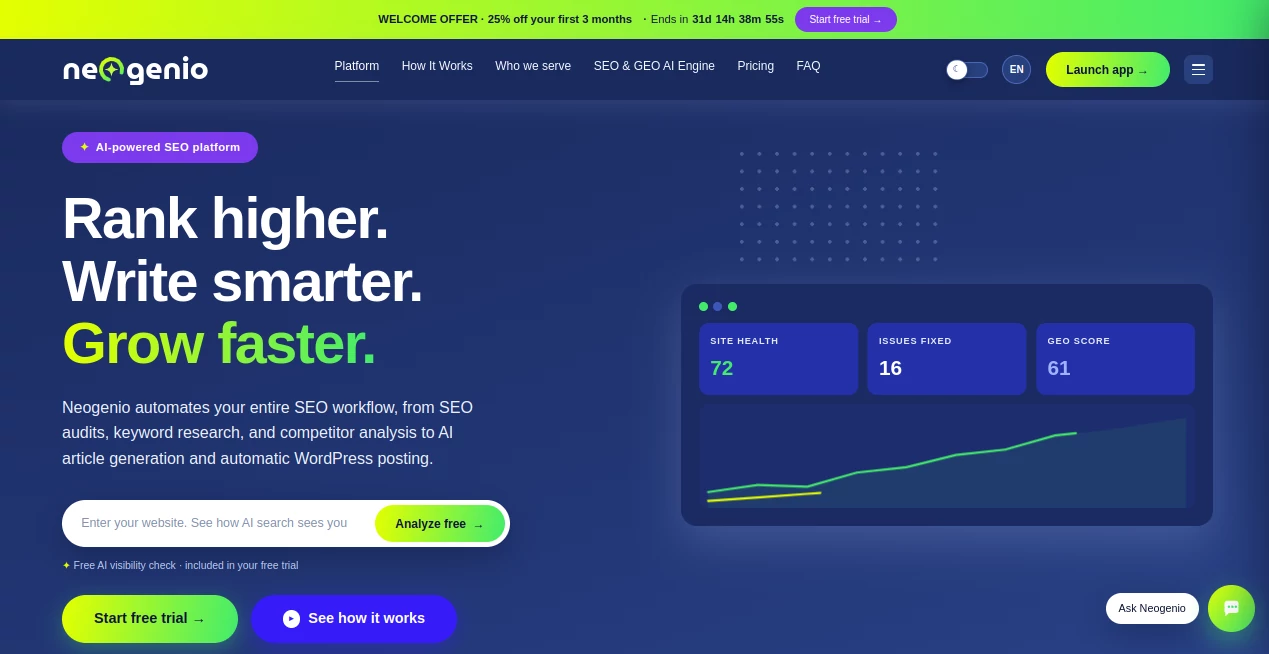
SEO can become complicated surprisingly quickly. Keyword research lives in one tool, competitor analysis in another, content writing somewhere else, and publishing still requires a trip into WordPress. Neogenio brings these pieces together into a single AI-powered SEO workflow designed for businesses, marketers, content teams, and agencies.
The platform covers the journey from discovering valuable keywords to creating optimized articles and publishing them to WordPress. It also goes beyond traditional SEO by adding AI search visibility, GEO scoring, citation tracking, and tools for understanding how systems such as ChatGPT, Gemini, and Perplexity interpret a website.
What makes the approach particularly practical is the level of control retained by the user. Articles can be reviewed before publication, while WordPress remains the final source of truth. For someone managing a content-heavy website, that can remove a lot of repetitive work without turning the publishing process into a completely hands-off operation.
Key Features
- AI-powered keyword research and keyword clustering
- SERP and competitor analysis
- AI article generation with SEO-focused structures
- Meta title and meta description generation
- FAQ schema and structured content
- Internal linking recommendations
- SEO and GEO audits with automated fixes
- AI search visibility and GEO scoring
- AI-generated images and brand color controls
- Direct WordPress publishing without requiring a plugin
- Rank tracking and SEO performance monitoring
- Content refresh and rewriting tools
- Support for six languages
User Interface
The platform is organized around a clear SEO workflow rather than a collection of disconnected utilities. Users can move from keywords to clusters, from clusters to articles, and then from finished content to WordPress publishing.
The workflow is especially appealing for people who prefer seeing the entire content process in one workspace. Projects can contain keyword information, content plans, SEO data, generated articles, and publishing details, making it easier to understand why an article is being created before spending time writing it.
For agencies, the workspace becomes even more useful. The Agency plan supports multiple websites and users, team roles, client management, brand voices, and branded reports. That makes the platform suitable for teams handling SEO across several client accounts rather than just a single website.
Accuracy & Performance
SEO content is only useful when it is connected to real search intent. The platform addresses this by analyzing keywords according to factors such as search intent, search volume, and difficulty, while SERP analysis helps reveal the type of content already performing for a particular query.
Generated articles are also evaluated before publication. The SEO engine checks elements such as content quality, keyword coverage, structure, readability, and alignment with search intent. This provides a useful second layer of review instead of treating generated text as automatically ready for publication.
Its GEO features add another dimension. Users can monitor how visible and quotable their content may be to AI systems, alongside conventional SEO measurements. For publishers adapting to AI-driven search, this is a valuable addition to a standard optimization workflow.
Capabilities
The strongest part of the platform is the connection between its individual capabilities. A user can import keywords, organize them into topical clusters, analyze search results, create a content structure, generate a complete article, identify internal linking opportunities, and send the finished draft to WordPress.
Content generation includes headings, metadata, semantic keywords, FAQs, and internal link suggestions. The system can also refresh existing content when an older page needs improvement rather than creating a completely new article.
Brand consistency is another thoughtful feature. Brand colors can be extracted from a website or logo and used with generated visuals, while writing-style controls help keep generated content closer to an established editorial identity.
The WordPress connection is also straightforward. It uses the standard WordPress REST API, so there is no plugin installation or site migration required. Content can be transferred with categories, tags, featured images, formatting, and SEO metadata, while drafts remain under the user's control before going live.
Security & Privacy
The platform is designed to work with WordPress without requiring users to install an additional plugin. For WordPress connections, it stores an application password rather than the user's main WordPress login password. According to the product documentation, that credential is encrypted at rest and can be revoked from WordPress when needed.
The publishing workflow also provides an important safety layer: generated content is sent as a draft and requires approval before publication. This is useful for businesses that want automation without giving an AI system unrestricted editorial control over their website.
Use Cases
SEO teams: SEO professionals can use the platform to move from keyword discovery and SERP research into content production and rank tracking without constantly switching between separate applications.
Content marketers: Marketing teams can build topical clusters, generate article drafts, refresh existing pages, and maintain a consistent writing style while keeping editorial approval in their own hands.
Small businesses: Businesses without a dedicated SEO department can use the platform to handle much of the research and content workflow internally instead of outsourcing every SEO task.
Agencies: Agencies managing several clients can benefit from multi-site management, separate projects, team roles, brand voices, and white-label reporting available with the Agency plan.
WordPress publishers: Website owners who already rely on WordPress can connect their site directly and transfer prepared content without installing another plugin.
International websites: Support for English, Romanian, German, French, Spanish, and Italian makes the platform useful for businesses publishing content across multiple language markets.
Pros and Cons
- Pros: Combines keyword research, content generation, SEO auditing, GEO analysis, rank tracking, and WordPress publishing in one workflow.
- Pros: Includes keyword clustering and SERP analysis instead of focusing only on AI writing.
- Pros: Supports AI search visibility and GEO scoring for modern search environments.
- Pros: WordPress publishing works through the native REST API without requiring a plugin.
- Pros: Articles remain drafts until the user approves them.
- Pros: Includes brand controls, internal linking, content refresh, and AI image generation.
- Cons: The platform is primarily designed around SEO and content workflows, so users looking for a general-purpose AI assistant may find its scope more specialized.
- Cons: Plans are designed around professional and business use, so they may be less suitable for people who only need occasional SEO content.
Pricing Plans
Neogenio does not offer a free tier. Paid plans start at €35 per month, with different options designed around the amount of SEO and content work a business or professional needs to handle.
A seven-day free trial is available, allowing potential customers to test the platform before committing to a paid subscription. No credit card is required to start the trial.
- Starter: €35 per month, designed for individuals and small businesses that need a complete SEO and content workflow.
- Advanced: €65 per month, aimed at growing businesses that require greater content and SEO capacity.
- Pro: €89 per month, positioned for professionals and teams that need higher usage limits and additional capacity.
- Agency: €269 per month, designed for agencies managing multiple client websites and users, with features such as team roles, multi-site management, client management, brand voices, and branded reports.
Annual billing can reduce the overall cost compared with monthly billing. The plans provide access to the platform's core SEO and AI capabilities, while usage limits and available capacity vary according to the selected plan.
How to Use Neogenio
Start by creating a project and importing existing keyword lists or researching new opportunities. Organize the keywords according to their search intent and other relevant metrics, then use AI clustering to group related queries into meaningful content topics.
Next, select a cluster and build an article around it. The platform can generate an SEO-focused article with metadata, FAQs, and internal linking suggestions. You can also apply your brand preferences and generate supporting imagery.
Before publishing, review the article and its SEO score. When everything looks right, connect the WordPress website and send the content directly to WordPress. The article can arrive as a draft with its categories, tags, featured image, formatting, and SEO metadata prepared for review.
Once content is published, rank tracking and SEO monitoring can help you follow its performance over time. This creates a useful loop: research, publish, measure, improve, and repeat.
Comparison with Similar Tools
Many SEO platforms concentrate on one part of the process. Some are excellent for keyword research, others focus heavily on content generation, while separate applications handle rank tracking or technical audits. The main advantage here is the attempt to connect these activities into one continuous workflow.
For example, instead of researching a keyword in one application and then manually transferring the information into an AI writer, users can move from keyword research to clustering and article creation inside the same workspace. The WordPress integration then reduces another manual step at the publishing stage.
The addition of GEO features also gives it a slightly different focus from traditional content-writing platforms. Rather than measuring only conventional search performance, the platform considers how content can be understood, quoted, and surfaced by AI answer engines.
Conclusion
For anyone treating SEO as an ongoing publishing operation rather than a collection of isolated tasks, this platform offers a compelling workflow. Its value comes less from simply generating an article and more from connecting research, planning, writing, optimization, publishing, and measurement.
The combination of keyword clustering, SERP research, AI content creation, internal linking, SEO audits, GEO visibility, rank tracking, and WordPress integration makes it particularly attractive to businesses and agencies that produce content regularly.
It is also refreshing to see automation paired with editorial control. Articles do not have to go straight from AI generation to a live website. Users can review the result first, make changes, and decide what actually gets published. For serious website owners, that balance can make automation much more useful in day-to-day SEO work.
Frequently Asked Questions (FAQ)
Does the platform require a WordPress plugin?
No. It connects through the standard WordPress REST API, so there is no plugin installation or migration required.
Can I review an article before it is published?
Yes. Content is sent to WordPress as a draft, allowing you to review and approve it before anything goes live.
Which AI models are used for article generation?
Articles are generated using Anthropic's Claude models, with the available model level depending on the selected plan. AI images are generated using OpenAI image models.
Does it support multiple languages?
Yes. The platform supports English, Romanian, German, French, Spanish, and Italian for its interface and generated content.
Can it track keyword rankings?
Yes. Rank tracking is included in the platform and can be used to monitor keyword positions and SEO scores over time.
Does it provide AI search optimization?
Yes. GEO features measure AI search visibility and provide information about how systems such as ChatGPT, Gemini, and Perplexity describe a business and which sources they rely on.
Is there a free trial?
Yes. A seven-day free trial is available without requiring a credit card. There is no permanent free tier, and paid plans start at €35 per month.
Is it suitable for SEO agencies?
Yes. The Agency plan supports multiple websites and users, client management, team roles, brand voices, and white-label reports, making it suitable for agencies managing several client projects.
Can existing content be refreshed?
Yes. Content refresh and rewriting tools are included, allowing older pages to be improved instead of always creating new articles from scratch.
What happens when an article limit is reached?
Content generation stops until the next billing period unless the user upgrades or adds additional capacity. The service does not automatically charge for content beyond the selected plan.
AI Website Builder , AI Content Generator , AI SEO Assistant , AI Marketing Plan Generator .
These classifications represent its core capabilities and areas of application. For related tools, explore the linked categories above.

Neogenio Alternatives Product
GPT Image 2 …

Translate a …

BootstrapKing

StyleBias
Publiq Studio

Geoleaper

URL2Pin

Simplified

Presenti AI