


















Swiftsell
What is Swiftsell?
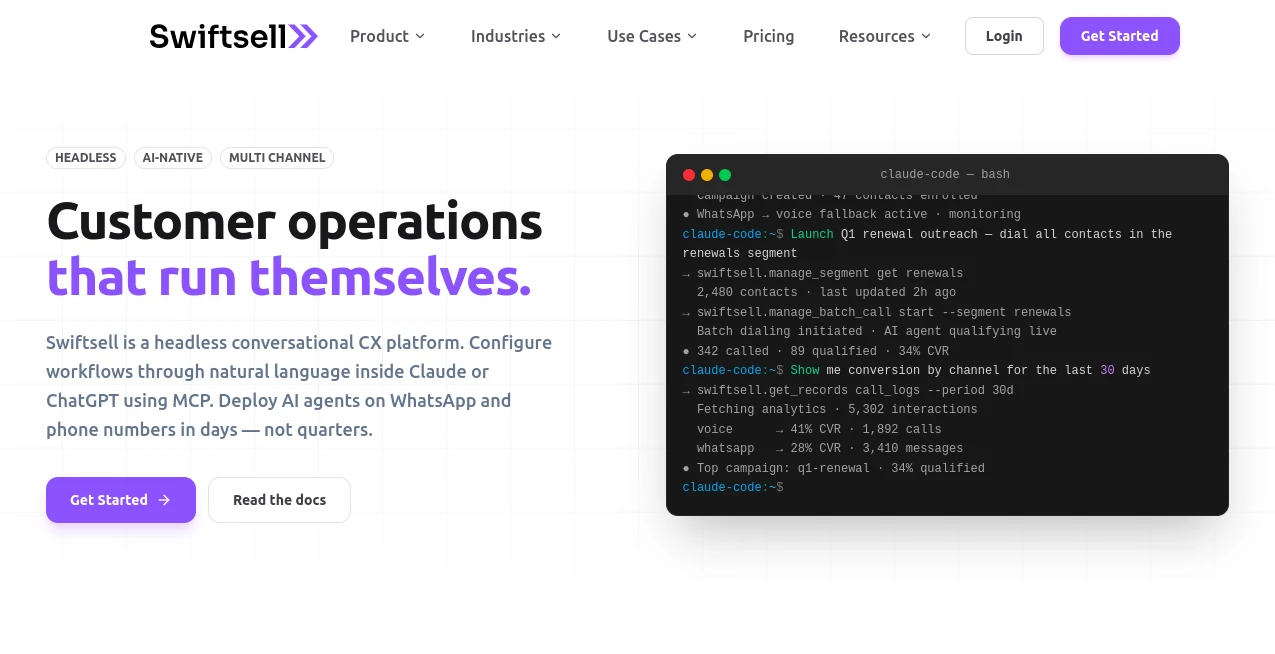
Swiftsell is a headless, AI-native conversational customer experience platform built for businesses that want to automate customer operations across voice calls and WhatsApp. Instead of relying on complicated visual workflow builders, teams can describe what they want in natural language and manage conversational workflows through AI clients such as Claude or ChatGPT using MCP.
The idea is refreshingly practical: let AI handle repetitive conversations while people step in when a situation genuinely needs human attention. Businesses can use the platform for customer support, lead qualification, appointment reminders, follow-ups, re-engagement campaigns, and other customer-facing workflows.
For example, a missed phone call can trigger a WhatsApp follow-up, while an appointment reminder can be handled by an AI voice agent that confirms the booking and schedules another contact when necessary. This makes the platform particularly interesting for teams that deal with a large number of customer conversations every day.
Key Features
- AI voice agents for inbound and outbound calls
- WhatsApp AI agents for customer conversations and operational messaging
- Outbound batch calling for large contact segments
- Natural-language workflow automation
- Lead qualification and customer re-engagement journeys
- Human escalation with conversation context
- AI-powered knowledge base for business information
- Audience segmentation and contact management
- Campaign monitoring and performance analytics
- CRM and system integrations through APIs and automation workflows
- MCP support for connecting workflows with AI clients
- Call logs and transcripts for voice interactions
User Interface
The platform takes a different approach from traditional customer automation software. Rather than making users build every process through a maze of visual nodes, workflows can be described conversationally. A team could define a process such as following up with customers after a missed call or launching a renewal campaign without having to manually construct every branch.
There is also a dashboard environment for managing contacts, conversations, agents, campaigns, and operational data. Audience tools allow contacts to be imported from CSV files, filtered using multiple attributes, and organized into segments for targeted communication.
This combination makes the experience suitable for both technical teams and business operators. Someone comfortable with AI clients can work conversationally, while operational teams can still use the management interfaces to review conversations and performance.
Accuracy & Performance
Accuracy is especially important when AI is handling customer conversations. The platform's knowledge base can use business websites, individual URLs, documents, and files as sources, giving agents access to information that reflects the company's own material rather than relying solely on generic knowledge.
The system can also retrieve live information from connected business systems during conversations. This is useful for situations such as checking an order status, retrieving account information, answering policy questions, or triggering an action after a customer has been identified.
Performance also benefits from automation at scale. Voice campaigns can handle batches of calls, while WhatsApp agents can work across large numbers of conversations simultaneously. The website demonstrates a sample campaign with 131 of 147 calls confirmed, showing the type of operational workflow the platform is designed to support.
Capabilities
The strongest part of the platform is the breadth of customer-operation workflows it can cover. Voice agents can manage inbound and outbound calls, appointment confirmations, reminders, follow-ups, and escalations. WhatsApp agents can handle support questions, lead qualification, re-engagement, and two-way operational campaigns.
The knowledge layer adds another useful dimension. Businesses can connect existing documentation and website content to their AI agents so the same information can power conversations across WhatsApp, voice, and web chat. When the AI cannot confidently answer a question, the conversation can be handed to a human with its previous context attached.
For sales teams, this can mean qualifying leads before a salesperson becomes involved. For support teams, it can mean resolving routine questions automatically. For service businesses, it can mean confirming appointments without requiring staff to make every call manually.
Security & Privacy
Customer-facing automation needs more than a convincing conversation. It also needs sensible controls around access, information, and human intervention. The platform provides role-based access capabilities, conversation records, audit-oriented activity tracking, and controls for managing access to customer information.
Its knowledge-base architecture also gives businesses visibility into their information sources, including processing status and refresh timing. This is useful when an AI agent needs to rely on current business information rather than outdated documents.
Businesses handling regulated or sensitive information should still review the platform's current security documentation, data-processing terms, and industry-specific compliance requirements before deployment.
Use Cases
- Customer Support: Handle common questions across voice and WhatsApp, retrieve relevant information, and escalate complex cases to human agents.
- Lead Qualification: Engage prospects automatically, ask qualifying questions, collect useful details, and pass qualified opportunities to sales teams.
- Appointment Booking: Make reminder calls, confirm appointments, handle responses, and follow up with customers.
- Customer Re-engagement: Reach dormant customers through WhatsApp campaigns and continue conversations based on their responses.
- Collections: Automate payment reminders, outbound calls, promise-to-pay tracking, and scheduled follow-ups.
- Healthcare Communication: Support appointment reminders, patient queries, follow-ups, and other repetitive communication workflows.
- Post-Sale Engagement: Stay in contact with customers after a purchase through automated follow-ups and service conversations.
- Onboarding: Guide customers through repetitive onboarding steps while giving human teams the ability to intervene when necessary.
Pros and Cons
Pros
- Combines voice and WhatsApp automation in one customer-operations platform.
- Natural-language workflow creation can reduce the complexity of automation setup.
- Supports both inbound and outbound voice interactions.
- Batch calling is useful for large-scale campaigns.
- Human handoff preserves conversation context.
- Knowledge-base features allow agents to work from company-specific information.
- MCP support makes the platform interesting for AI-native teams.
- Includes contact segmentation and campaign analytics for operational use.
Cons
- The most advanced automation and integrations are reserved for paid plans.
- Businesses with complex requirements may need technical integration work.
- Voice usage beyond the included allowance is charged by the minute on the Pro plan.
- Teams in regulated industries should carefully evaluate compliance requirements for their specific use case.
- The platform is primarily aimed at businesses with meaningful customer communication volume rather than casual individual users.
Pricing Plans
The platform offers a free plan as well as paid options for teams that need more automation and scale.
- Free: $0 forever. Includes one WhatsApp Business API account, 60 AI voice minutes per month, one user seat, a lifetime allocation of 500 conversations, live agent handoff, conversational workflow building, and call logs and transcripts.
- Pro: $99 per month. Includes three WhatsApp Business API accounts, up to 10,000 contacts, 300 AI voice minutes per month, outbound batch calling, multi-channel campaigns, API integrations, workflow automation, MCP support, an AI knowledge base, and analytics. Additional voice usage is charged at $0.08 per minute.
- Enterprise: Custom pricing. Designed for larger organizations needing unlimited WhatsApp Business API accounts and seats, volume voice pricing, dedicated account management, custom integrations, SSO/SAML, multi-location management, and migration support.
WhatsApp Business API conversation fees are billed separately by Meta and vary according to country and conversation category.
How to Use the Platform
- Create a workspace and configure the customer-operation environment.
- Connect the relevant WhatsApp Business accounts and voice capabilities.
- Add business information through websites, URLs, documents, or other supported knowledge sources.
- Create an AI agent for the required customer interaction.
- Describe the desired workflow using natural language or configure the workflow through the available tools.
- Connect CRM or other business systems when live customer data or actions are required.
- Define escalation rules so complex conversations can reach human agents.
- Launch a campaign or activate the agent and monitor conversations, calls, and performance.
- Review analytics and customer interactions to improve the workflow over time.
Comparison with Similar Tools
Traditional chatbots are often designed around website conversations, while conventional call-center software typically focuses on routing calls between human representatives. This platform sits somewhere between these categories, combining AI voice conversations, WhatsApp messaging, workflow automation, knowledge management, and human escalation.
Another distinction is the AI-native approach. Instead of treating automation as a collection of visual flowcharts that must be manually maintained, the platform allows teams to express operational goals in natural language. That can be particularly appealing to companies already using AI assistants as part of their daily development and operations workflow.
For a small business that only needs a basic website chatbot, this level of functionality may be more than necessary. For a company managing thousands of customer conversations, however, the combination of voice, WhatsApp, automation, and business data can provide a much more complete operational layer.
Conclusion
Customer communication becomes difficult to manage when every missed call, support question, appointment reminder, and follow-up requires someone on the team to take action. This platform tackles that problem by putting AI agents directly into the conversations businesses already have with their customers.
Its strongest appeal comes from the combination of voice and WhatsApp automation, natural-language workflow creation, business-specific knowledge, and human escalation. Rather than trying to remove people from the customer experience entirely, it can take care of repetitive interactions and leave employees with the conversations that actually require judgment.
The free plan also gives smaller teams a practical way to explore the technology before committing to a larger deployment. For organizations with substantial customer communication volume, the Pro and Enterprise options provide a path toward campaigns, integrations, batch calling, analytics, and broader operational automation.
Frequently Asked Questions (FAQ)
What is this platform used for?
It is designed to automate customer operations through AI voice agents and WhatsApp agents. Common applications include customer support, lead qualification, appointment reminders, re-engagement, collections, onboarding, and post-sale communication.
Can it handle phone calls?
Yes. AI voice agents can handle both inbound and outbound calls, including appointment reminders, follow-ups, support conversations, and batch calling campaigns.
Can it automate WhatsApp conversations?
Yes. WhatsApp agents can manage support questions, lead qualification, re-engagement journeys, broadcasts with two-way replies, and other customer communication workflows.
Does it support human agents?
Yes. Conversations can be escalated to human representatives, with relevant conversation context available so the customer does not have to repeat everything from the beginning.
Is there a free plan?
Yes. The free plan costs $0 and includes one WhatsApp Business API account, 60 AI voice minutes per month, one user seat, 500 lifetime conversations, workflow tools, live-agent handoff, and call logs and transcripts.
Does it integrate with other business systems?
Paid plans include API integrations and workflow automation capabilities, allowing customer conversations to connect with CRM and other business systems.
Can the AI use a company's own information?
Yes. The knowledge-base system can use websites, individual URLs, documents, and files as sources for AI agents, helping conversations stay grounded in the company's own information.
AI Sales Assistant , AI Voice Assistants , AI Customer Service Assistant , AI Voice & Audio Editing .
These classifications represent its core capabilities and areas of application. For related tools, explore the linked categories above.

Swiftsell Alternatives Product

Duct Tape 3

Audio Convert

LeadCanvas

Seedance 2.0…

mp3tourl

vo4 ai

Sourcetable

Voice Art
TranAI
