
Synthesized
What is Synthesized?
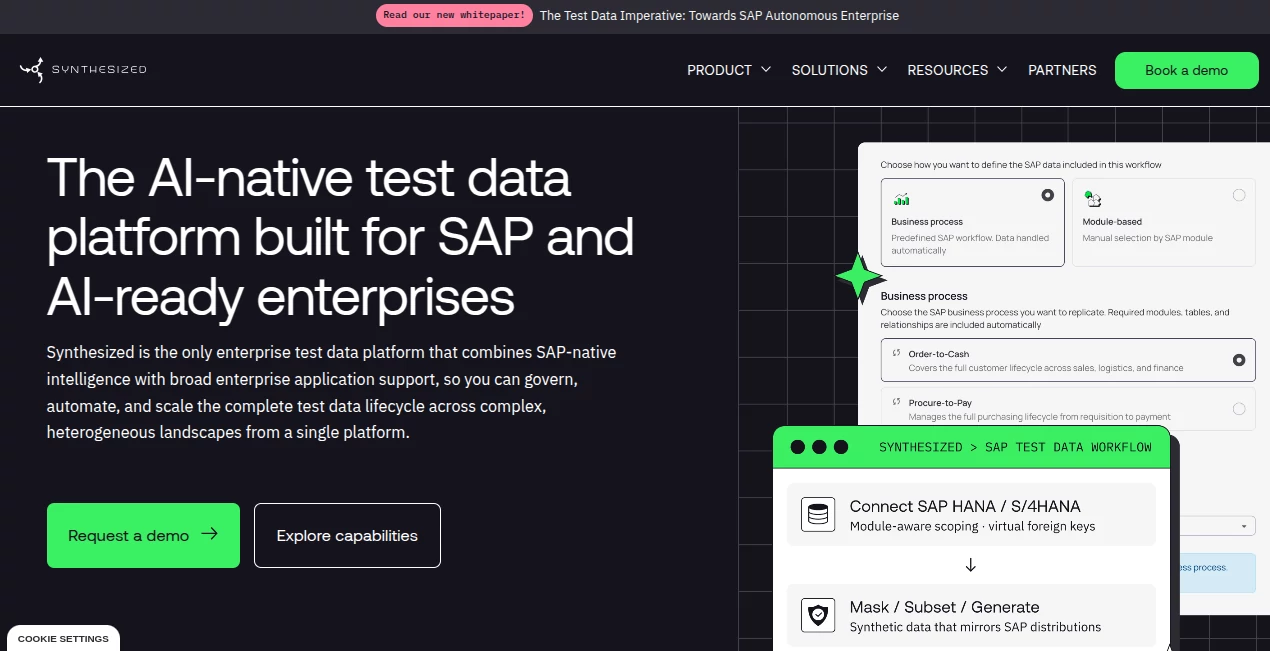
Synthesized is an enterprise-focused data platform designed to help development, QA, data, and DevOps teams work with realistic data without exposing sensitive production information. Instead of relying on incomplete mock records or waiting for sanitized production copies, teams can create governed, production-like scenarios for testing, development, migrations, analytics, and AI-agent validation.
The platform combines synthetic data generation, data masking, and intelligent subsetting. It understands database schemas, relationships, business rules, workflow states, and permissions, allowing teams to create useful datasets while preserving important structural characteristics such as referential integrity.
This approach is particularly valuable for organizations working with complex enterprise systems where test data can become a major bottleneck. Whether a team is preparing a database for application testing or validating a large migration, having realistic data available on demand can make the entire development cycle considerably smoother.
Key Features
- Production-like data generation: Create realistic datasets designed around specific testing and development requirements.
- Data masking: Transform sensitive information while retaining useful formats, structures, and relationships.
- Data subsetting: Give teams access to the relevant portion of a database instead of exposing an entire production environment.
- Referential integrity: Preserve relationships between connected tables and records when creating or transforming datasets.
- AI-assisted configuration: Data requirements can be described with the help of an LLM through YAML configuration or a Python DSL.
- CI/CD integration: Data generation workflows can become part of automated development and delivery pipelines.
- Enterprise database support: The platform works with technologies including PostgreSQL, SQL Server, Oracle, SAP HANA, Salesforce, MySQL, DB2, and others.
- Cloud deployment: Deployment options are available for AWS, Google Cloud, and Microsoft Azure.
User Interface
The platform is built around a workflow rather than a simple data-generation screen. Teams can specify their requirements, create a transformation job, review data categorization and access rights, and then run the job as part of a pipeline.
For technical teams, this workflow is practical because test data becomes something that can be defined and managed alongside the rest of the development process. The Data as Code approach also makes complex requirements easier to reproduce instead of relying on manual database preparation every time a new environment is needed.
Accuracy & Performance
The main strength is not simply producing large amounts of artificial data. The platform is designed to preserve the characteristics that make enterprise datasets useful for testing. Schemas, relationships, distributions, business logic, and referential integrity can be retained while sensitive values are transformed.
According to the provider, automated data provisioning can reduce the cost of an application development and testing lifecycle by more than 70%. Its test-data workflows are also designed to support large-scale generation, performance testing, load testing, migrations, and continuous testing.
For a QA engineer, this means a test environment can contain scenarios that are much closer to real application conditions. For a developer, it can mean fewer delays caused by waiting for an appropriate database snapshot.
Capabilities
The platform covers three major areas: generation, masking, and subsetting. Synthetic datasets can be created from scratch, sensitive values can be masked while preserving useful characteristics, and production databases can be reduced to smaller datasets while keeping important relationships intact.
It can also support AI and machine learning workflows. Its SDK can be used to generate and prepare data for machine learning and analytics, including situations where datasets need rebalancing, imputation, anonymization, or additional synthetic records.
Another useful capability is integration with automated development environments. Generated data can be delivered into CI/CD workflows and data pipelines, making test-data provisioning part of a repeatable engineering process rather than a manual task.
Security & Privacy
Security is central to the platform's purpose. Rather than giving development teams unrestricted access to production information, sensitive fields can be transformed through masking policies and only the required subsets can be provided.
The platform supports codified regulatory rules for masking and access controls. This allows organizations to build privacy requirements directly into data transformation workflows and reduce the risks associated with moving personally identifiable information into non-production environments.
The result is a more practical balance between privacy and realism: engineers get data that behaves like real application data without necessarily receiving the original sensitive values.
Use Cases
Software development: Development teams can create production-like databases for local, staging, and other lower-level environments without depending entirely on production dumps.
QA and test automation: QA teams can generate datasets for different scenarios, including edge cases and large-volume testing. This can improve test coverage while reducing the time spent preparing environments.
Database migrations: Organizations moving between systems can use realistic test datasets to validate migration processes before making changes to production.
AI-agent validation: Enterprise AI agents often need to interact with realistic business states. Governed scenarios can provide a safer environment for evaluating these systems before deployment.
Machine learning: Data scientists can use synthetic data to expand sparse datasets, rebalance distributions, and prepare information for model development.
Enterprise applications: Support for systems such as SAP, Oracle, Salesforce, PostgreSQL, and SQL Server makes the platform suitable for organizations with complex application ecosystems.
Pros and Cons
- Pros: Realistic production-like data, strong privacy focus, masking and subsetting capabilities, preservation of database relationships, automation through CI/CD, broad enterprise database support, and cloud deployment options.
- Pros: The Data as Code approach can make complex data requirements repeatable and easier to integrate into engineering workflows.
- Cons: The platform is primarily aimed at technical and enterprise teams, so smaller organizations looking for a simple consumer-facing synthetic data generator may find its feature set more extensive than necessary.
- Cons: Advanced enterprise deployments require contacting the provider rather than selecting a straightforward public subscription from a conventional pricing page.
Pricing Plans
The provider offers a self-service free version of its platform, while premium and enterprise licensing is handled through the sales team. The SDK is also available as a self-service free offering and can be installed for data generation and analytics workflows.
For larger organizations, pricing depends on the required deployment, infrastructure, data workflows, and enterprise needs. Companies evaluating the platform for production-scale test-data management can request a demonstration to discuss their particular environment.
How to Use It
Start by defining the type of data your development or testing workflow requires. Requirements can be described using YAML configuration with LLM assistance for database workflows or through a Python DSL for datasets.
Next, create a data transformation job and specify the relevant generation, masking, or subsetting rules. Data categorization and access rights can be checked as part of the workflow.
Once the configuration is ready, run the job and deliver the resulting dataset to the required destination. The process can also be incorporated into a CI/CD pipeline so that suitable test data becomes available whenever a new development or testing environment is created.
Comparison with Similar Tools
Traditional mock-data generators are often useful for creating isolated records, but enterprise testing frequently requires much more than realistic-looking names, addresses, or transactions. Connected databases depend on relationships, constraints, business rules, and specific distributions.
This platform takes a broader approach by combining synthetic generation with masking and subsetting. That makes it particularly interesting for organizations that need to reproduce realistic database conditions while controlling access to sensitive information.
Compared with manually sanitizing production databases, automated workflows can also provide a more repeatable process. Instead of preparing a new copy by hand for every testing cycle, teams can codify their requirements and integrate data provisioning into existing engineering pipelines.
Conclusion
For organizations where test data is slowing down development, QA, migration projects, or AI validation, Synthesized provides a strong technical approach to the problem. Its combination of synthetic generation, intelligent masking, database subsetting, and automation goes beyond simply creating fake records.
The strongest advantage is the focus on keeping data useful while making it safer to use outside production. Teams can work with realistic structures and relationships, automate provisioning, and build repeatable data workflows around their existing infrastructure.
It is best suited to engineering and enterprise environments where data complexity, privacy requirements, and development speed all matter. For those teams, reliable access to production-like test data can remove a surprisingly large obstacle from the software delivery process.
Frequently Asked Questions (FAQ)
What is this platform used for?
It is used to generate, mask, and subset realistic data for software development, QA, database testing, migrations, analytics, machine learning, and AI-agent validation.
Can it work with production databases?
Yes. The platform is designed to work with sensitive enterprise data while applying masking, subsetting, and governance controls to create safer non-production datasets.
Does it preserve database relationships?
Yes. Maintaining referential integrity is one of its important capabilities, allowing related tables and records to remain consistent during data generation and transformation.
Which databases are supported?
Supported technologies include PostgreSQL, SQL Server, Oracle, SAP HANA, MySQL, DB2, Salesforce, and other enterprise database systems.
Can it be integrated with CI/CD?
Yes. Data-generation jobs can be incorporated into CI/CD and data pipelines, allowing test data to be provisioned as part of automated workflows.
Is there a free version?
Yes. A free self-service version is available, and the provider also offers a free SDK for data generation and analytics. Premium and enterprise licensing is handled through the sales team.
Can it be used for machine learning?
Yes. The SDK can be used to create synthetic data for machine learning and analytics, including data rebalancing, imputation, anonymization, and dataset expansion.
Is it suitable for enterprise environments?
Yes. Its support for complex databases, privacy controls, cloud deployment, automation, and enterprise applications makes it particularly well suited to larger technical organizations.
AI Data Mining , AI Testing & QA , AI Developer Tools , AI DevOps Assistant .
These classifications represent its core capabilities and areas of application. For related tools, explore the linked categories above.
Synthesized details
Website unavailable — View Alternatives
Pricing
- Freemium
Apps
- Web App
Categories

Synthesized Alternatives Product

Mythx AI

GLM 5

KaneAI

AI Agent Ski…

You.bot

Discord Time…
FurWall

CtrlOps

tanship