
















tellus
What is tellus?
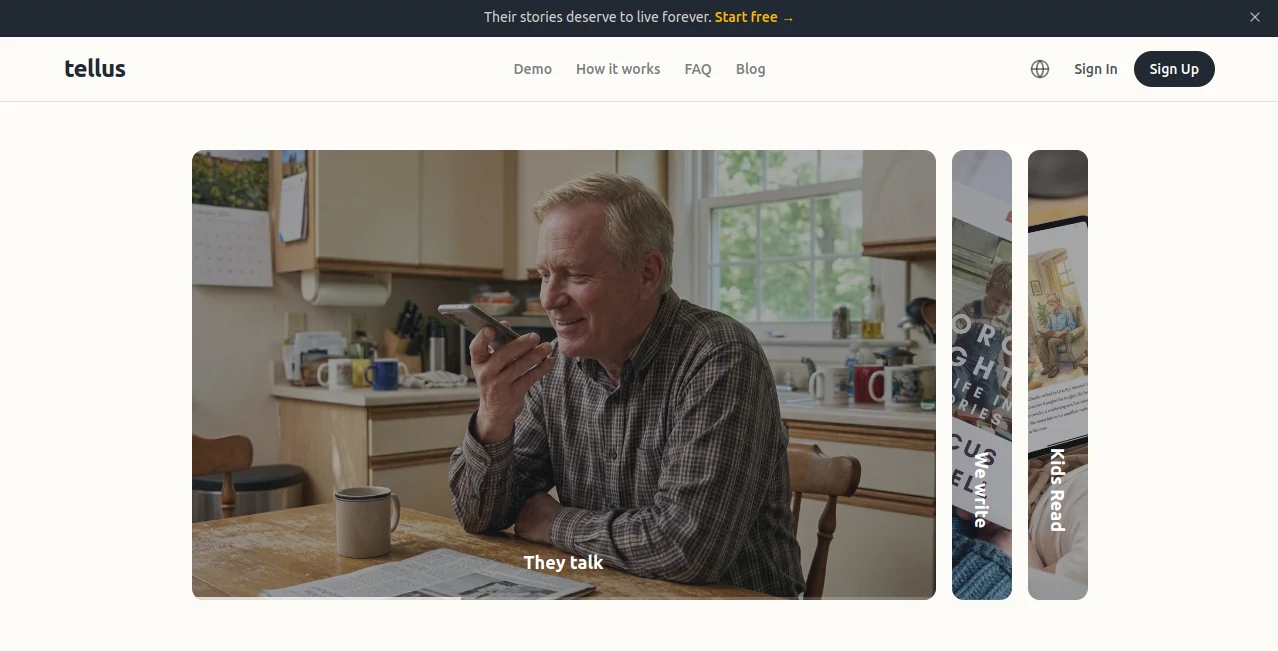
Tellus is a family storytelling tool designed to preserve the memories, experiences, and voices of parents and grandparents without asking them to sit down and write a memoir. Instead of dealing with blank pages, complicated interviews, or hours of manual transcription, family members can simply answer thoughtful questions by voice. Their recordings can then become written memoir chapters and illustrated stories for children.
The idea is refreshingly simple: people talk naturally, while the technology takes care of the difficult parts. This makes the experience particularly appealing for older family members who may not enjoy typing or using complicated creative software. It also gives younger relatives an easy way to capture stories they might otherwise never think to ask about.
Key Features
- Voice recording designed around natural conversations and personal memories.
- AI transcription and summaries that turn spoken memories into usable written material.
- A living memoir that can grow as new recordings are added over time.
- Personalized children's stories created from real family experiences.
- Original voice recordings remain available, preserving tone, pauses, laughter, and personality.
- Family sharing features allow memories to be enjoyed by the people who matter most.
- Support for more than 95 languages makes the concept useful for families with different linguistic backgrounds.
User Interface
The interface is built around simplicity rather than a long list of professional editing controls. A typical session begins with a question or prompt, followed by a straightforward recording experience. The person sharing the memory does not need to prepare a manuscript, edit audio, or understand how transcription software works.
That approach matters when the person being recorded is a parent or grandparent who may not be comfortable with modern creative applications. The fewer technical decisions they have to make, the more attention they can give to the story itself.
Accuracy & Performance
Voice transcription is useful here because the goal is not simply to create a raw transcript. Recordings are used as the foundation for structured memoir content and other written stories. The platform also emphasizes preserving the speaker's authentic words, voice, and accent rather than turning every recording into something that sounds generic.
As with any automated transcription or generative writing system, important family details should still be reviewed before a memoir is treated as a definitive historical record. Names, dates, places, and sensitive memories are worth checking, especially when the final story is intended to be shared with several generations.
Capabilities
The most interesting capability is the way one conversation can produce more than one type of keepsake. A recording can contribute to a written memoir while the same family memory can also inspire an illustrated children's story.
For example, a grandparent describing a childhood adventure could become part of a chronological life story for adults while also becoming a simpler bedtime narrative for younger family members. This gives ordinary memories a second life instead of leaving them buried inside audio files that nobody has time to organize.
The memoir can also develop gradually. Families do not have to capture an entire life in one weekend. They can record one memory at a time, gradually building a larger collection of experiences.
Security & Privacy
Privacy is especially important when dealing with personal family histories. The service states that recordings are encrypted and that access is controlled by the person who created the memories. The platform positions these recordings as private family material rather than public social content.
This is a meaningful distinction for people sharing personal experiences, family relationships, childhood memories, and other information that was never intended for public viewing. Even so, families should review the platform's current privacy terms and sharing settings before uploading particularly sensitive material.
Use Cases
There are several situations where this type of tool can be genuinely useful. Adult children can use it to preserve their parents' childhood memories, family history, career experiences, or stories about how important relationships began.
It can also work well as a thoughtful gift. Instead of buying another physical item that may eventually be forgotten, a family can create something that becomes increasingly valuable as more memories are recorded.
Grandparents can also use the resulting stories to connect with younger family members. A story about getting lost as a child, meeting a future spouse, starting a first job, or overcoming a difficult period can become something children can read and revisit later.
For families living in different cities or countries, the recording format provides another advantage: memories can be captured remotely rather than requiring everyone to be in the same room for a formal interview.
Pros and Cons
- Pros: Very low barrier to recording, no writing required, preserves original voice recordings, turns memories into structured memoir content, creates children's stories from real experiences, supports family sharing, and offers a lifetime option without a subscription.
- Cons: Generated stories may still need human review for factual details, the experience depends on the quality and completeness of spoken memories, and families looking for professional video-based family documentaries may need a different type of service.
Pricing Plans
The service offers a free plan that allows unlimited memory recording, AI transcription and summaries, family sharing, story requests, and a selection of other features. The free tier also includes 15 storybook tokens and allows users to listen to the first three stories before upgrading.
The Lifetime plan costs $69.99 as a one-time payment. It includes unlimited memories, transcription and summaries, living memoir generation, family sharing, access to all family stories, the included storybook tokens, and ongoing memoir updates. The absence of a recurring subscription makes the pricing particularly straightforward for a project that may be used over several years.
How to Use Tellus
Start by creating a recording session and choosing a memory prompt. The questions are designed to encourage personal stories rather than short factual answers, so the speaker can explain what happened in their own way.
Next, let the family member talk naturally. There is no need to turn the conversation into a formal interview. A quiet room and a relaxed atmosphere are usually enough. Short sessions can be better than trying to record an entire lifetime in one sitting.
Once the recording is captured, the platform processes the spoken material and turns it into written content. Over time, individual memories can form a larger memoir. Families can also use the resulting memories as the foundation for personalized children's stories.
A useful approach is to begin with an easy question. Asking about a favorite childhood place or the first job someone had can often produce a more natural conversation than beginning with a broad request such as "Tell me your whole life story."
Comparison with Similar Tools
Traditional memoir services often require the person telling the story to write, type, or participate in lengthy interviews. Generic transcription tools can solve the speech-to-text problem, but they generally stop at the transcript and leave the family to organize the material afterward.
This approach sits somewhere between those two options. Its focus is not simply converting audio into text. The broader goal is turning spoken memories into something a family can actually read, share, and preserve.
It is also different from video-based family history projects. Video captures facial expressions and surroundings, while voice recording can feel much less formal. For someone who becomes uncomfortable when a camera is pointed at them, simply pressing a recording button may be enough to keep the conversation flowing.
Conclusion
Preserving family history is often less about finding extraordinary events and more about capturing the small details that disappear with time. The way someone remembers school, the story behind a marriage, a difficult first job, an old family tradition, or a childhood adventure can become surprisingly valuable years later.
This tool takes a practical approach to that problem by letting people speak instead of write. The combination of voice preservation, transcription, memoir creation, and personalized children's stories makes it more than a conventional recording app. It gives families a simple way to turn conversations into keepsakes that can continue growing over time.
For anyone who has ever thought, "I wish I had asked my parents about that," starting with one short recording may be the easiest way to make sure the next generation does not have the same regret.
Frequently Asked Questions (FAQ)
Does it require the person to write their memoir?
No. The experience is built around speaking. A family member can answer questions by voice, while the service handles transcription and turns the material into written stories.
Can it preserve the original voice recording?
Yes. Original voice recordings are preserved so family members can return to the actual sound of the person's voice rather than relying only on the written version.
Can the recordings become a complete memoir?
Yes. Individual recordings can contribute to a growing memoir, allowing a family to build a larger life story gradually rather than completing the entire project in one session.
Can family memories be turned into children's stories?
Yes. Real memories can be adapted into illustrated children's stories, creating a more accessible way for younger family members to discover stories about their parents and grandparents.
Does it support multiple languages?
The service states that it supports more than 95 languages, making it suitable for many multilingual families.
Is there a free plan?
Yes. The free plan allows unlimited recording and includes features such as AI transcription and summaries, family sharing, and a limited number of storybook tokens.
Is there a subscription?
No subscription is required for the Lifetime plan. The listed Lifetime option is a one-time payment of $69.99.
Is the family information private?
The service states that recordings are encrypted and that users control who can access their family stories. Families should still review the current privacy and sharing policies before adding highly sensitive information.
Who is this tool best suited for?
It is particularly suitable for families who want to preserve the stories of parents and grandparents without requiring them to write, edit audio, or participate in a formal video interview.
AI Book Writing , AI Life Assistant , AI Transcription , AI Story Writing .
These classifications represent its core capabilities and areas of application. For related tools, explore the linked categories above.

tellus Alternatives Product

YouMind

Dialogues wi…

Startup Read…

Whisper Web

SubtitleGene…

Filmpitch

Yes No Oracle

Play Queens …

GetFIT App