
ThunderPhone
What is ThunderPhone?
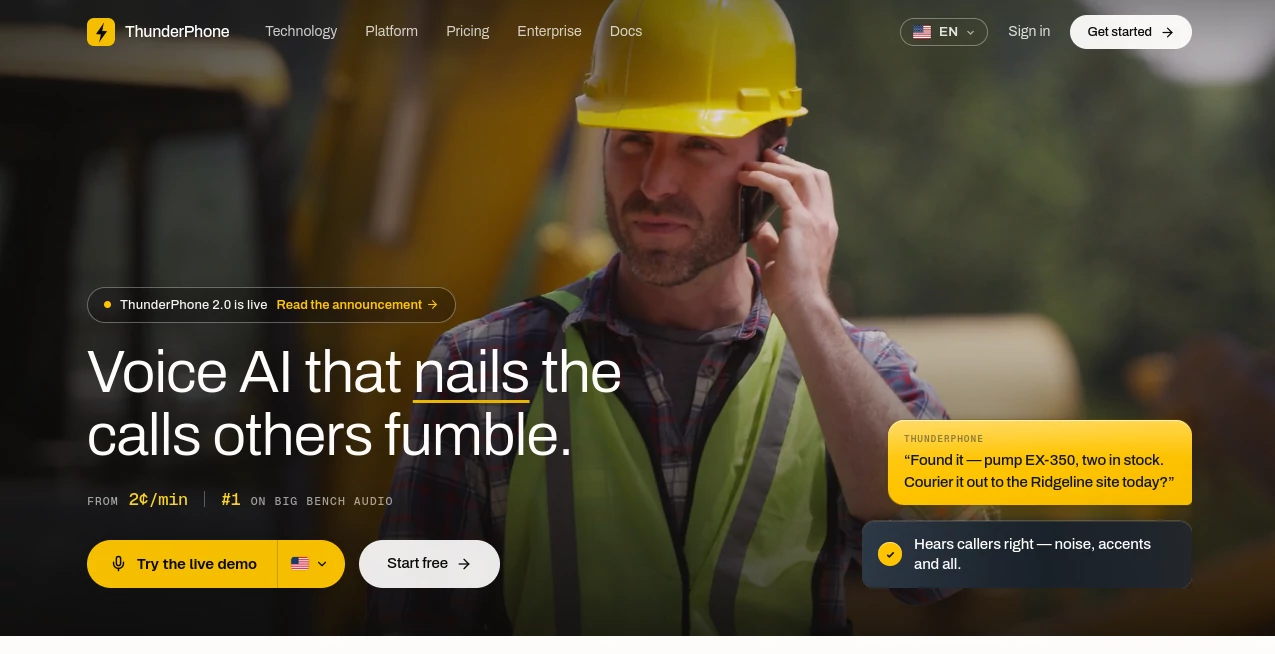
ThunderPhone is a voice AI platform built for businesses that need phone conversations to feel less like automated menus and more like real interactions. It can answer incoming calls, place outbound calls, run follow-up campaigns, and power voice conversations through web-based widgets.
What makes the platform particularly interesting is its focus on the messy parts of real conversations. People interrupt, change their minds, speak with accents, talk over one another, or call from noisy environments. The system is designed to handle those situations while keeping the conversation moving naturally.
It is also built with cost-conscious teams in mind. Instead of separating transcription, language models, voice generation, and platform charges into a complicated bill, the service offers all-inclusive per-minute tiers starting at 2 cents per minute.
Key Features
- Inbound and outbound AI phone calls
- Support for more than 40 languages, including mixed-language conversations
- Native SIP trunking for existing telephony infrastructure
- DTMF capture for keypad-based interactions
- Voicemail and answering-machine detection
- Cold, warm, and human call transfers with context preservation
- Knowledge grounding using uploaded business documents
- Live call supervision and real-time guidance
- Automated testing and AI-graded call scenarios
- Monitoring, transcripts, and production call analysis
- Web voice widgets for browser-based conversations
- API access for custom voice workflows
User Interface
The platform takes a practical approach to building voice agents. Instead of forcing users to configure dozens of technical settings, the main workflow starts with describing what the agent should do in plain language. Users can then choose a voice and select an intelligence tier.
The operator dashboard brings agents, campaigns, experiments, test calls, and live calls into one place. This is useful for teams that want to manage phone automation without constantly switching between separate tools.
For developers, the same voice runtime can be accessed through an API. That creates a nice balance: non-technical users can work from the visual interface, while engineering teams can build custom workflows around the underlying infrastructure.
Accuracy & Performance
Audio understanding is one of the platform's strongest selling points. Its system combines multiple transcripts with direct audio-to-language-model processing, helping it deal with information that can easily be lost by a traditional speech-to-text pipeline.
The company reports a 99.4% result on Big Bench Audio for its highest intelligence tier, based on testing published in July 2026. The platform is also designed around real-world latency rather than relying solely on ideal laboratory conditions.
In practical terms, that can matter when a caller gives an address, spells a name, mentions a product code, or speaks while background noise is present. A voice agent that understands the actual conversation is far more useful than one that simply converts every sentence into text.
Capabilities
The system can handle both inbound and outbound calling. A business can use it as a virtual front desk, appointment assistant, sales qualification agent, reminder service, customer support representative, or follow-up caller.
Its voice agents can also interrupt and resume naturally when a caller jumps into the conversation. Short acknowledgements such as "mm-hm" are handled without unnecessarily stopping the dialogue, while cross-talk and background noise are taken into account.
For more structured workflows, DTMF support allows agents to work with keypad interactions. Voicemail and screener detection can help outbound campaigns avoid treating answering machines like live customers.
Another useful feature is knowledge grounding. Businesses can provide documents that contain relevant information, allowing agents to retrieve answers from company material rather than relying entirely on general-purpose knowledge.
Security & Privacy
The platform is designed for organizations that need stronger operational and compliance controls. The company states that it supports HIPAA and GDPR requirements, with a Business Associate Agreement and Data Processing Agreement available at no additional charge.
Enterprise customers can also discuss options such as custom deployments and data residency. These features make the platform more suitable for organizations where handling customer conversations requires additional governance.
As with any service handling phone conversations, businesses should still review the provider's current privacy documentation, data-processing terms, retention policies, and applicable recording regulations before deploying it in production.
Use Cases
- Customer support: Answer common questions, collect information, and transfer callers to human representatives when necessary.
- Appointment scheduling: Handle booking conversations and connect agents with calendars and other business systems.
- Sales qualification: Ask predefined questions, collect customer details, and route qualified prospects to sales teams.
- Outbound reminders: Contact customers about appointments, confirmations, renewals, or follow-ups.
- Insurance: Automate pre-sales conversations and gather information before a human representative takes over.
- Reception and front desk: Provide an always-available first point of contact for incoming calls.
- Surveys and research: Conduct structured outbound conversations and collect responses at scale.
- Web voice support: Add voice conversations directly to a website or application without requiring visitors to dial a phone number.
Pros and Cons
- Pros: Very low starting price, full-stack per-minute pricing, inbound and outbound calling, 40+ language support, strong audio understanding, SIP integration, live supervision, testing tools, knowledge grounding, and API access.
- Cons: Some advanced options cost extra, premium voices and certain language paths can increase the per-minute price, and teams with very simple voice requirements may find the broader platform more capable than they actually need.
Pricing Plans
The pricing model is based on usage rather than a mandatory monthly platform subscription. The Spark tier costs 2 cents per minute and is positioned as the cost-effective option. Bolt costs 5 cents per minute and focuses on faster response times, while Storm costs 9 cents per minute and provides the highest level of audio understanding and instruction following.
All three tiers include the core voice stack, including inbound and outbound calls, SIP trunking, web voice widgets, more than 40 languages, voice options, testing, monitoring, transcripts, transfers, and DTMF.
There are optional charges for features such as premium voices, selected language paths, verbal acknowledgements, long prompts, and call supervision. One unusual pricing detail is automatic hold detection: hold time is charged at a flat 2 cents per minute across all tiers.
For high-volume enterprise deployments, custom rates may be available, with the company stating that some large-scale use cases can reach 1 cent per minute or less under an enterprise agreement.
How to Use It
Getting started is relatively straightforward. First, create an account and define the job your voice agent needs to perform. The instructions can be written in plain language, which makes the initial setup approachable even for teams without extensive voice-AI experience.
Next, select a voice and choose the intelligence level that matches the workload. Spark is suitable for cost-sensitive applications, Bolt emphasizes faster responses, and Storm is intended for conversations where audio understanding and instruction following are especially important.
After that, connect your phone infrastructure through SIP or use another supported calling option. Integrations can then be added for systems such as CRM platforms, calendars, APIs, MCP servers, and knowledge bases.
Before sending the agent into production, use automated test scenarios to check how it behaves. Once live, production calls can be monitored, transcribed, and evaluated so that recurring problems can be identified and improvements can be made over time.
Comparison with Similar Tools
The biggest difference is the pricing philosophy. Many voice AI platforms separate the costs of telephony, transcription, language models, voice generation, and platform usage. That can make the final cost harder to predict.
Here, the main tiers package the core voice stack into a single per-minute rate. The published starting prices are 2 cents for Spark, 5 cents for Bolt, and 9 cents for Storm, while several optional capabilities can add to the final bill.
It also takes a broader approach to call operations. Beyond simply generating a voice response, the platform includes testing, monitoring, live supervision, knowledge retrieval, call transfers, SIP support, and tools for improving agents after they are deployed.
For a small business that only needs a basic answering bot, a simpler service may be enough. For teams handling high call volumes or complicated conversations, the combination of voice infrastructure, operational controls, and low usage-based pricing can be much more compelling.
Conclusion
Voice automation becomes genuinely useful when it can deal with the unpredictable nature of human conversation. This platform is clearly designed around that idea rather than treating phone calls as a simple speech-to-text pipeline.
Its combination of real-time voice agents, strong audio understanding, multilingual conversations, telephony integrations, knowledge grounding, monitoring, and API access gives businesses plenty of room to build sophisticated call workflows.
The pricing is another major attraction. Starting at 2 cents per minute, the platform is positioned well for companies that want to experiment with voice automation without immediately committing to a large software subscription.
For customer service, scheduling, sales, reminders, front-desk operations, and other call-heavy workflows, it is a particularly interesting option to test. The best way to judge it, however, is to put one of your more difficult call scenarios through the system and see how it performs under real conditions.
Frequently Asked Questions (FAQ)
What is this platform used for?
It is used to build AI voice agents that can answer and place phone calls, handle customer conversations, schedule appointments, perform follow-ups, qualify leads, and automate other voice-based workflows.
How much does it cost?
The published plans start at 2 cents per minute for Spark, followed by 5 cents per minute for Bolt and 9 cents per minute for Storm. Optional features can increase the final usage cost.
Does it support multiple languages?
Yes. The platform understands more than 40 languages and can handle accents and conversations that switch between languages during the same call.
Can it make outbound calls?
Yes. It supports programmatic outbound calls as well as campaigns with pacing and retry controls. Voicemail and screener detection are also available for outbound workflows.
Can I connect my existing phone system?
Yes. Native SIP trunking allows businesses to connect existing telephony infrastructure without rebuilding their entire routing setup.
Can callers be transferred to a human?
Yes. Cold and warm transfers are supported, with conversation context preserved during the handoff.
Is there an API?
Yes. Developers can access the same core voice runtime through an API and build custom call workflows around it.
Can it use company documents when answering questions?
Yes. Knowledge grounding allows businesses to provide documents that agents can retrieve information from during conversations.
Does it support healthcare use cases?
The company states that its platform is HIPAA and GDPR compliant, with BAA and DPA options available. Organizations should still review the applicable compliance and data-handling requirements for their specific deployment.
How quickly can an agent be launched?
The platform states that a production voice agent can be launched in about ten minutes, depending on the phone setup, integrations, and workflow requirements.
AI Customer Service Assistant , AI Speech Recognition , AI Speech to Text , AI Voice Assistants .
These classifications represent its core capabilities and areas of application. For related tools, explore the linked categories above.
ThunderPhone details
Website unavailable — View Alternatives
Pricing
- Freemium
Apps
- Web App
Categories

ThunderPhone Alternatives Product

Weblo AI

Audio Transc…

Zeemo AI

Speech Notes

BetterAntisp…
ReviewRespon…

Read PDF Alo…

Video to Text

Klyra AI