
tokenhot
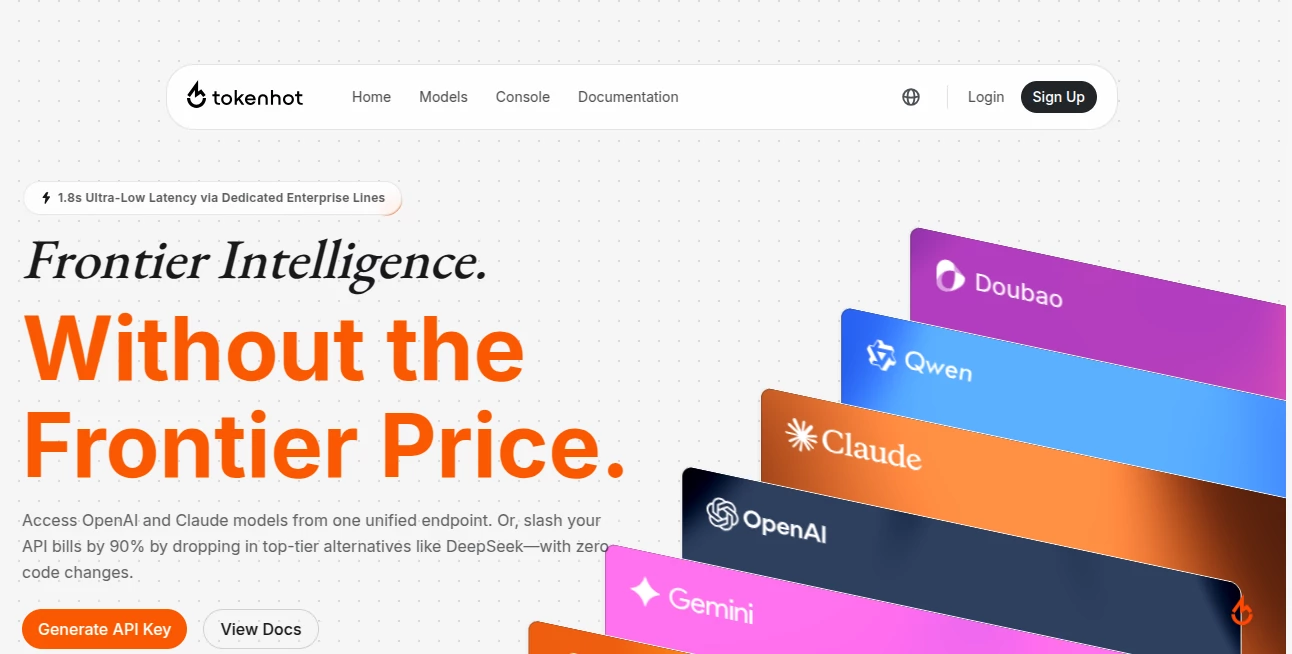
What is tokenhot?
TokenHot is a powerful unified AI API platform designed for developers, startups, and enterprises that need seamless access to multiple leading AI models through a single endpoint. Instead of managing separate accounts, APIs, and billing systems for every provider, the platform simplifies the entire workflow by offering one OpenAI-compatible API that connects to more than 100 popular language, image, audio, and video models.
Whether you're building AI assistants, coding tools, content generation platforms, automation workflows, or multimodal applications, this solution removes much of the complexity associated with integrating different AI providers. Developers can continue using familiar SDKs while switching between models without rewriting existing code.
One of its strongest advantages is the balance between performance, flexibility, and affordability. With enterprise-grade infrastructure, distributed routing, transparent pay-as-you-go pricing, and a strong focus on developer experience, it provides a practical foundation for modern AI applications that need reliability at scale.
Key Features
User Interface
The developer experience is refreshingly straightforward. API documentation is well organized, onboarding is quick, and existing OpenAI integrations require minimal changes before they are ready to work with dozens of supported models. Clear examples in multiple programming languages help reduce implementation time.
Accuracy & Performance
The platform is optimized for low-latency responses and high-concurrency workloads. Intelligent infrastructure helps maintain stable performance even during heavy traffic, making it suitable for production environments where response time and reliability directly impact user experience.
Capabilities
Developers gain access to more than one hundred AI models from multiple providers through a unified API. The platform supports text generation, reasoning, coding assistance, image generation, video generation, speech synthesis, speech recognition, and multimodal AI workflows. Switching between models only requires changing the model identifier rather than rebuilding an application.
Security & Privacy
Privacy is treated as a core feature. The service follows a zero-data-retention approach for prompts and generated outputs while acting as a secure gateway between developers and AI providers. This design makes it attractive for businesses handling sensitive or confidential information.
Use Cases
Developers can rapidly prototype AI products without maintaining multiple API integrations.
Software companies can build intelligent assistants that dynamically choose different language models depending on performance or cost.
SaaS platforms can integrate text, image, video, and voice generation from a single infrastructure.
AI startups can reduce operational costs while gaining access to the latest foundation models.
Enterprise teams can build scalable customer support systems, coding assistants, research tools, automation pipelines, and multimodal applications using one consistent API.
Pros and Cons
Pros
Access to over 100 AI models through one API.
Compatible with existing OpenAI SDKs.
Simple pay-as-you-go pricing.
Enterprise-grade reliability and concurrency.
Supports text, image, audio, and video AI models.
Zero data retention policy for enhanced privacy.
Developer-friendly documentation and onboarding.
Cons
No traditional free subscription plan.
Model pricing varies depending on the provider.
Primarily designed for developers rather than non-technical users.
Pricing Plans
The platform uses a transparent pay-as-you-go pricing model without mandatory subscriptions or seat-based licensing. Users only pay for the API resources they consume, making it suitable for both small experiments and large-scale production deployments.
How to Use TokenHot
Create an account and generate an API key.
Connect your application using the OpenAI-compatible endpoint.
Select the desired AI model from the supported catalog.
Send requests using your preferred SDK or HTTP client.
Scale your application while switching between providers without modifying your overall integration.
Comparison with Similar Tools
Unlike traditional AI providers that only expose their own models, this platform serves as a unified gateway for multiple leading AI ecosystems. Compared to managing separate integrations for OpenAI, Anthropic, Google Gemini, and other providers, developers benefit from simplified maintenance, centralized billing, faster experimentation, and easier model switching. It is particularly valuable for teams that frequently evaluate new models or optimize costs without rewriting application logic.
Conclusion
Building modern AI products often means balancing performance, pricing, scalability, and flexibility across several model providers. This platform removes much of that complexity by offering a single, reliable infrastructure that connects developers to a broad ecosystem of advanced AI models. Its OpenAI compatibility, enterprise-grade architecture, strong privacy practices, and developer-first approach make it an excellent choice for businesses looking to accelerate AI development while keeping integrations simple and future-ready.
Frequently Asked Questions (FAQ)
Is the platform compatible with existing OpenAI applications?
Yes. Most existing OpenAI integrations require only minimal configuration changes.
How many AI models are supported?
More than 100 language, image, audio, and video models from multiple providers are available.
Does it store prompts or generated content?
No. The platform states that it follows a zero-data-retention policy for prompts and generated outputs.
Who should use this platform?
It is ideal for developers, AI startups, SaaS companies, and enterprises building scalable AI-powered applications.
What pricing model is available?
Users pay only for the resources they consume through a flexible pay-as-you-go billing system.
AI Code Assistant , AI API Design , Large Language Models (LLMs) , AI Developer Tools .
These classifications represent its core capabilities and areas of application. For related tools, explore the linked categories above.

tokenhot Alternatives Product

Empiriolabs …

CtrlOps

ModelsLab

CoolVerdict

DDS Gub

TruthSpine

Chatref

You.bot

Ideavibes AI