
treg
What is treg?
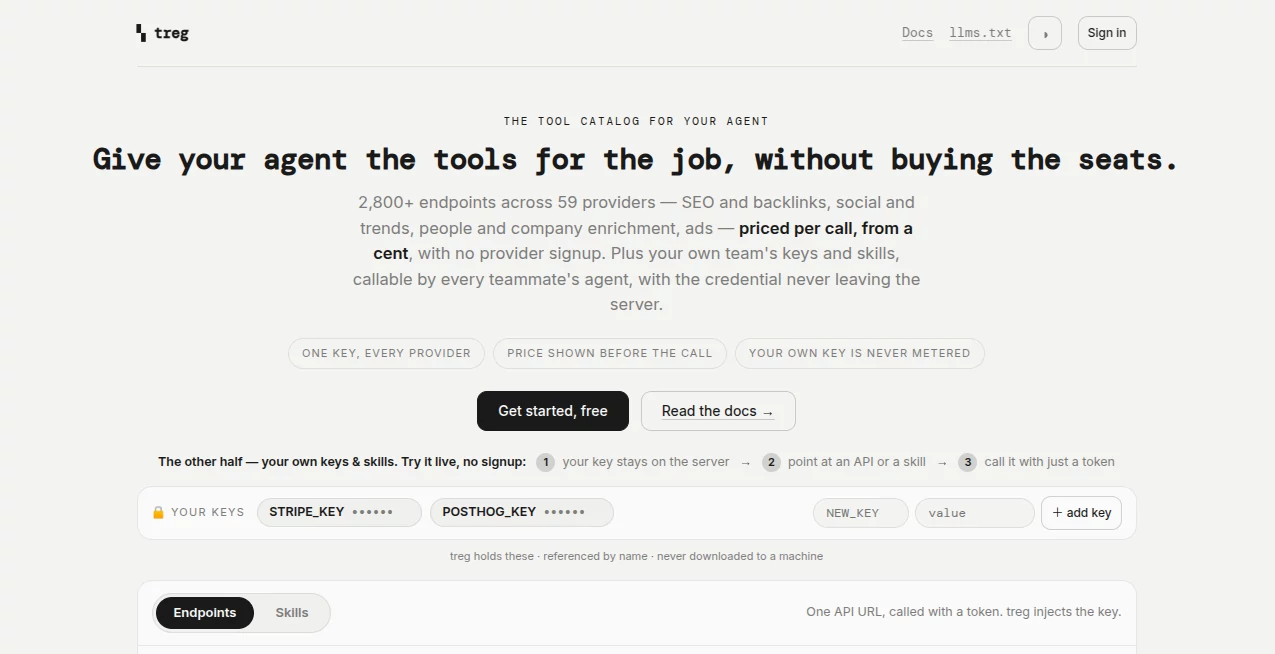
Modern AI coding agents can write code, analyze information, and automate workflows, but they often need access to specialized external data before they can complete a real business task. treg is designed to solve that problem by giving AI agents access to a large catalog of expert tools through a unified connection.
Instead of creating separate accounts and managing individual API credentials for SEO platforms, business databases, social networks, advertising systems, and research services, users can connect their agent to one centralized tool layer. The platform currently provides access to more than 2,600 endpoints across dozens of providers, making it particularly useful for teams building AI-powered workflows that need reliable external data.
The idea is refreshingly practical. An agent can focus on the task, while the platform helps identify the appropriate provider, displays pricing and performance information, and handles the connection behind the scenes.
Key Features
- Access to more than 2,600 expert tool endpoints.
- A unified credential for connecting agents with multiple providers.
- SEO data including keywords, rankings, backlinks, search results, and analytics.
- AI visibility and citation-related research capabilities.
- Company research, funding information, contact enrichment, and work email verification.
- Social media and trend research across several major platforms.
- Advertising and campaign management integrations.
- Provider comparison based on pricing, measured success rate, and response speed.
- Support for bringing your own provider API keys.
- Open-source infrastructure with an AGPL license.
User Interface
The interface is built around the concept of simplicity rather than presenting users with hundreds of disconnected dashboards. The main catalog organizes capabilities according to the job an agent needs to perform, such as keyword research, backlink analysis, company enrichment, social research, or advertising management.
This approach is especially useful for developers who do not want to spend time switching between multiple vendor dashboards. Instead, the agent can discover the relevant capability and make the appropriate request.
Accuracy & Performance
One of the more interesting aspects of the platform is that provider selection is not presented as a blind choice. The catalog can expose pricing, measured success rates, median response times, and recent availability. This gives an AI agent more useful information when deciding which service should handle a particular request.
For example, SEO workflows can compare several providers for keyword data or backlink information rather than automatically relying on a single source. The platform also reports real operational measurements, which can be valuable when reliability matters as much as raw functionality.
Capabilities
The range of capabilities goes well beyond traditional SEO software. An AI agent can work with keyword research, competitor data, SERP results, backlinks, Search Console, GA4, AI visibility information, company databases, funding records, people enrichment, email verification, social content, advertising platforms, and other business data sources.
The same architecture can therefore support very different workflows. A marketing team could research a new market, identify relevant companies, find decision-makers, analyze competitors, and prepare campaign data without manually moving information between several services.
Security & Privacy
Credential management is an important part of the platform's design. Provider credentials are handled server-side rather than being scattered across an agent's local environment. Users can also connect their own provider keys, with those credentials taking precedence when configured.
The platform states that provider keys are not written to the user's machine, repository, or agent context. This design can reduce the risk associated with keeping numerous API credentials in local configuration files or development environments.
Use Cases
SEO professionals can use the platform to give AI agents access to keyword volumes, keyword ideas, competitor rankings, backlink information, domain metrics, live search results, Search Console data, and analytics.
For sales teams, company search and enrichment workflows can combine company information, funding history, employee details, and work email verification. This makes it possible to build prospecting workflows that would otherwise require several separate subscriptions.
Marketing teams can also use it for social trend research, advertising workflows, competitor research, and campaign analysis. Developers building AI agents can take advantage of the unified tool layer to give their applications access to a much wider range of external capabilities.
Pros and Cons
- Pros: Large catalog of tools, unified authentication, pay-per-use pricing, provider comparison, support for existing API keys, open-source architecture, and strong compatibility with AI agent workflows.
- Pros: Users can avoid paying for several full subscriptions when they only need individual API calls occasionally.
- Pros: Pricing and provider performance information can help agents make more informed choices.
- Cons: Users who only need one specialized service may find the broader catalog unnecessary.
- Cons: Some capabilities depend on third-party provider availability, quotas, API restrictions, or authentication requirements.
Pricing Plans
The pricing model is based primarily on usage rather than a traditional monthly software subscription. New teams receive $1.00 in free credit to start, and individual calls are priced according to the underlying provider and operation.
Examples shown on the platform include keyword-related calls costing fractions of a cent, backlink operations priced by usage, and company or email-enrichment requests charged per result. The exact cost is displayed before a call is made, helping users understand the expense before running a workflow.
There is also support for bringing your own provider key. When an existing provider account is connected, calls routed through that key are not metered against the platform balance.
How to Use treg
Getting started is designed around connecting the service to an AI coding agent. The setup command installs the necessary tooling and registers the available capabilities with compatible agent environments.
Once connected, users can describe a task instead of manually selecting an individual API. The agent can search the available catalog, compare suitable providers, and use the selected endpoint to complete the requested workflow.
For example, a user could ask an agent to research a market, find relevant keywords, evaluate competitors, and identify promising opportunities. The agent can then access the required external data through the connected tool layer.
Comparison with Similar Tools
Traditional platforms such as dedicated SEO suites, sales intelligence databases, email verification services, and advertising management systems are generally built around their own dashboards and subscription plans. That model works well for users who need the same service regularly, but it can become expensive when an AI agent only needs a handful of calls.
This platform takes a different approach by putting multiple providers behind a common interface. Instead of committing to one vendor for every capability, an agent can compare available providers for a particular task and pay according to actual usage.
That distinction makes the platform particularly interesting for developers and AI automation teams. It is less about replacing every specialized application and more about making those capabilities accessible directly inside agent-driven workflows.
Conclusion
For developers building serious AI agents, access to external data is often the missing piece between a clever prototype and a useful automation system. treg addresses that gap with a broad catalog of tools, unified authentication, usage-based pricing, and provider-level comparisons.
Its strongest advantage is the way it changes the interaction from choosing a software subscription to describing a task. Whether the job involves SEO research, company intelligence, lead enrichment, social trends, or advertising data, an AI agent can access specialized services without forcing the user to maintain a separate workflow for every provider.
For teams experimenting with agentic automation, that makes it a compelling addition to the modern AI development stack.
Frequently Asked Questions (FAQ)
What is treg used for?
It provides AI agents with access to a large catalog of external tools and data providers, covering areas such as SEO, company research, lead enrichment, social media, advertising, and analytics.
How many tools are available?
The catalog currently contains more than 2,600 endpoints provided through dozens of different providers.
Does it require a separate API key for every provider?
No. The platform provides a unified credential for its catalog. Users can also connect their own provider keys when they already have accounts with specific services.
Does it require a monthly subscription?
The main pricing approach is usage-based. Users pay for the calls they make rather than purchasing a traditional seat-based subscription for every provider.
Can developers use it with AI coding agents?
Yes. The platform is designed specifically around AI agents and supports environments such as Claude Code, Codex, Cursor, and other compatible agent or MCP clients.
Is it open source?
Yes. The platform describes its infrastructure as 100% open source and uses the AGPL license.
Can an existing provider account be connected?
Yes. Users can bring their own provider key, and the platform states that an existing provider key takes precedence over its managed access.
Is there free credit for new users?
New teams receive $1.00 in free credit, allowing them to test the service before spending their own balance.
AI Lead Generation , AI SEO Assistant , AI Social Media Assistant , AI Developer Tools .
These classifications represent its core capabilities and areas of application. For related tools, explore the linked categories above.

treg Alternatives Product

Skillselion

ABC Dynamic …

tanship

PZERO

Sendmux

extractkeywo…

FurWall

Blackbox AI

Velokey