


















Wingbits
What is Wingbits?
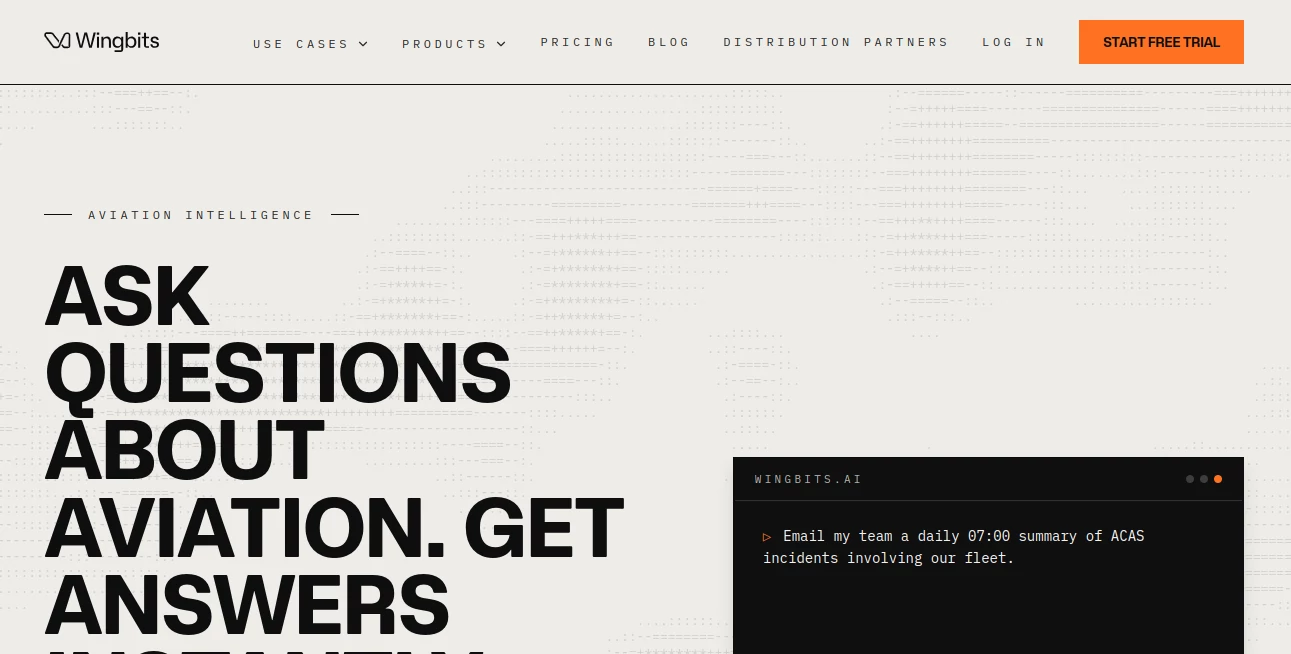
Wingbits.AI is an aviation intelligence platform built for people who need useful answers from flight data without spending hours working through flight trackers, databases, or technical documentation. It brings live and historical aviation data into a simple, natural-language experience, allowing users to ask questions, investigate aircraft activity, monitor airspace, and follow specific events from one place.
The idea is refreshingly straightforward: instead of figuring out how to query aviation data, you simply describe what you want to know. The platform can then return an answer based on live or historical flight information and provide a traceable data trail behind the result.
For aviation professionals, researchers, OSINT analysts, lessors, charter brokers, underwriters, traders, and serious aviation enthusiasts, this can make flight intelligence considerably easier to work with. The underlying network includes more than 6,000 verified ADS-B ground stations across more than 120 countries and tracks over 200,000 flights each day.
Key Features
- Natural-language aviation search: Ask questions about live and historical flight activity using ordinary language rather than SQL, query syntax, or technical API documentation.
- Automated monitoring agents: Create agents that watch aircraft, fleets, regions, squawk codes, airspace activity, and specific aviation events on a recurring schedule.
- Live and historical data: Investigate what is happening now or look back at previous flight activity to understand routes, aircraft movements, operators, and regional patterns.
- Event monitoring: Agents can monitor events such as 7500, 7600, and 7700 squawk codes, ACAS/TCAS incidents, GPS interference, and other aviation signals.
- Multiple alert channels: Monitoring results can be delivered through Slack, Microsoft Teams, Telegram, or email.
- Verified aviation data: Flight information comes from a professionally operated ADS-B network, with signals authenticated at receiving stations and cross-checked to identify possible spoofing.
- Audit-ready reports: Conversations can be exported as PDF or JSON reports with the supporting data trail included.
- Developer access: Live and historical aviation data can also be accessed through an API, low-latency data streams, or MCP for developers and AI systems.
User Interface
The interface is designed around a simple conversational workflow. Rather than presenting users with a complicated aviation database, it lets them describe the question or monitoring task in plain English.
That makes a noticeable difference for users who understand aviation but are not interested in learning another technical query language. Someone researching an aircraft can ask a direct question, while a team monitoring a particular region can describe the condition they want watched and let the platform create the monitoring workflow.
The agent builder is particularly practical. You describe what should be monitored, confirm the generated agent, select a schedule, and choose where alerts should arrive. It feels closer to setting up a digital analyst than configuring traditional flight-data software.
Accuracy & Performance
Accuracy is one of the more important aspects of an aviation intelligence platform, especially when the information is being used for research, risk analysis, or operational decisions. The underlying network is built around verified ADS-B receiving stations rather than simply presenting an untraceable collection of flight positions.
The network currently spans more than 6,000 stations in over 120 countries and tracks more than 200,000 flights daily. The provider also reports sub-second stream latency, with 99% of data arriving within that range.
Another useful detail is source verification. Signals are authenticated at the receiving station and cross-checked across the network for potential spoofing. This gives users more context when evaluating whether a flight position or event should be trusted.
There are also clear limitations. The platform cannot see aircraft that are not transmitting ADS-B, does not provide ATC-filed flight plans or maintenance schedules, and should not be treated as a system for predicting future delays or events. Those boundaries make the product easier to evaluate realistically.
Capabilities
The platform goes beyond basic flight tracking. Users can investigate individual aircraft, fleets, operators, routes, regions, military callsigns, airspace activity, and historical movements. This makes it useful when the question is not simply “Where is this aircraft?” but rather “What has this aircraft been doing?”
Automated agents add another layer. An analyst might create an agent to watch a particular fleet, monitor a region every few minutes, or flag specific aviation events. The system can then send the relevant information to the team's existing communication channel rather than requiring someone to continuously watch a dashboard.
For developers, the data layer opens a different route. Live and historical aviation data can be queried programmatically, while MCP access allows the same type of verified aviation information to be connected to compatible AI systems and agents.
Security & Privacy
Data provenance is a central part of the platform's approach. The underlying ADS-B signals are authenticated to their receiving stations, and the network uses cross-checking to help identify spoofing. This is especially relevant for analysts who need to understand where a particular piece of flight information came from.
The service also separates its aviation data capabilities from the broader applications built on top of them. Users can work through conversational tools and monitoring agents, while organizations that require raw data can access dedicated API, streaming, and MCP options.
As with any service handling potentially sensitive operational research, organizations should review the provider's current privacy policy and terms before deploying it for internal or confidential workflows.
Use Cases
Aviation lessors can use automated monitoring to keep track of aircraft activity and gain additional visibility into where their assets are operating.
Charter brokers can investigate aircraft movements and historical activity more quickly when researching potential options or answering client questions.
Insurance underwriters can use flight activity and aviation signals as additional research inputs when examining operational patterns and potential risk indicators.
OSINT analysts and researchers can investigate aircraft movements, historical routes, military callsigns, airspace activity, and other signals while retaining a traceable source behind the information.
Prediction-market traders can monitor aircraft activity when physical movements are relevant to a market. Instead of manually checking aircraft identifiers and flight trackers, they can describe the condition they want an automated agent to watch.
Developers and AI builders can access the underlying aviation data through APIs, low-latency feeds, and MCP, making the data useful for custom applications and AI-powered workflows.
Aviation enthusiasts can also benefit from the conversational interface. Someone who normally spends time jumping between flight trackers and aviation databases can ask a question directly and explore the answer without learning a specialized data system first.
Pros and Cons
- Pros: Natural-language aviation research makes complex flight data easier to explore.
- Pros: Live and historical flight data are available from the same environment.
- Pros: Automated agents can monitor aviation events continuously rather than relying on manual tracking.
- Pros: Alerts can be delivered through Slack, Microsoft Teams, Telegram, and email.
- Pros: Source tracing and network-level verification provide useful context for research.
- Pros: API, streaming, and MCP options make the data suitable for technical teams as well as individual analysts.
- Cons: Aircraft that do not transmit ADS-B cannot be directly observed through the platform.
- Cons: It does not replace ATC flight-plan systems, maintenance databases, or charter-booking platforms.
- Cons: Advanced data products and tailored business access require contacting sales.
Pricing Plans
The platform currently offers a 14-day Pro trial at no cost, with no credit card required. The trial includes full Pro access along with chat and monitoring agents, giving new users a practical way to test the service before committing to a longer-term arrangement.
For organizations with more demanding requirements, custom pricing is available. Tailored plans can include extended historical data, API access, low-latency streams, and MCP access. This approach makes more sense for teams that need aviation data as part of an existing research, analytics, or software workflow rather than simply using the conversational interface.
How to Use It
Start by creating an account and using the free trial. Once inside the platform, begin with a straightforward aviation question in plain English. You do not need to learn SQL or a proprietary query language first.
For continuous monitoring, describe the situation you want to watch. For example, you could ask for an agent to monitor a particular fleet, aircraft, region, squawk code, or aviation event. Review the generated configuration and confirm it.
Choose how frequently the agent should run. Monitoring can be scheduled from very frequent checks to weekly activity, depending on the task. Then select Slack, Microsoft Teams, Telegram, or email as the delivery destination.
When investigating a result, pay attention to the supporting flight information and source trail. This is particularly useful for research tasks where being able to explain how an observation was obtained matters as much as the observation itself.
Developers who need direct access can take a different route and explore the API, data streams, or MCP offering for integration into their own applications and AI systems.
Comparison with Similar Tools
Traditional flight trackers are excellent when the main requirement is seeing aircraft positions on a map. The approach here is different. Instead of making the user navigate a visual tracker and manually assemble information, it puts conversational analysis and automated monitoring at the center of the experience.
General-purpose AI assistants can explain aviation concepts, but they do not automatically have access to a dedicated, continuously updated aviation data network. The advantage here is the connection between an AI interface and a specialized source of live and historical flight information.
Generic data APIs can provide raw aviation information to developers, but they often leave the analysis, monitoring logic, and alerting workflow to the customer. The agent-based approach reduces that setup work by allowing users to describe the monitoring requirement in ordinary language.
The result is a product that sits somewhere between an aviation research assistant, an automated monitoring service, and a developer-facing flight-data platform. That combination is particularly appealing for teams that need both quick answers and repeatable monitoring workflows.
Conclusion
Aviation data can become surprisingly difficult to work with once a simple “where is this aircraft?” question turns into a deeper investigation. Historical movements, fleet activity, airspace events, GPS interference, emergency squawks, and source verification can quickly push users into multiple tools and manual research.
This platform takes a more streamlined approach. Its conversational interface makes aviation data accessible without technical query skills, while monitoring agents turn recurring research tasks into automated workflows. The verified ADS-B network underneath the service adds another important layer, particularly for users who care about data provenance.
It is not designed to replace every aviation information system, and its ADS-B-based nature comes with clear limitations. But for researchers, aviation professionals, analysts, traders, developers, and enthusiasts who want faster access to live and historical flight intelligence, it offers a compelling combination of AI-assisted research, automated monitoring, and direct aviation data access.
Frequently Asked Questions (FAQ)
What type of aviation data can users explore?
Users can work with live and historical flight information, aircraft movements, routes, operators, fleets, regions, squawk events, ACAS/TCAS incidents, and GPS-interference signals derived from the underlying network.
Can it monitor aircraft automatically?
Yes. Monitoring agents can be configured to watch specific aircraft, fleets, regions, squawk codes, and other aviation conditions. Agents can run on a recurring schedule and send results to supported communication channels.
Which notification channels are supported?
Alerts and reports can be delivered through Slack, Microsoft Teams, Telegram, and email. Custom message templates are also supported for destinations.
Does it provide historical flight information?
Yes. The service can work with historical flight data as well as live activity, making it suitable for investigating previous movements and identifying patterns over time.
Does it offer an API?
Yes. Developers can access live and historical aviation data through an API. Low-latency data streams and MCP access are also available for suitable business and AI integration requirements.
Does it require coding?
No for the conversational and monitoring-agent experience. Users can create queries and describe monitoring requirements in plain English. Technical integrations are available separately for developers who need direct data access.
Can it detect GPS jamming?
Yes. GPS-interference signals derived from the network can be monitored, and automated agents can be configured around relevant aviation events.
Can it see every aircraft?
No. The system relies on ADS-B transmissions and therefore cannot directly observe aircraft that are not transmitting ADS-B. It also does not provide ATC-filed flight plans, maintenance schedules, or charter-booking availability.
Is there a free trial?
Yes. New users can start with a 14-day Pro trial without providing a credit card. The trial includes access to chat and monitoring agents.
Who is this platform best suited for?
It is particularly useful for aviation professionals, lessors, charter brokers, insurance teams, OSINT analysts, researchers, prediction-market traders, developers, and aviation enthusiasts who need to investigate or monitor flight activity without building their own aviation-data workflow.
AI Research Tool , AI Analytics Assistant .
These classifications represent its core capabilities and areas of application. For related tools, explore the linked categories above.

Wingbits Alternatives Product

CoolVerdict

Where Is Thi…

Arobis AI Vi…

SuperAI

Glanced

Ecom Mediate…

Diploria AI

UPDF AI

AI Complianc…
