

















AltHunt
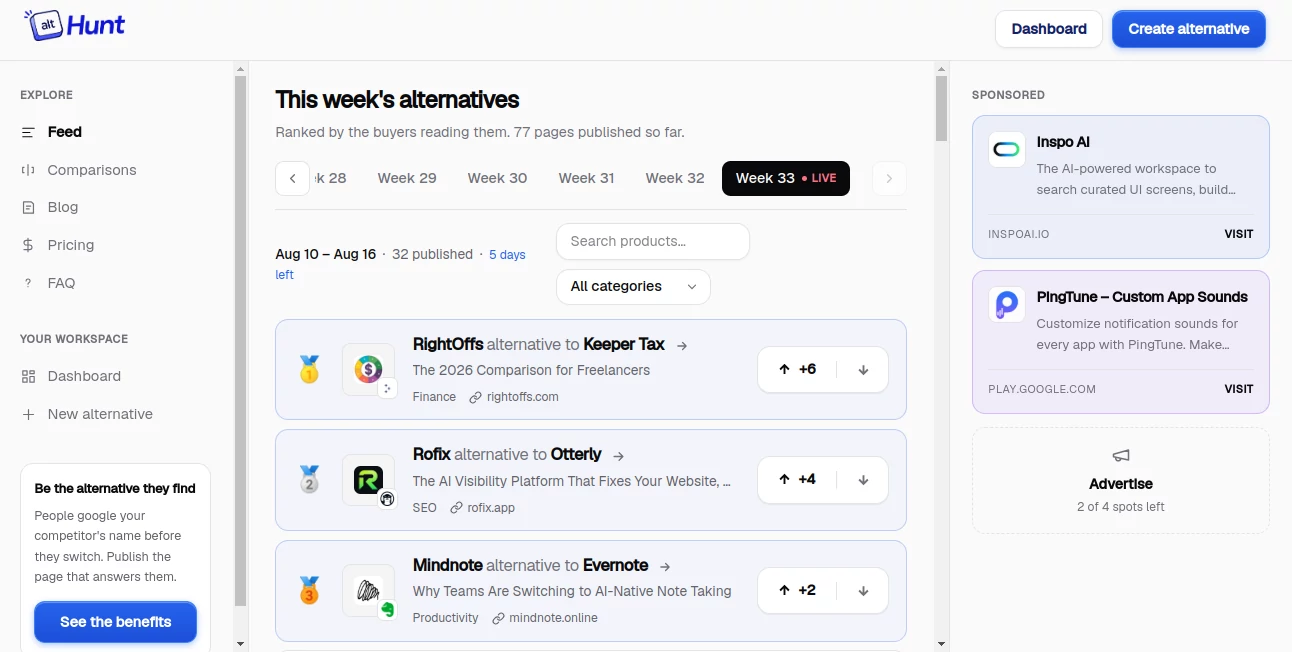
What is AltHunt?
Alt Hunt is a SaaS comparison platform built for companies that want to be discovered when potential customers are already looking for alternatives. Instead of relying only on a traditional product landing page, businesses can publish structured comparison pages that place their product alongside established competitors.
The idea is refreshingly practical. A buyer searching for an alternative is usually much closer to making a decision than someone casually browsing software. The platform helps SaaS makers create pages designed around that moment, combining product comparisons, feature information, pricing details, and honest tradeoffs in one place.
For a growing software company, this can be especially useful because comparison searches often reveal strong purchase intent. Rather than simply saying that a product is better, a comparison page can explain where it fits, what it does differently, and which type of customer may benefit most from making the switch.
Key Features
- Structured alternative pages for SaaS products
- Feature comparison matrices
- Pricing comparisons
- AI-powered draft generation
- Notion-style block editor
- Comparison pages designed around competitor searches
- Support for images, videos, code snippets, and CTA blocks
- Product discovery through a searchable comparison feed
- Weekly rankings based on buyer engagement
- Multi-language publishing on the Pro plan
- Custom branding on the Pro plan
- Unlimited post-publication edits on the Pro plan
User Interface
The interface is designed around publishing rather than complicated marketing automation. Users can move from creating an alternative page to editing its content without having to learn a large collection of unfamiliar controls.
The block-based editor is particularly useful for SaaS teams that want to assemble a comparison page with different types of content. Images, videos, code snippets, and calls to action can be included alongside the written comparison, giving the resulting page more depth than a simple text listing.
The overall experience feels focused. Instead of turning the platform into another large marketing dashboard, the product keeps its attention on one practical task: creating pages that help buyers compare software.
Accuracy & Performance
Comparison content is most useful when it gives potential customers enough information to make a sensible decision. The platform's structure encourages product owners to discuss features, pricing, strengths, weaknesses, and tradeoffs rather than relying entirely on promotional claims.
AI-powered draft generation can speed up the initial writing process, while the editor allows the product owner to review and refine the result before publication. This is a useful workflow for teams that want to get a comparison page online quickly without giving up control over the final message.
The platform also presents comparisons through a searchable feed and organizes published pages by categories, giving individual comparisons another discovery path beyond direct search.
Capabilities
The strongest capability is the ability to turn a competitor-focused search into a dedicated product comparison page. A SaaS company can publish an alternative page explaining why a buyer might choose its product, while still presenting meaningful differences between the two options.
Pages can include feature matrices, pricing information, verdict-style conclusions, media, calls to action, and supporting content. This makes the format suitable for products ranging from developer software and productivity applications to marketing platforms and other business-focused SaaS products.
Another useful feature is the weekly comparison feed. Published alternatives can appear in a ranked environment where buyer activity influences their position. For newer SaaS products, this provides an additional discovery mechanism instead of depending entirely on their own website traffic.
Security & Privacy
The platform provides dedicated Privacy and Terms pages, but users should still review the current policies before publishing sensitive business information. As with any third-party publishing service, companies should avoid placing confidential customer information, private credentials, or proprietary data inside comparison content.
For normal product marketing material, the platform's publishing model is straightforward: companies create public comparison content intended for potential buyers and control the information they choose to present.
Use Cases
- SaaS alternative pages: Create dedicated pages targeting customers comparing your product with a larger competitor.
- Competitive positioning: Explain where your product offers a different approach, pricing model, or feature set.
- Buyer education: Give prospects a clearer view of the differences between competing products before they make a purchase.
- Product discovery: Gain exposure through a dedicated feed of SaaS comparisons.
- Startup marketing: Give a newer SaaS product another channel for reaching users who are actively considering alternatives.
- Content creation: Use AI-assisted drafting to get the first version of comparison content ready faster.
- International growth: Pro users can publish translations in five European languages.
Pros and Cons
Pros
- Focused specifically on SaaS alternative and comparison pages
- AI-assisted draft generation saves time during content creation
- Feature matrices make product differences easier to understand
- Free plan available with no recurring subscription fee
- Supports multimedia and CTA blocks
- Pro plan offers a lifetime payment rather than a recurring monthly charge
- Useful format for high-intent competitor searches
Cons
- The free plan limits each product to one comparison page
- Free users have only one post-publication edit
- Advanced branding and publishing features require the Pro plan
- The platform is primarily designed for SaaS comparison marketing rather than general-purpose content publishing
- The Pro plan is currently presented as coming soon on the pricing page
Pricing Plans
The platform uses a simple free-and-paid structure. The Free Tier costs $0 forever and includes one comparison page per product, AI-powered draft generation, the block editor, up to two images, one video embed, one code snippet, one CTA block, and one edit after publication.
The Pro plan is listed at $49 as a one-time lifetime payment. It adds up to 10 alternative pages, translations into five European languages, unlimited post-publication edits, unlimited high-resolution images and uploads, unlimited video embeds and code snippets, priority AI generation, custom branding, and removal of the platform badge. The pricing page currently marks the Pro purchase option as coming soon.
How to Use the Platform
Start by creating an account and opening the alternative-page creation workflow. Enter the product information and select the competitor you want to position against. The AI-assisted drafting feature can then help prepare the initial comparison content.
Review the generated material carefully and adjust it to reflect the real capabilities, pricing, and limitations of your product. Add supporting images, videos, code snippets, or a CTA where they genuinely help the reader.
Before publishing, read the comparison as if you were a potential customer. The strongest pages are not simply advertisements. They make the decision easier by explaining who should choose the product and where another option might be a better fit.
Comparison with Similar Tools
Traditional SaaS directories generally focus on listing products, while general website builders and CMS platforms give companies broad control over publishing. This platform takes a narrower approach: it is built around the specific search behavior of people looking for alternatives to software they already know.
That focus is its main distinction. A standard product page talks primarily about the product itself. A dedicated alternative page starts with the buyer's existing reference point and answers the more immediate question: “Should I switch?”
For a SaaS company already producing landing pages, blog posts, and documentation, comparison pages can therefore complement rather than replace existing marketing content.
Conclusion
Alt Hunt takes a clear approach to SaaS marketing: meet potential customers at the point where they are actively comparing products. Its combination of structured comparison pages, feature matrices, pricing information, AI-assisted drafting, and buyer-focused discovery makes the concept particularly relevant to startups and growing software companies.
The free tier also makes it easy to test the idea without committing to a recurring subscription. For teams with several competitors to target, the Pro offering provides more publishing capacity and additional control over the finished pages.
If your SaaS product frequently appears in searches such as “alternative to,” “X vs Y,” or “best alternative to X,” creating well-researched comparison pages can be a worthwhile addition to your acquisition strategy.
Frequently Asked Questions (FAQ)
What is this platform used for?
It is designed to help SaaS companies publish comparison and alternative pages that position their products against established competitors.
Does it have a free plan?
Yes. The Free Tier costs $0 forever and includes one comparison page per product along with AI-powered draft generation and several content blocks.
Does it use AI to create comparison content?
Yes. AI-powered draft generation is included in the Free Tier and can help users prepare the initial version of a comparison page.
How much does the Pro plan cost?
The Pro plan is listed at $49 as a one-time lifetime payment. It provides additional pages, translations, unlimited edits, expanded media capabilities, priority AI generation, and custom branding.
Can users publish multiple alternative pages?
Free users can publish one comparison page per product. The Pro plan increases this limit to up to 10 alternative pages.
Is the Pro plan available now?
The pricing page currently lists the Pro plan at $49 lifetime but marks the purchase option as coming soon.