Callsy
What is Callsy?
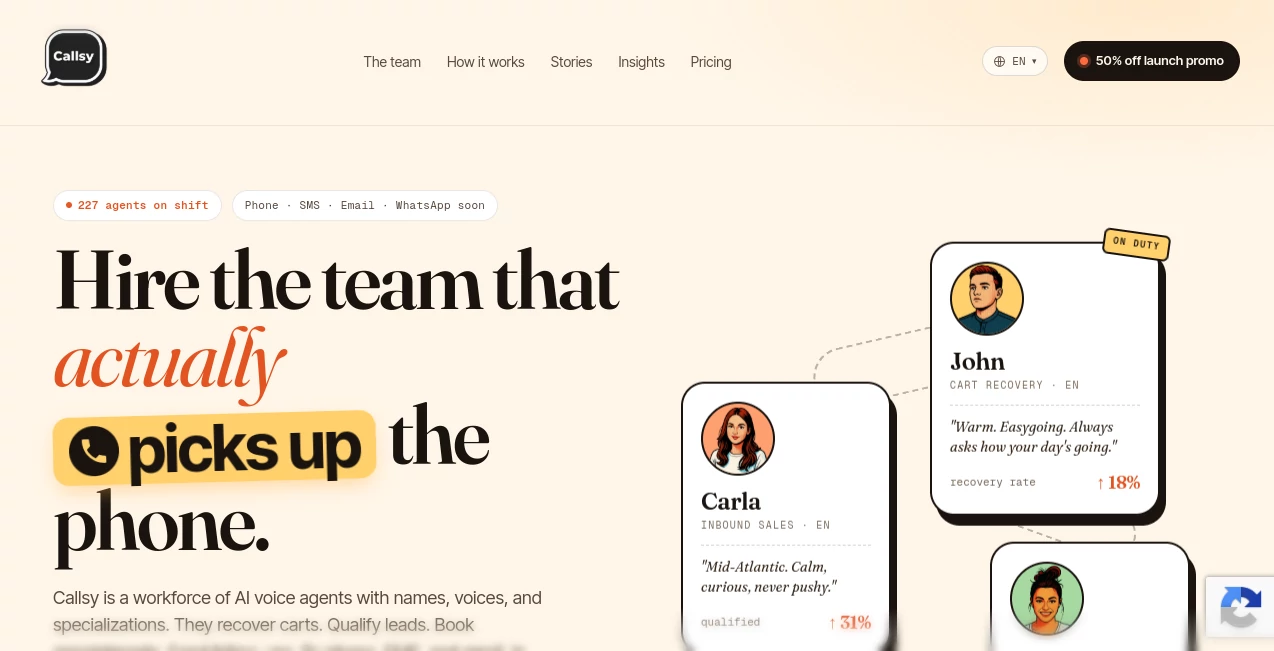
Callsy is an AI voice agent platform built for businesses that need more than a chatbot or an automated email. It provides AI agents that can handle phone calls, SMS, and email follow-ups around the clock, helping businesses recover abandoned carts, qualify leads, book appointments, reconnect with inactive customers, manage payment reminders, and collect customer feedback.
The idea is refreshingly practical: instead of waiting for a customer to call back or hoping someone on the team notices a missed opportunity, an AI agent can take action at the right moment. For an online store, that might mean calling someone who left a €127 cart unfinished. For a clinic, it could mean confirming an appointment and sending a reminder. For a sales team, it can mean qualifying a new lead and routing a promising conversation to the right employee.
The platform is designed to be quick to deploy, with the company stating that businesses can connect their existing stack and get an agent working in about five minutes. It also supports more than 40 languages and offers a selection of voices designed around different accents and regions.
Key Features
- AI voice agents for automated business calls
- Abandoned cart recovery through phone and SMS
- Inbound lead qualification and sales routing
- Appointment booking and reminders
- Win-back campaigns for inactive customers
- Payment reminders and collection workflows
- NPS and customer feedback calls
- Phone, SMS, and email communication
- 60+ voice options across 40+ languages
- Custom scripts and brand-specific conversations
- Conversation transcripts and summaries
- Analytics and contact management
- Integrations with Shopify, WooCommerce, WordPress, Klaviyo, Omnisend, and other tools
- Webhook support for custom workflows
User Interface
The interface is built around the idea of managing a small team of specialized AI agents rather than configuring a complicated collection of automation rules. Each agent can have a specific role, voice, and workflow, while businesses can monitor activity from a central dashboard.
This approach makes sense for teams that want to separate different customer journeys. One agent can focus on abandoned carts while another handles appointment bookings and another works on lead qualification. The result is easier to understand than putting every workflow into one oversized automation.
Accuracy & Performance
Performance is particularly important for voice-based AI because a useful conversation needs to feel responsive rather than scripted. The platform offers region-specific voices and supports a wide range of languages, with the available voice library covering different accents and conversational styles.
The company also publishes example performance figures for individual workflows, including reported recovery, qualification, booking, reactivation, payment, and feedback results. These figures are best treated as customer or use-case examples rather than guaranteed results, since actual performance will depend on the business, audience, offer, and workflow.
Capabilities
The strongest part of the platform is its range of business-focused workflows. It is not limited to answering incoming calls. Agents can proactively contact customers, continue conversations through SMS, send emails, qualify prospects, schedule appointments, and follow up when a customer does not answer.
For e-commerce businesses, abandoned cart recovery is a particularly useful application. An agent can contact a shopper, answer questions, address objections, and send a checkout link by text. For service businesses, appointment booking and reminders can reduce the amount of manual communication required from staff.
There is also support for custom workflows through webhooks and integrations, making the platform more suitable for companies that already have established marketing, sales, or customer-management systems.
Security & Privacy
Privacy matters when an AI system is handling customer conversations, contact information, and business data. The platform states that it is GDPR-ready, uses EU hosting, and provides GDPR-compliant data processing. It also states that its voice agents identify themselves as AI during calls.
Businesses should still review the platform's current privacy documentation, data-processing terms, and applicable communication regulations before deploying automated calls or messages, particularly when operating across different countries.
Use Cases
- Abandoned Cart Recovery: Contact shoppers who leave products in their carts and continue the conversation through phone or SMS.
- Lead Qualification: Ask predefined qualification questions and route promising prospects to a human sales representative.
- Appointment Booking: Check availability, schedule appointments, and send confirmations or reminders.
- Customer Win-Back: Reconnect with customers who have not purchased recently and encourage them to return.
- Payment Reminders: Follow up on overdue invoices and help customers complete payment-related actions.
- NPS & Feedback: Contact customers after a purchase and collect conversational feedback without relying entirely on traditional surveys.
- Inbound Sales: Handle initial conversations with prospects and transfer qualified opportunities to the appropriate team member.
Pros and Cons
- Pros: 24/7 AI voice agents, multiple communication channels, strong e-commerce use cases, appointment booking, lead qualification, a broad voice and language selection, integrations with popular business platforms, webhook support, and a quick setup process.
- Cons: Results can vary considerably between businesses and workflows. Automated calling also requires careful attention to consent and local communication regulations. Businesses with highly unusual workflows may need additional configuration or custom integrations.
Pricing Plans
The current Pro plan is advertised at €49 per month under a 50% launch discount, reduced from €99 per month. The plan includes 380 actions per month, with additional actions charged separately. It supports up to six AI agents and includes voice, SMS, email, custom voices and scripts, transcripts, summaries, analytics, CRM functionality, MCP server access, and API access.
The current offer also includes free setup, a seven-day money-back guarantee, and the ability to cancel at any time. Pricing and promotional terms may change, so businesses should check the latest plan details before subscribing.
How to Use It
- Choose the type of AI agent you need, such as cart recovery, lead qualification, booking, win-back, payments, or customer feedback.
- Select a suitable voice and language for your customers.
- Connect the relevant business tools, such as Shopify, WooCommerce, WordPress, Klaviyo, or Omnisend.
- Configure the agent's role, conversation instructions, brand voice, and follow-up rules.
- Connect a webhook or API if your workflow requires a custom integration.
- Test the conversation and make sure the agent handles common customer questions correctly.
- Launch the workflow and monitor conversations, transcripts, contacts, and results from the dashboard.
Comparison with Similar Tools
Traditional chatbots are useful when customers are already on a website, but they cannot independently pick up a phone and continue a real conversation. Email automation can reach large audiences, yet it often depends on customers opening and responding to messages. Traditional call centers provide human interaction but require staffing, scheduling, and ongoing operational costs.
This platform sits between these approaches. It combines automated voice conversations with SMS and email follow-ups, allowing a business to respond to customers across multiple channels without assigning every interaction to a human employee.
Its biggest advantage is the focus on specific revenue and customer-service workflows rather than generic conversations. Businesses looking primarily for automated cart recovery, lead qualification, appointment booking, or customer follow-up may find this approach more useful than a general-purpose conversational AI system.
Conclusion
For businesses where a missed call, abandoned checkout, forgotten appointment, or uncontacted lead can directly affect revenue, AI voice agents offer a compelling way to close communication gaps. The combination of phone calls, SMS, email, specialized agents, and business integrations makes this platform particularly interesting for e-commerce companies, clinics, service providers, and sales teams.
The quick setup is another strong point. Instead of building a voice automation system from scratch, businesses can choose an existing workflow, connect their tools, configure the conversation, and start testing. The ability to create several specialized agents also makes it possible to keep different customer journeys organized.
It is not a replacement for every human conversation, and businesses should carefully review compliance requirements before launching automated outreach. But for repetitive, time-sensitive interactions, it can provide a practical extra layer of customer communication that works well beyond normal business hours.
Frequently Asked Questions (FAQ)
What does this AI platform do?
It provides AI agents that can make and receive business calls, send SMS and emails, qualify leads, recover abandoned carts, book appointments, follow up with customers, handle payment reminders, and collect feedback.
How quickly can I set it up?
The platform states that businesses can connect their existing tools and get an agent live in approximately five minutes, depending on the workflow and integrations being configured.
How many languages are supported?
The platform currently promotes support for more than 40 languages and offers a large selection of voices with different regional accents and styles.
Can it recover abandoned shopping carts?
Yes. Abandoned cart recovery is one of its core use cases. An AI agent can contact shoppers by phone, follow up by SMS when appropriate, answer questions, and help guide the customer back toward completing the purchase.
Does it support integrations?
Yes. Available integrations include Shopify, WooCommerce, WordPress, Klaviyo, Omnisend, and other business tools, while webhooks can be used for custom connections.
Is it suitable for appointment-based businesses?
Yes. Appointment booking and reminders are among the supported workflows. An agent can communicate with customers, check available times, arrange appointments, and send confirmations or reminders.
Does it support GDPR requirements?
The company states that its service is GDPR-ready and EU-hosted, with GDPR-compliant data processing. Businesses should still review the applicable terms and privacy requirements for their specific use case.
AI Sales Assistant , AI Customer Service Assistant , AI E-commerce Assistant , AI Voice Assistants .
These classifications represent its core capabilities and areas of application. For related tools, explore the linked categories above.

Callsy Alternatives Product

LeadCanvas

AI Product P…

Gemini Omni …

Free GPT IMG

Weblo AI

Omni Voice

LPM 1.0

Vmake AI

Speechara