
Cerebras Inference
What is Cerebras Inference?
Cerebras Inference is built for developers who want AI applications to feel fast, responsive, and ready for real-time interaction. Instead of treating inference speed as an afterthought, the platform makes it a central part of the development experience, giving builders access to leading language models through a high-speed inference infrastructure.
The service is particularly interesting for applications where waiting several seconds for a response can make the product feel sluggish. Coding assistants, research agents, automation systems, conversational applications, and other AI-powered workflows can benefit from rapid token generation and lower response latency.
Getting started is also relatively straightforward. OpenAI API compatibility means developers can integrate the service into existing applications with minimal changes rather than rebuilding their entire AI stack from scratch.
Key Features
- High-speed inference designed for interactive AI applications.
- Support for leading open and commercial model families.
- OpenAI API compatibility for easier integration.
- Streaming responses for more responsive user experiences.
- Function calling and tool-use capabilities on supported models.
- Structured outputs and JSON-based responses on supported models.
- Free credits for developers who want to prototype before paying.
- Higher rate limits and priority processing for paid users.
- Enterprise options with dedicated capacity and custom requirements.
- Access to models suitable for coding, reasoning, research, automation, and agentic workflows.
User Interface
This is primarily a developer-focused inference service rather than a traditional consumer chatbot, so the experience revolves around APIs, model selection, documentation, and developer workflows. That is a strength for technical teams: the interface stays focused on getting models into applications instead of adding unnecessary layers between the developer and the inference engine.
The platform also provides a model catalog and documentation that help developers understand which models are available and what capabilities they support. For someone experimenting with several models, this makes it easier to choose an option based on speed, context length, capabilities, and intended workload.
Accuracy & Performance
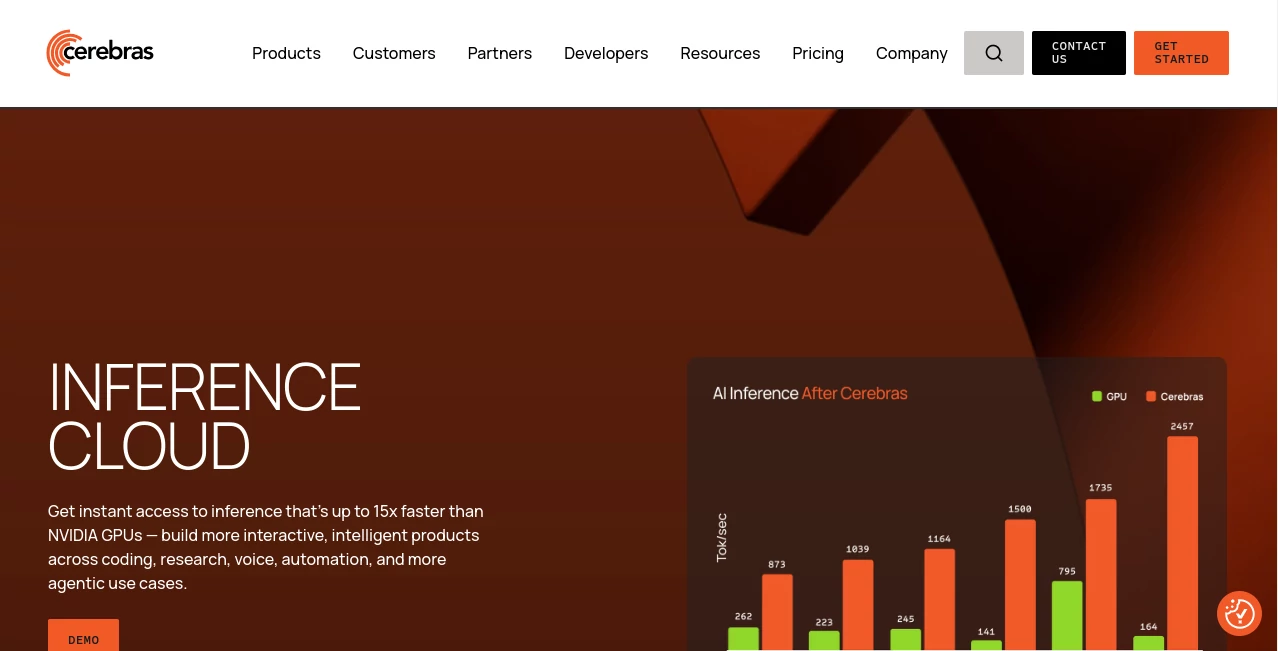
Speed is the standout characteristic. The platform states that its inference can reach speeds up to 15 times faster than NVIDIA GPU-based inference in certain comparisons. The underlying infrastructure uses a wafer-scale processor specifically designed for AI workloads, allowing the service to focus heavily on throughput and latency.
Fast token generation is more than a benchmark number when an application needs to generate long responses, run repeated model calls, or power an agent that reasons through several steps. A faster model response can make these workflows feel considerably more natural.
Supported models include options such as Llama 3.1 8B and OpenAI GPT OSS, while additional preview and dedicated-endpoint models are available depending on the workload and service tier. Current documentation lists GPT OSS at around 3,000 tokens per second and Llama 3.1 8B at around 2,200 tokens per second on the public production endpoints.
Capabilities
The platform is designed for more than simple text generation. Depending on the selected model, developers can use streaming, function calling, structured outputs, JSON mode, tool use, reasoning capabilities, and long context windows.
This makes it suitable for applications that need an LLM to interact with software rather than simply return a paragraph of text. A developer could use it behind a coding assistant, connect it to external tools, create an automated research workflow, or build a conversational application where response speed directly affects the user experience.
Model selection is another important part of the service. Developers can choose between different model sizes and families instead of being locked into a single model. This flexibility is useful when one application prioritizes reasoning quality while another needs maximum throughput and low latency.
Security & Privacy
Security requirements can vary significantly between prototypes and production systems. The platform provides enterprise-oriented options for organizations that need higher throughput, dedicated queue priority, custom model weights, uptime guarantees, and dedicated support.
Developers should still review the current service documentation and applicable enterprise terms before sending sensitive or regulated information through an inference API. The appropriate configuration depends on the application's data requirements, compliance obligations, and deployment model.
Use Cases
- AI Coding Assistants: Fast inference is useful for code generation, debugging, explanation, and interactive development tools.
- AI Agents: Agentic applications often make several model calls in sequence, making response time especially important.
- Research Applications: Researchers can use language models for summarization, question answering, analysis, and repeated reasoning workflows.
- Real-Time Applications: Fast token generation can make conversational and interactive products feel more immediate.
- Automation: Businesses can connect models to workflows where AI needs to interpret information and trigger actions.
- Document Processing: Long-context models can be used for document analysis, summarization, and question answering.
- Developer Platforms: Software companies can add language-model capabilities to their own products without maintaining the underlying inference infrastructure.
Pros and Cons
Pros
- Exceptional inference speed is the main advantage.
- OpenAI API compatibility can reduce integration effort.
- Multiple model families provide flexibility.
- Streaming and tool-oriented capabilities support interactive applications.
- A free starting option makes experimentation accessible.
- Paid and enterprise tiers are available for applications that need more capacity.
Cons
- The service is primarily aimed at developers rather than casual users.
- Model availability and capabilities can vary between tiers and endpoints.
- Free usage comes with rate limits.
- Some advanced enterprise capabilities require contacting the sales team.
- Preview models may change or be discontinued, so production applications should favor officially supported production models.
Pricing Plans
The service currently offers a free starting option, a self-serve developer tier, and an enterprise offering. New users can receive $5 in free credits after creating an account, giving developers an opportunity to test prompts, agents, and real-time applications before committing to paid usage.
The Developer tier uses pay-per-token pricing and starts with a $10 funding amount. It provides higher rate limits and higher-priority processing compared with the free tier.
Enterprise customers receive production-oriented features such as higher rate limits, dedicated queue priority, custom model weights, uptime guarantees, and dedicated support. Pricing is customized according to the organization's requirements.
How to Use It
- Create an account and obtain an API key.
- Choose a model that matches the application's requirements.
- Use the API through the supported developer interfaces.
- If an existing application uses the OpenAI API format, adapt the API configuration with minimal code changes.
- Test response speed, output quality, context requirements, and rate limits.
- Move to a paid tier when the application needs additional capacity or priority processing.
- For large production workloads, discuss enterprise requirements with the provider.
Comparison with Similar Tools
Many AI inference providers compete primarily on model selection, price, ecosystem, or ease of integration. This service takes a particularly strong position around inference speed and latency.
For a developer building a simple prototype, model quality and price may be the most important considerations. For an application that repeatedly calls an LLM, generates long responses, or needs to react immediately to user input, inference speed can become equally important. In those situations, the underlying hardware and high token-generation rates can make this platform especially attractive.
It is also worth comparing supported models, context limits, tool calling, structured output support, pricing per million tokens, and rate limits before selecting an inference provider. The fastest option is not automatically the best choice for every workload, but applications where latency is central can benefit significantly from this approach.
Conclusion
For developers who care deeply about AI response speed, this is one of the more compelling inference platforms to consider. Its combination of specialized AI hardware, fast token generation, model flexibility, API compatibility, and developer-friendly pricing makes it a practical option for both experimentation and serious application development.
The biggest appeal is simple: faster inference can change how an AI product feels. An assistant that responds quickly can feel interactive, while an agent that completes several model calls without long pauses can become much more useful. For developers building the next generation of AI-powered software, that difference is worth testing firsthand.
Frequently Asked Questions (FAQ)
What is this service mainly used for?
It provides high-speed AI inference for developers building applications powered by language models. Common uses include coding assistants, AI agents, research tools, automation, document processing, and real-time applications.
Does it support OpenAI-compatible APIs?
Yes. OpenAI API compatibility is provided to make it easier for developers to integrate the inference service into applications that already use compatible API patterns.
Is there a free option?
Yes. New users can receive $5 in free credits, although free access is subject to rate limits.
Which models are available?
The available catalog changes over time, but supported production models include options such as Llama 3.1 8B and OpenAI GPT OSS. Preview and dedicated-endpoint models can provide additional choices depending on the use case and account type.
Is it suitable for production applications?
Yes. Production workloads can use paid and enterprise options with higher throughput, priority processing, and additional enterprise features. Developers should select officially supported production models for applications where long-term availability is important.
Why is inference speed important?
Fast inference can reduce waiting time for users and shorten workflows that require multiple model calls. This is particularly valuable for conversational applications, coding assistants, and AI agents that need to respond or reason in real time.
AI API Design , Large Language Models (LLMs) , AI Developer Tools .
These classifications represent its core capabilities and areas of application. For related tools, explore the linked categories above.
Cerebras Inference details
Website unavailable — View Alternatives
Pricing
- Free
Apps
- Web App
Categories

Cerebras Inference Alternatives Product

OGimage

Latency Atlas

Gemini Omni

DeepSeek V4

CoolVerdict

UpMocker

Claude and C…

Schema Synth

Reverse Imag…