Concord
What is Concord?
Managing contracts becomes surprisingly difficult once a company has hundreds or thousands of agreements spread across departments, folders, inboxes, and cloud storage. Concord brings those contracts into one centralized environment and uses AI to make the information inside them easier to understand, search, manage, and act on.
The platform is designed to cover the full contract journey, from intake and drafting through negotiation, signing, deadlines, renewals, and ongoing management. Its approach is particularly useful for organizations where legal teams need to stay involved in important agreements without becoming a bottleneck for every routine request.
Rather than treating contracts as static documents, the platform turns them into searchable business information. Teams can find important terms, monitor dates, collaborate on changes, and use AI to answer questions about agreements without manually digging through every page.
Key Features
- AI Copilot for understanding contract terms, risks, obligations, and language.
- AI-powered extraction of important contract information such as dates, payment terms, and other key fields.
- Centralized contract repository with full-text search, filtering, and sorting.
- Legally binding electronic signatures.
- Online redlining, comments, live editing, and collaboration.
- Contract templates with smart fields for faster document creation.
- Deadline, renewal, and termination reminders.
- Version control and complete audit trails.
- Bulk uploading for bringing existing agreements into the platform.
- Approval workflows and intake forms on higher-tier plans.
- Integrations with services including Salesforce, HubSpot, Google Drive, Box, Dropbox, Zapier, and Slack.
User Interface
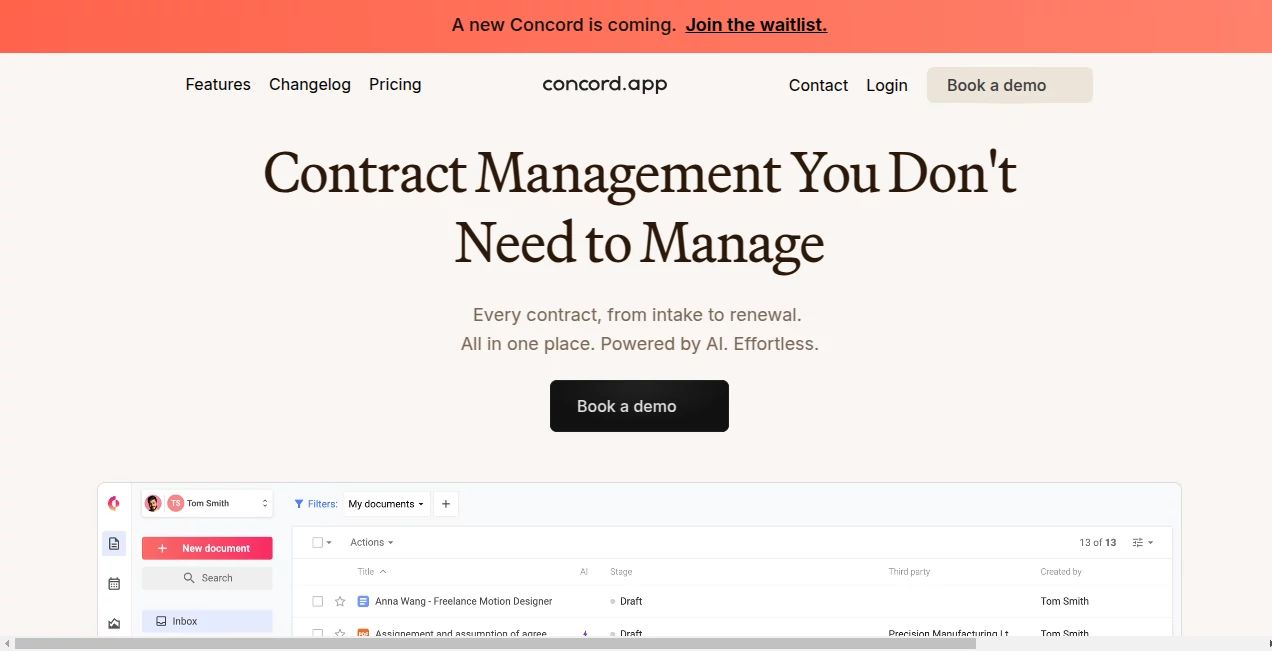
The interface is built around the idea that contract work should not require users to constantly switch between email threads, shared folders, signing platforms, and spreadsheets. Documents, conversations, revisions, approvals, and signatures can be handled within the same environment.
The centralized repository is especially practical for teams dealing with a large number of agreements. Instead of remembering where a particular document was stored, users can search contract information and filter results according to the data they need.
For a sales, procurement, finance, or operations team, this can make everyday contract work feel much closer to a normal business workflow rather than a separate legal process.
Accuracy & Performance
The AI features are designed around extracting useful information from real business contracts rather than simply generating text. The system can identify important dates, payment terms, obligations, risks, and other contract information, making large collections of agreements easier to review.
Its OCR and full-text search capabilities are also useful when organizations have accumulated older documents in PDF or Word formats. Existing agreements can be uploaded in bulk and transformed into a searchable repository, reducing the need for manual document-by-document inspection.
For teams that regularly search for renewal dates, governing-law clauses, payment information, or specific contractual language, this approach can save a considerable amount of repetitive work.
Capabilities
The platform covers much more than electronic signatures. Users can create agreements from templates, collaborate with counterparties, negotiate changes through online redlining, collect approvals, execute documents electronically, and continue managing them after signing.
AI can also assist with contract review by explaining risks and obligations and suggesting edits. Automated alerts help teams stay aware of upcoming deadlines, while structured contract data makes it possible to search and report on agreements across the organization.
Higher plans add capabilities such as intake forms, approval workflows, custom roles, custom teams, customized reports, clause libraries, subsidiary management, bulk sending, and an open API. This makes the platform suitable for organizations that want to build more structured contract operations around their existing processes.
Security & Privacy
Contracts often contain commercially sensitive information, so security is an important consideration for any contract management platform. The service provides audit trails and activity tracking to maintain visibility into document activity, including collaboration and signing events.
The company also states that its platform is SOC 2 compliant, GDPR compliant, and HIPAA-ready. Organizations evaluating the service should still review the current security documentation and contractual requirements to make sure the available controls match their own compliance obligations.
Use Cases
Legal departments can use the platform to organize agreements, prioritize important requests, review contract language, and reduce repetitive administrative work. AI-assisted review can also help answer routine questions before every request needs direct legal attention.
Procurement teams can keep supplier agreements organized, monitor important dates, and make sure contracts do not disappear into disconnected folders. Finance teams can search payment terms and other commercial information without manually opening every document.
Sales teams benefit from faster negotiation, online collaboration, templates, and electronic signatures. HR departments can manage employment-related agreements and associated deadlines, while operations and IT teams can maintain a centralized view of agreements relevant to their work.
A practical example is a company with several hundred supplier contracts. Instead of maintaining a separate spreadsheet for renewal dates, the team can centralize the agreements, allow AI to extract relevant information, and use automated reminders to identify upcoming actions.
Pros and Cons
Pros
- End-to-end contract management in one platform.
- Strong AI-assisted contract review and information extraction.
- Built-in electronic signatures and negotiation tools.
- Searchable repository with OCR and structured contract data.
- Useful integrations with popular business applications.
- Automated reminders for important contract dates.
- Suitable for multiple departments beyond legal teams.
Cons
- The paid plans are positioned primarily toward businesses rather than casual individual users.
- Advanced features require higher-tier plans.
- Companies with very simple document-signing needs may not need the full contract management feature set.
- Teams with complex requirements may need time to configure workflows, roles, templates, and integrations.
Pricing Plans
The current pricing structure is aimed at business users and is billed annually. The Essentials plan starts at $499 per month and includes five users, with additional users priced at $49 per month. It includes AI Copilot and extraction, unlimited electronic signatures, unlimited documents, free viewers and guests, collaboration tools, deadline reminders, amendment management, and core contract management features.
The Business plan costs $899 per month when paid annually and includes five users. Additional users cost $69 per month. It adds intake forms, approval workflows, custom roles, custom teams, customized reports, and integrations with Salesforce, HubSpot, Google Drive, Box, Dropbox, Zapier, and Slack.
The Enterprise plan starts at $1,299 per month with five users, while additional users cost $89 per month. It adds features such as a clause library, subsidiary management, bulk sending, an open API, custom branding, and additional enterprise capabilities. Volume discounts are available for larger organizations.
Pricing and included features can change, so companies considering deployment should confirm the latest plan details and requirements before purchasing.
How to Use
Start by bringing your existing agreements into the centralized repository. Documents can be uploaded individually or in bulk, allowing an organization to begin building a searchable contract library without manually recreating every record.
Once documents are available, use AI-powered extraction and search to identify important information such as dates, terms, obligations, and other contract details. This is particularly useful when dealing with a large collection of agreements.
For new contracts, teams can work with templates and smart fields, send documents for review, collaborate on edits, manage approvals, and complete electronic signatures. After execution, automated reminders and structured contract information help keep the agreement useful throughout its lifecycle.
A good starting point is to migrate a manageable group of active contracts first. This makes it easier to establish naming conventions, workflows, roles, and reminder processes before expanding the system across the entire organization.
Comparison with Similar Tools
Traditional contract repositories mainly solve the storage problem. A modern contract lifecycle management platform needs to address what happens before, during, and after signing. This is where an AI-driven approach can make a meaningful difference.
Compared with a basic document storage system, the platform combines repository functionality with contract search, AI extraction, negotiation, approvals, electronic signatures, reminders, and audit trails. Compared with using several disconnected applications, the benefit is having more of the workflow in one environment.
The strongest advantage is likely to appear in organizations where contracts are already creating administrative overhead. A small company with only a handful of agreements may find a simpler solution sufficient, while teams managing a growing contract portfolio can gain more value from centralized data and automation.
Conclusion
Contract management is rarely difficult because signing a document is complicated. The real challenge comes afterward: knowing what was agreed, finding the right version, remembering important dates, answering questions, and keeping every stakeholder aligned.
Concord brings these activities into a single contract management environment and adds AI where it can reduce repetitive work. Its combination of contract intelligence, searchable documents, collaboration, electronic signatures, workflow automation, and integrations makes it a strong option for organizations looking to modernize how agreements are handled.
For businesses that have outgrown shared folders, spreadsheets, and long email chains, the platform offers a more structured way to manage contracts from the first request through renewal or termination.
Frequently Asked Questions (FAQ)
What is this platform used for?
It is a contract management platform designed to help organizations create, negotiate, sign, organize, search, and manage business agreements throughout their lifecycle.
Does it use AI for contract management?
Yes. Its AI capabilities can assist with contract review, risk and obligation analysis, document extraction, summaries, and finding important information inside agreements.
Does it support electronic signatures?
Yes. Legally binding electronic signatures are included, with unlimited e-signatures available in the listed paid plans.
Can existing contracts be uploaded?
Yes. Organizations can upload existing documents, including through bulk uploading, and create a searchable contract repository.
Does it support integrations?
Yes. Depending on the plan, integrations include Salesforce, HubSpot, Google Drive, Box, Dropbox, Zapier, and Slack.
Is there a free plan?
The current pricing page lists paid business plans rather than a permanent free plan. Companies can contact the provider or book a demo to discuss deployment.
Which teams can use it?
The platform is designed for legal, procurement, finance, sales, HR, operations, and IT teams, making it suitable for organizations where contracts are shared across multiple departments.
Can it track contract deadlines?
Yes. The system can identify important dates and provide reminders for deadlines, renewals, and other contract events.
AI Workflow Management , AI Document Extraction , AI Contract Management , AI Legal Assistant .
These classifications represent its core capabilities and areas of application. For related tools, explore the linked categories above.

Concord Alternatives Product

Referent

Chatzy AI
Plainpaper

PDFgear
Discord Time…
Transpic
Manifestly C…
LaunchBoard
GLM-OCR Onli…