
Humalike
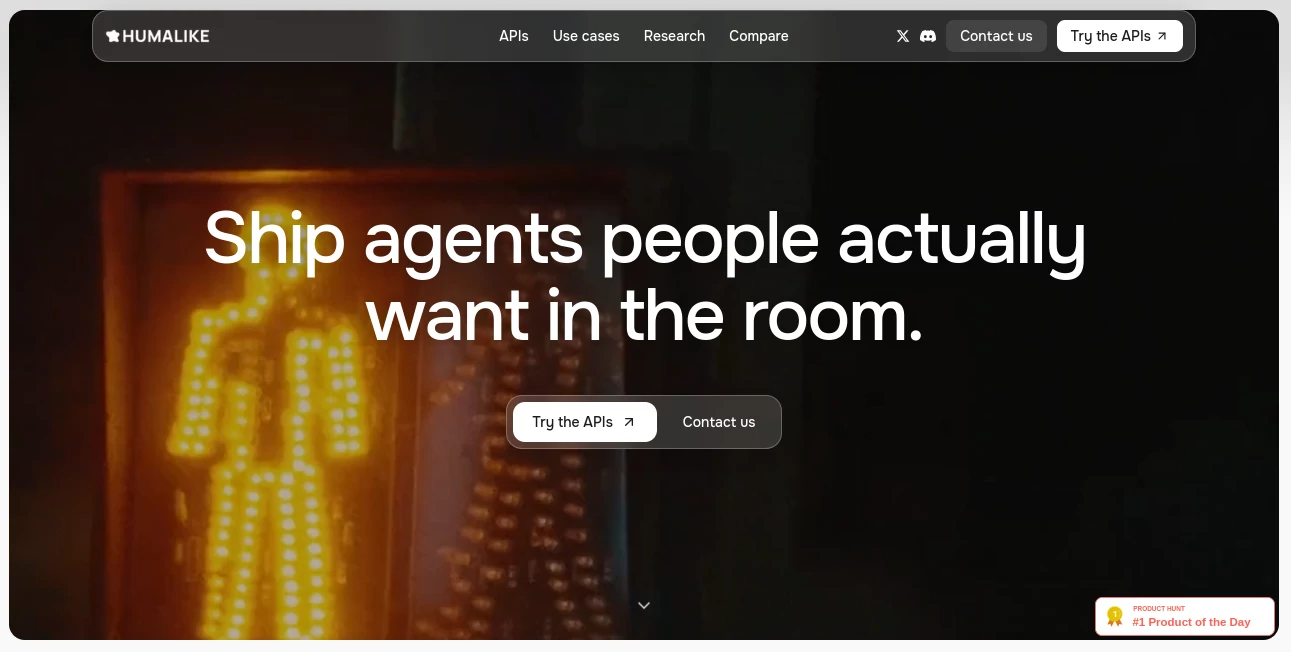
What is Humalike?
Humalike is a behavioral infrastructure platform built for teams that want AI agents to behave more naturally around people. Instead of focusing only on what an agent should say, it focuses on something that is often overlooked: when to speak, when to stay quiet, how to remember people, and how to adapt to the social environment.
The platform sits between an existing language model and the real conversation. This makes it particularly interesting for products that operate in group chats, communities, games, classrooms, workplaces, and AI-powered hardware. The approach is practical: developers can bring their preferred model and voice stack while adding a behavioral layer designed for human interaction.
For example, an AI coworker does not need to answer every message in a busy team channel. A good coworker knows when a comment needs a response and when silence is more appropriate. That distinction is at the heart of this platform.
Key Features
The platform provides seven behavioral components that can be combined according to the needs of an AI agent. They are designed to remain independent of a particular model, use case, or technology stack.
- Turn-Taking: Manages conversational timing so an agent can decide when to speak, wait, or interrupt.
- Theory of Mind: Helps an agent consider what different people may believe, want, or feel during an interaction.
- Norms: Allows agents to recognize group-specific tone, unwritten rules, slang, and inside jokes.
- Persona: Creates a more consistent personality grounded in real community context rather than a generic character description.
- Social Memory: Helps agents remember people, opinions, behavior, and relevant history across conversations.
- Social Signals: Detects conversational cues such as pauses, edits, and removed reactions that can otherwise be missed.
- Social Observability: Provides insight into how an agent is being received, including engagement and signs that people may be bored or annoyed.
User Interface
This is primarily a developer-facing infrastructure product rather than a traditional consumer application with a large collection of editing screens. The experience revolves around APIs, integration, documentation, and connecting behavioral capabilities to an existing agent.
That approach makes sense for product teams. Instead of replacing an existing AI stack, the behavioral layer can be added around the system a team has already built. There is also a dedicated integration for Hermes that is designed to add several humanlike behaviors without rebuilding the agent from scratch.
Accuracy & Performance
The platform takes a behavioral approach to improving agent interactions rather than presenting a simple accuracy score. Its research work includes studies around humanlike facilitation in group chats and local adaptation to social norms, which gives the product a research-oriented foundation.
Performance is particularly relevant in situations where timing matters as much as the response itself. An agent that gives a technically correct answer at the wrong moment can still create a poor experience. Turn-taking, social signals, memory, and group norms are intended to address precisely this problem.
Capabilities
The range of applications is broader than ordinary chatbots. Developers can use the behavioral components for gaming characters, AI coworkers, educational agents, companions, community systems, and humanoid products.
The multi-user focus is especially notable. The same behavioral infrastructure is designed to work in one-to-one conversations as well as environments involving several people. This gives developers room to build agents that can participate in a real group without simply responding to every message.
There is also a Hermes integration that combines turn-taking, persona, theory of mind, and social learning. This provides a useful starting point for developers who want to experiment with more socially aware agents.
Security & Privacy
Security is treated as an important part of the infrastructure. The company states that data is encrypted both in transit and at rest, with access controls in place. SOC 2 Type II and ISO 27001 are listed as in progress, while GDPR compliance is also shown as in progress.
For teams working with conversations and user behavior, this area deserves careful attention. Before deploying the system with sensitive production data, businesses should review the current security documentation, privacy policy, data handling practices, and subprocessor information for their particular use case.
Use Cases
One of the strongest aspects of the platform is the variety of environments where its behavioral layer can be useful.
- AI Gaming Characters: NPCs, teammates, and opponents can remember players and respond according to the context of previous sessions.
- AI Coworkers: Agents can join team channels, contribute to discussions, and remember what different teammates are working on.
- AI Companions: Hardware-based companions can use context, memory, mood, and timing to decide when interaction is appropriate.
- Ed-Tech: Educational agents can study alongside learners, discuss ideas, and participate in longer-running learning relationships.
- Creators & Communities: Community agents can react to conversations, understand local humor, and avoid overwhelming channels with unnecessary responses.
- Humanoids: Home robots can recognize household members, learn unwritten rules, understand context, and make better decisions about when to act or remain quiet.
- Therapy and Care: Specialized agents can use social signals and memory to maintain context and identify situations where escalation to a human may be appropriate.
Pros and Cons
Pros
- Works with different LLMs and technology stacks.
- Designed specifically around social behavior rather than simple text generation.
- Supports both one-to-one and group interactions.
- Offers several behavioral components that can be combined for different products.
- Useful across gaming, education, communities, companions, and workplace agents.
- New accounts receive $20 in free credits without requiring a payment card.
- Research-backed approach with published work related to humanlike group interaction and social norms.
Cons
- It is mainly aimed at developers and AI product teams rather than casual users.
- Some behavioral APIs are still listed as coming soon.
- Public pricing information is limited, so teams may need to contact the company for deployment details.
- Security and compliance certifications such as SOC 2 Type II and ISO 27001 are still described as in progress.
Pricing Plans
The platform does not currently present a conventional public pricing table with monthly plans on its main website. Instead, new accounts receive $20 in free credits to start building, with no credit card required. This is a useful way for developers to test the behavioral APIs and see how they fit into an existing product before discussing a larger deployment.
For production projects, especially commercial applications with significant conversation volume, it is best to contact the team directly for current pricing, usage limits, deployment options, and any enterprise requirements.
How to Use Humalike
Getting started is aimed at developers who already have an AI product or are building one. First, identify where the agent struggles socially. It might interrupt conversations, forget returning users, fail to understand a community's tone, or respond when it should remain silent.
Next, choose the behavioral components that address those problems. Turn-taking can help with conversational timing, social memory can maintain continuity between interactions, while norms and persona can make the agent feel more appropriate to a particular community.
The APIs can then be integrated alongside the existing model and application stack. Developers can also experiment with the Hermes integration, which provides a quicker route to adding several behavioral capabilities to a compatible agent.
A sensible first test is a small group environment. Give the agent a limited role, observe how people react, and measure whether it contributes at useful moments rather than simply increasing message volume. That kind of real-world feedback is particularly valuable for a product focused on social behavior.
Comparison with Similar Tools
The platform occupies a somewhat different position from many popular AI agent and conversational platforms. Rather than trying to be the complete application or replacing the underlying language model, it concentrates on the behavioral layer between the model and the people interacting with it.
This distinction is important. A developer can already have an LLM, application backend, memory system, or voice stack and still need better social behavior. In that situation, adding a specialized behavioral layer can be more practical than rebuilding the entire agent architecture.
Compared with character-focused systems, the emphasis here is broader than personality alone. Compared with conventional LLM APIs, the focus extends beyond generating an appropriate reply to understanding timing, group norms, social memory, and how an agent's behavior is being received.
Conclusion
Building an AI agent that can generate a good answer is relatively straightforward. Building one that knows when to answer, remembers who it is talking to, understands the tone of a community, and behaves appropriately in a group is a much harder problem.
That is where this platform makes its strongest case. Its behavioral APIs give developers a way to work on the social side of AI without abandoning the models and infrastructure they already use. The focus on turn-taking, memory, norms, social signals, and theory of mind makes it particularly relevant for products where people and AI need to share the same conversational space.
For developers building AI coworkers, gaming characters, companions, educational agents, community bots, or future humanoid systems, this is an interesting layer to explore. The free starting credits also make it easier to test the concept before committing to a larger integration.
Frequently Asked Questions (FAQ)
What is Humalike?
Humalike is a behavioral infrastructure platform for AI agents. It provides APIs and components designed to help agents interact with people in a more socially aware way.
Can I use my own LLM?
Yes. The platform is designed to be model-agnostic, allowing developers to bring the language model and voice stack they already use.
What is the main feature?
Turn-taking is presented as the flagship behavioral API. It helps an agent determine when to speak, wait, or interrupt while combining other behavioral capabilities underneath.
Does it support group conversations?
Yes. The infrastructure is designed for both one-to-one and multi-person environments, making it suitable for group chats, communities, team channels, and other shared conversational spaces.
Is there a free trial?
New accounts receive $20 in free credits to start building, and the website states that no credit card is required.
What security measures are available?
The company states that data is encrypted in transit and at rest and that access is restricted. SOC 2 Type II, ISO 27001, and GDPR compliance are currently described as in progress.
Who is this platform best for?
It is best suited to developers, startups, and product teams building AI agents that need to operate naturally around people rather than simply answer isolated prompts.
Can it be used for AI companions?
Yes. AI companions are one of the platform's highlighted use cases, particularly for products that need contextual memory, mood awareness, consistent personality, and better conversational timing.
Can it work with Hermes?
Yes. A dedicated integration is available for Hermes that can add turn-taking, persona, theory of mind, and social learning capabilities to the agent.
AI Life Assistant , AI Chatbot , AI Education Assistant , AI Developer Tools .
These classifications represent its core capabilities and areas of application. For related tools, explore the linked categories above.

Humalike Alternatives Product

SciFig

Where Is Thi…

Geekflare AI

Rate My Prof…

DeepSeek V4

AuraMeaning

Nimbalyst

LPM 1.0

KaneAI