













inite.ai
Verified Blue CheckMark
Verified Blue CheckMark products are featured above free or unverified listings.
This badge indicates authenticity and builds trust, giving your product higher visibility across the platform.
Upgrade to get verified
Verified Blue CheckMark products are featured above free or unverified listings. This badge indicates authenticity and builds trust, giving your product higher visibility across the platform.
Upgrade to get verified
What is inite.ai?
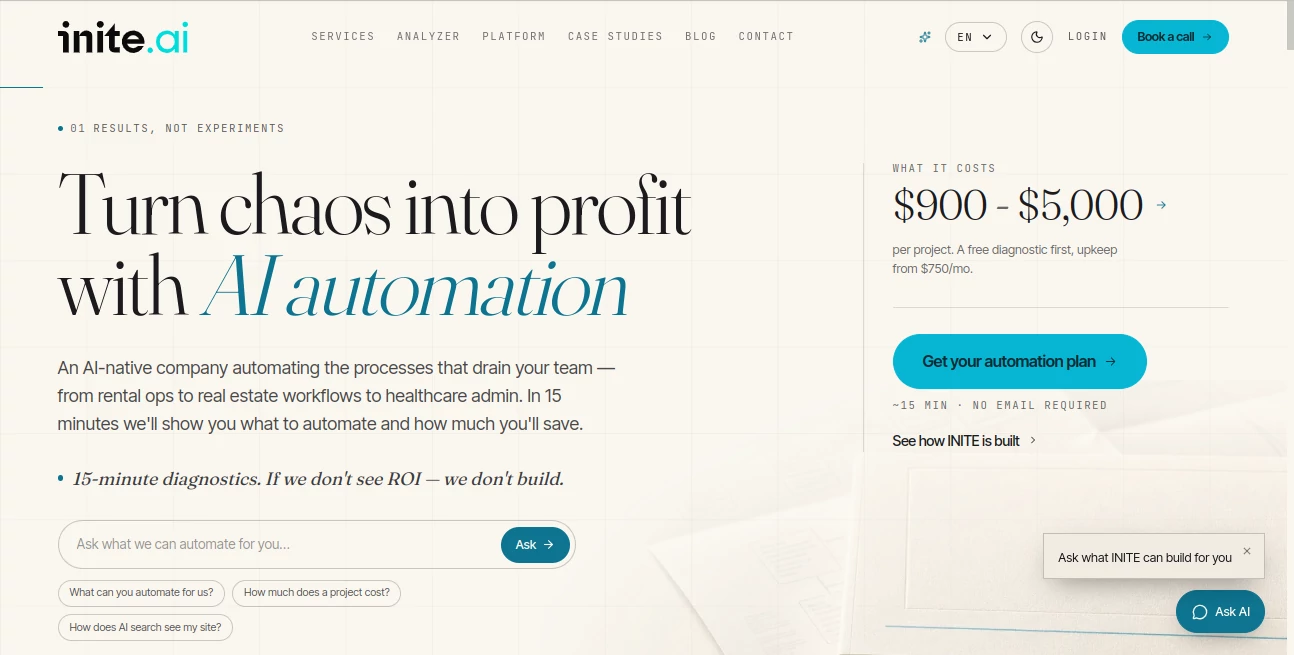
INITE is an AI-native platform and automation company designed to help businesses turn repetitive operational work into measurable, working systems. Rather than focusing only on AI experiments or standalone chatbots, it looks at the processes that consume time across sales, support, operations, and other business functions, then identifies where automation can create a practical return.
One particularly useful part of the platform is its AI visibility analysis. A website can be technically sound and still struggle to appear in answers generated by modern AI assistants. The platform evaluates how a site can be discovered, understood, and represented by AI systems, giving businesses a clearer picture of where improvements may be needed.
The approach is deliberately practical. The company says its initial diagnostic takes around 15 minutes and is intended to identify worthwhile automation opportunities before implementation begins. For businesses that have too many manual handoffs, scattered information, or slow response processes, that diagnostic-first approach can be a useful starting point.
Key Features
The platform brings several related capabilities together instead of treating AI visibility, automation, and business infrastructure as completely separate projects.
User Interface
The web experience is organized around diagnostics, analysis, services, and specific business solutions. The AI visibility analyzer is particularly straightforward: users can provide a website and receive an assessment covering areas such as AI share of voice, retrieval readiness, search presence, AI identity, technical performance, sentiment, mention position, and competitor gaps.
This makes the first interaction relatively easy even for someone who is not deeply involved in technical SEO or AI engineering. More advanced users can then move into reports, recommendations, implementation services, or the broader platform ecosystem.
Accuracy & Performance
Performance is approached through measurable business outcomes rather than abstract AI scores alone. The company states that its automation work typically targets one to three workflows for production delivery within two to four weeks.
Its visibility analysis uses a defined scoring model with multiple components rather than relying on a single metric. The audit considers AI visibility, retrieval readiness, search presence, technical factors, identity and crawlability, sentiment, position, and competitor gaps.
For automation projects, the company also describes a diagnostic process designed to determine whether an implementation is likely to produce sufficient return before development starts. That distinction is important for companies that want automation tied to an actual business process rather than another experimental AI project.
Capabilities
The platform covers a broad range of business automation scenarios. Examples presented by the company include lead response, order processing, document workflows, customer support, and other operational processes.
Its AI visibility tools can analyze a website's ability to be retrieved and interpreted by AI systems. The analysis also looks at files and signals that may help AI systems understand an organization, including llms.txt, structured identity information, robots directives, and other AI-oriented resources.
Beyond individual services, the underlying ecosystem includes shared Identity, Brain, and Billing infrastructure. The company describes the Brain component as a bitemporal knowledge graph designed to retain facts, relationships, provenance, and changes over time, while Identity provides authentication and Billing handles subscriptions, usage, credits, and related payment functionality.
Security & Privacy
Security and privacy are addressed through dedicated policies and platform infrastructure. The published privacy policy states that the service operates under a legal framework that includes GDPR requirements for applicable users in the EU, EEA, and UK, as well as CCPA-related provisions.
The platform also describes OAuth 2.0 and OpenID Connect capabilities through its identity infrastructure. Passkeys, magic links, service tokens, and centralized access management are among the authentication features described by the company.
Businesses should still review the current privacy policy, terms, and service-specific documentation before connecting sensitive systems or operational data.
Use Cases
There are several practical situations where this platform can make sense. A company receiving leads through several channels, for example, may have employees manually collecting, sorting, and following up with those inquiries. An automated intake and response workflow can reduce the number of manual steps involved.
Another use case is AI visibility. A business may already invest heavily in traditional search optimization but still find that AI assistants do not clearly understand its products, services, or expertise. The visibility audit can help identify technical and content-related gaps that affect how the business is represented in AI-generated answers.
Document-heavy operations are another natural fit. Teams dealing with repetitive document workflows, customer requests, or administrative processes can evaluate which steps should be removed, automated, or connected to existing systems.
The service is primarily positioned toward B2B organizations with roughly 10 to 200 employees, particularly teams working in sales, support, and operations.
Pros and Cons
One of the strongest aspects is the emphasis on measurable processes. Instead of starting with a generic promise to add AI to a business, the approach begins by identifying a specific operational problem and estimating its potential value.
The AI visibility analyzer is also useful as a standalone starting point because it gives website owners a structured way to investigate how their sites may appear to AI assistants.
On the other hand, this is not primarily a simple consumer AI application that someone opens for a quick writing, image, or chatbot task. Much of the offering is aimed at businesses that are prepared to evaluate workflows, integrations, and implementation requirements. Organizations looking only for a lightweight standalone AI tool may find the broader platform more extensive than necessary.
Pricing Plans
The AI visibility section currently offers a free plan for businesses that want to begin with basic analysis. Paid options are available for organizations that need deeper analysis and more frequent monitoring.
- Free: $0, with basic AI visibility analysis.
- AI Visibility Starter: $29 per month.
- AI Visibility Growth: $79 per month.
- AI Visibility Autopilot: $149 per month.
The paid plans expand capabilities such as daily analyses, AI citation audits, market intelligence, technical audits, saved reports, score tracking, and deeper recommendations. Annual billing is also offered with two months free according to the published pricing page.
For custom automation projects, pricing is handled separately. The company states that implementation engagements can start from $5,000, with scope and deliverables determined through the diagnostic and subsequent agreement.
How to Use It
Getting started with the AI visibility side is relatively simple. Begin by entering your website into the analyzer and allow the system to assess its current visibility across the areas included in its scoring model.
Review the resulting score and recommendations rather than focusing only on the headline number. Look at retrieval readiness, AI identity, search presence, technical performance, and competitor gaps to understand where the largest opportunities may exist.
For businesses interested in automation, the process is more consultative. Start with a specific operational problem such as lead handling, customer support, document processing, or order management. The diagnostic process can then be used to determine what is worth automating and what should remain under human control.
Comparison with Similar Tools
Many AI platforms concentrate on a single function, such as content generation, customer chat, workflow automation, or search optimization. This platform takes a broader approach by connecting AI visibility analysis with business automation and shared infrastructure.
That difference matters when the goal is not simply to experiment with an AI feature but to improve an existing business process. A traditional SEO platform may provide search-oriented metrics, while a workflow automation product may focus on connecting applications. Here, the emphasis extends from understanding how a business is represented in AI systems to identifying operational processes that can be automated.
The most appropriate comparison therefore depends on the problem being solved. For a company looking specifically for content generation, a specialized writing platform may be more relevant. For a company investigating AI visibility alongside operational automation, the broader approach can be considerably more useful.
Conclusion
INITE takes a business-first approach to AI. Its value is not simply in adding another AI interface to an existing workflow, but in examining where AI can produce a measurable operational improvement.
The combination of AI visibility analysis, automation diagnostics, implementation services, and shared infrastructure makes the platform particularly interesting for growing B2B teams. The free visibility analysis also gives website owners a low-risk way to investigate how well their digital presence can be understood by modern AI systems.
For organizations that want to move beyond AI experiments and identify concrete opportunities for automation or better AI visibility, the platform provides a structured place to begin.
Frequently Asked Questions (FAQ)
What is INITE used for?
It is used for AI visibility analysis, business process automation, AI agents, and related infrastructure for organizations that want to introduce AI into practical operational workflows.
Does it offer a free plan?
Yes. The AI visibility product includes a free plan that provides access to basic analysis, with paid plans available for deeper insights and additional monitoring features.
How much does the AI visibility service cost?
The published paid plans currently start at $29 per month for AI Visibility Starter, followed by Growth at $79 per month and Autopilot at $149 per month. A free option is also available.
Who is the platform designed for?
The broader automation service is aimed primarily at B2B companies with approximately 10 to 200 employees, especially teams working in sales, support, and operations.
Can it analyze a website for AI visibility?
Yes. The AI visibility analyzer evaluates several areas, including AI share of voice, retrieval readiness, search presence, AI identity and crawlability, technical performance, AI sentiment, mention position, and competitor gaps.
Can it automate business workflows?
Yes. Its services cover processes such as lead response, order processing, document workflows, customer support, and other operational tasks. The company says typical initial deliveries involve one to three workflows reaching production within two to four weeks.
Does it provide custom implementation?
Yes. Beyond the self-service visibility plans, the company provides diagnostic and implementation services for businesses that need customized automation workflows and integrations.
Is it only an SEO tool?
No. AI visibility is one part of the offering. The broader platform also covers business automation, AI agents, operational workflows, and shared infrastructure for identity, knowledge, and billing.