
Brio
What is Brio?
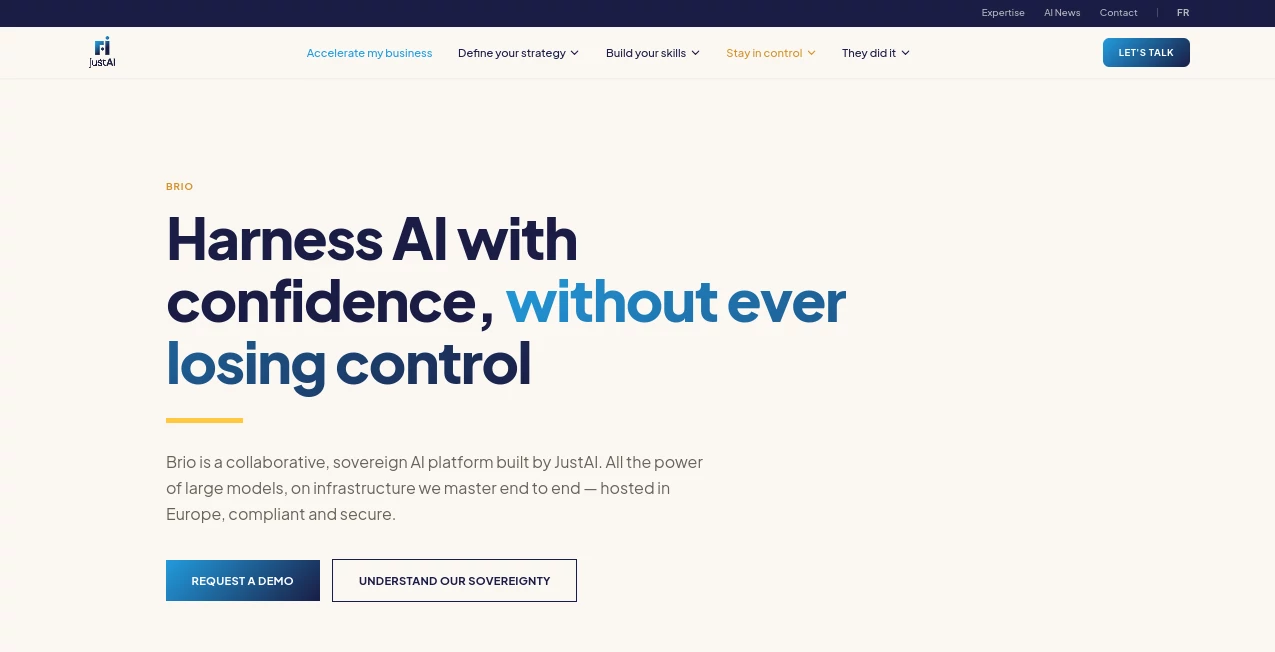
For companies adopting generative AI, the biggest question is not always what an AI model can do. It is often where the data goes, who controls the infrastructure, and how easily teams can work together. Brio takes a different approach by combining generative AI, collaboration and AI agents inside a sovereign environment designed for organisations that need stronger control over their technology.
The platform is built by JustAI and is hosted in Europe. Instead of depending on external AI APIs, it uses open-source language models that are deployed and orchestrated in-house. This makes it particularly interesting for organisations that handle sensitive documents, internal knowledge or business information and want AI capabilities without sending that information through third-party cloud AI services.
At its core, the platform is designed as a shared workspace rather than simply another chatbot. Teams can interact with a contextual personal assistant, work together on documents and conversations, and use specialised AI agents for more involved tasks. The result is an environment where AI becomes part of everyday team workflows instead of sitting in a separate application.
Key Features
- Contextual personal assistant that can work with documents, projects and organisational knowledge.
- Real-time multi-user collaboration through shared conversations and editable documents.
- Collaborative AI agents designed to work with people and with one another.
- Unified workspaces for centralising conversations, content and knowledge.
- Dashboards for monitoring AI adoption and organisational KPIs.
- Carbon footprint tracking for individual AI requests.
- Open-source language models deployed and orchestrated in-house.
- European hosting through infrastructure including OVHcloud and Scaleway.
- No reliance on third-party AI APIs such as ChatGPT, Gemini, Claude or Mistral Cloud.
- Security architecture designed for demanding environments.
User Interface
The workspace-oriented design makes the platform feel closer to a collaborative business environment than a traditional question-and-answer chatbot. Teams can work with AI in shared spaces, exchange information and edit documents together rather than keeping every interaction isolated in an individual's account.
The unified approach is especially useful for organisations where information is distributed across projects and departments. Bringing conversations, knowledge and different content formats into one environment can reduce the friction of constantly switching between separate tools.
Accuracy & Performance
One of the most useful aspects of the platform is its contextual approach. Its personal assistant is designed to understand an organisation's documents, projects and internal context, allowing users to ask questions based on the information relevant to their work rather than relying only on generic model knowledge.
Performance also benefits from the way the infrastructure is managed. Open-source models are deployed and orchestrated directly by the provider rather than accessed through external AI APIs. For businesses, this architecture can offer greater control over the technical environment while keeping AI capabilities close to the data and workflows they are intended to support.
Capabilities
The platform covers several layers of AI-assisted work. A contextual assistant can help users interact with organisational knowledge, while collaborative features allow several people to participate in the same AI-supported workflow. Specialised agents add another layer by handling more complex tasks and coordinating with teams.
There is also an operational side that is easy to overlook. Dashboards provide visibility into adoption and KPIs, helping organisations understand whether their AI investment is actually being used and producing measurable value. Carbon tracking per request adds another useful perspective for companies that want to monitor the environmental impact of their AI usage.
Security & Privacy
Security and data sovereignty are among the strongest reasons to consider this platform. The provider states that data remains in Europe and that the system does not depend on third-party AI APIs. Open-source LLMs are hosted and orchestrated in-house, while the infrastructure uses OVHcloud and Scaleway hosting.
The platform also states that user data is not used for model training and that there is no telemetry sent to the United States. Its security architecture includes a self-hosted DevSecOps pipeline, GGUF model formats, a whitelisted reverse proxy and dedicated GPUs.
The provider reports a 94.29% level of compliance against ANSSI recommendations, corresponding to 33 of 35 recommendations. It also describes documented security mitigations, internal testing and planned external audits. These details make the security approach more concrete than simply describing a product as “secure.”
Use Cases
- Internal knowledge: Teams can use the contextual assistant to work with company documents, projects and organisational information.
- Collaborative document work: Multiple users can work on shared editable documents with AI involved in the process.
- Complex business workflows: Specialised AI agents can assist with tasks that require several steps or different areas of expertise.
- AI adoption management: Organisations can use dashboards to monitor adoption and relevant KPIs.
- Privacy-sensitive organisations: European hosting and the absence of third-party AI API dependencies can be valuable where data sovereignty is important.
- Responsible AI initiatives: Carbon tracking per request gives organisations another metric for understanding AI usage.
- Team productivity: A shared AI environment can help employees work with company knowledge without moving between multiple disconnected applications.
Pros and Cons
- Pros: European data hosting, strong focus on sovereignty, collaborative workspace, contextual organisational assistant, AI agents, open-source models and detailed security architecture.
- Pros: Useful monitoring features for AI adoption, KPIs and carbon footprint.
- Pros: Designed with organisations and demanding environments in mind rather than only individual consumers.
- Cons: The enterprise-oriented approach may be more than an individual user needs from a simple AI assistant.
- Cons: Access is currently positioned around requesting a demo, so users looking for an instant self-service signup may find the process less convenient.
- Cons: Organisations already comfortable with mainstream AI cloud platforms may need to evaluate the different infrastructure and deployment model before making a switch.
Pricing Plans
No public pricing plans are listed on the product page. Instead, interested organisations are invited to request a demo and discuss the platform in real conditions. This approach is understandable for a product aimed at teams and organisations with potentially different infrastructure, security and deployment requirements.
For companies evaluating the platform, it would be sensible to ask about the number of users, available models, storage, deployment options, support, integration requirements and any usage-based costs during the consultation.
How to Use It
- Request a demonstration through the provider's website.
- Explain the organisation's main AI use cases, workflows and data requirements.
- Evaluate the collaborative workspace, contextual assistant and AI agent capabilities.
- Review the data sovereignty and security architecture against internal requirements.
- Identify the teams and projects that would benefit most from the platform.
- Use adoption and KPI dashboards to measure how AI is being used across the organisation.
Comparison with Similar Tools
Many popular AI assistants are primarily accessed through large cloud platforms and third-party model APIs. This platform is aimed at a different requirement: maintaining greater control over the AI stack and keeping organisational data within a European environment.
The distinction becomes particularly important for businesses that cannot treat internal documents and conversations like ordinary consumer content. Instead of focusing solely on the model's ability to generate an answer, the platform puts infrastructure ownership, collaboration, data sovereignty and governance closer to the centre of the experience.
It also differs from a basic chatbot because collaboration and specialised AI agents are built into the same workspace. A team can therefore move from asking a question to sharing information, editing documents and coordinating AI-supported work without treating each activity as a separate workflow.
Conclusion
For organisations that want generative AI but are uncomfortable handing sensitive business information to a collection of external AI services, this platform presents a compelling alternative. Its strongest selling point is not simply the ability to generate text or answer questions. It is the combination of AI capabilities with European hosting, open-source models, collaboration and a deliberate focus on sovereignty.
The collaborative workspace is another important advantage. Instead of giving every employee an isolated AI assistant, organisations can create a shared environment where people, documents, knowledge and specialised agents work together.
It is best suited to teams that take data control seriously and want AI to become part of their internal infrastructure rather than another disconnected SaaS subscription. For those organisations, a demo can be a practical way to determine whether the architecture, security model and collaborative features fit their real workflows.
Frequently Asked Questions (FAQ)
Is the platform hosted in Europe?
Yes. The provider states that the platform is hosted in Europe, with infrastructure including OVHcloud and Scaleway.
Does it rely on third-party AI APIs?
No. The provider states that it does not depend on third-party APIs such as ChatGPT, Gemini, Claude or Mistral Cloud. Open-source language models are deployed and orchestrated in-house.
Can teams collaborate with AI?
Yes. The platform supports multi-user chat, shared editable documents and collaborative AI agents designed to work alongside teams.
Can it work with company documents and knowledge?
Yes. Its contextual personal assistant is designed to work with documents, projects and organisational knowledge to provide answers based on the relevant business context.
Does the platform provide security controls?
Yes. The security architecture includes self-hosted DevSecOps, GGUF model formats, a whitelisted reverse proxy, dedicated GPUs and documented security mitigations. The provider also reports 33 of 35 ANSSI recommendations met.
Is pricing publicly available?
No public pricing plans are shown on the product page. Organisations are directed to request a demo to explore the platform and discuss their requirements.
AI Workflow Management , AI Knowledge Management , AI Productivity Tools , AI Team Collaboration .
These classifications represent its core capabilities and areas of application. For related tools, explore the linked categories above.

Brio Alternatives Product

LLaMaRush

Discord Time…

DemoDash

Hairstyle An…

Where Is Thi…

Zloth

Layven
Gemini Omni

Arobis AI Vi…