
Marpy
What is Marpy?
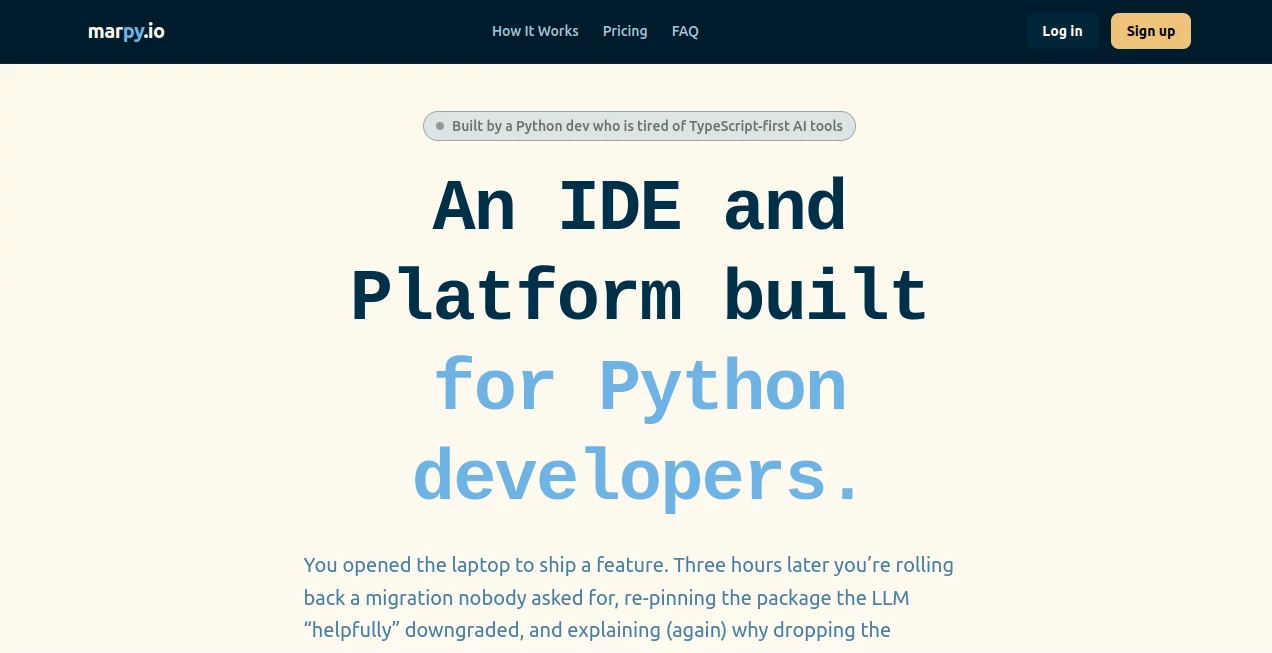
Building Python applications often means juggling multiple tools, configuring infrastructure, managing databases, and dealing with deployment headaches before a project even reaches production. This platform takes a different approach by bringing development, AI assistance, deployment, and infrastructure management into a single browser-based environment.
Designed with Python developers in mind, it provides a streamlined workflow for creating, testing, and deploying real-world applications. Instead of treating Python as an afterthought, the platform focuses entirely on frameworks such as Django, FastAPI, and Flask. Developers can write code, collaborate with AI, manage databases, and launch applications without switching between countless services.
What makes this solution particularly appealing is its emphasis on production readiness. Rather than simply generating code, it helps developers avoid common mistakes through built-in safeguards, migration controls, secure secret management, and deployment workflows. The result is a development experience that feels practical, reliable, and surprisingly efficient.
Key Features
User Interface
The browser-based IDE offers a clean and developer-friendly workspace that eliminates the need for extensive local setup. Code editing, terminal access, project management, and AI assistance are available in a single environment. The interface feels familiar to experienced developers while remaining approachable for newcomers who want to start building quickly.
Integrated project navigation, real-time editing, deployment controls, and database management tools help reduce context switching. Everything is accessible from the browser, making development possible from virtually any device.
Accuracy & Performance
One of the strongest aspects of the platform is its awareness of the Python ecosystem. AI-generated suggestions are based on modern package versions and current documentation, helping developers avoid outdated code patterns and deprecated APIs.
The system also understands project structure, dependencies, and framework conventions. This leads to more relevant code completions, smarter refactoring suggestions, and faster development cycles without sacrificing reliability.
Capabilities
The platform goes far beyond code generation. It supports application scaffolding, AI-assisted development, database management, deployment automation, versioned migrations, managed hosting, and infrastructure orchestration.
- Browser-based Python development environment
- AI-assisted code generation and refactoring
- Django, Flask, and FastAPI support
- Managed database integration
- One-click deployment workflows
- Containerized application hosting
- Git-based development workflows
- Production-ready infrastructure management
This combination allows developers to move from idea to production significantly faster than traditional development setups.
Security & Privacy
Security is clearly treated as a priority rather than an afterthought. Sensitive credentials are stored using managed secret systems instead of being embedded directly into project files. Database operations that could potentially damage production environments are protected through safety mechanisms and manual confirmation requirements.
Additional safeguards help prevent accidental file system access outside project boundaries, reducing the risk of destructive commands or unintended changes. These protections create a safer environment for teams that rely heavily on AI-assisted development.
Use Cases
- Building and deploying Python web applications
- Creating backend APIs with FastAPI or Flask
- Developing enterprise Django applications
- Rapid prototyping of new software ideas
- AI-assisted software development workflows
- Managing cloud-hosted Python projects
- Team collaboration on production applications
- Learning Python development without complex local setup
For startups, independent developers, and engineering teams, the platform provides a practical path from concept to deployment without unnecessary infrastructure complexity.
Pros and Cons
Pros
- Built specifically for Python developers
- Browser-based workflow reduces setup time
- Integrated deployment and hosting capabilities
- Strong database migration safeguards
- Modern AI-assisted coding experience
- Managed infrastructure and database services
- Supports major Python frameworks
- Helpful security and secret management features
Cons
- Primarily focused on Python projects
- Advanced teams may still require custom infrastructure workflows
- Newer platform compared to some established development environments
- Developers deeply attached to local IDEs may face an adjustment period
Pricing Plans
The platform offers a free entry-level plan that allows developers to explore the environment without providing payment information. This makes it easy to evaluate the workflow before committing to a paid subscription.
- Starter: Free plan with limited projects, storage, database access, and AI usage.
- Solo: Suitable for individual developers building production applications.
- Team: Includes collaboration tools, role management, and deployment approvals.
- Enterprise: Custom solutions with advanced security, compliance, and infrastructure options.
The availability of both free and scalable paid plans makes the platform suitable for hobby projects, startups, and larger organizations alike.
How to Use Marpy
Getting started is straightforward and does not require extensive infrastructure knowledge.
- Create an account and start a new project.
- Select a preferred Python framework.
- Use the built-in AI assistant to generate or improve code.
- Connect and manage databases directly from the platform.
- Test features within the integrated development environment.
- Review migrations and deployment settings.
- Deploy the application to a production-ready environment.
- Monitor logs, updates, and future releases from the same dashboard.
This workflow minimizes friction and allows developers to focus on building software rather than configuring infrastructure.
Comparison with Similar Tools
Many AI coding platforms attempt to support every programming language and framework. While this broad approach can be useful, it often results in generic experiences that lack deep understanding of specific ecosystems.
In contrast, this platform concentrates on Python development. Its framework awareness, migration safety features, managed databases, and deployment workflows provide a level of specialization that general-purpose coding assistants often struggle to match.
Compared with browser-based development platforms and AI-powered coding tools, the experience feels more aligned with the needs of backend engineers who are building production applications rather than simple prototypes.
Conclusion
For Python developers looking to accelerate development without sacrificing reliability, this platform delivers an impressive combination of AI assistance, deployment automation, infrastructure management, and security safeguards.
The browser-based workflow removes many of the traditional barriers associated with application development, while the production-focused features help prevent costly mistakes. Whether building a startup MVP, a customer-facing web application, or an internal business platform, it offers a practical and efficient environment for modern Python development.
By combining intelligent coding assistance with deployment-ready infrastructure, it creates a development experience that feels focused, mature, and genuinely useful for real-world software projects.
Frequently Asked Questions (FAQ)
Is this platform suitable for beginners?
Yes. The browser-based environment reduces setup complexity and helps new developers start building applications quickly.
Which Python frameworks are supported?
The platform is designed for popular frameworks including Django, Flask, and FastAPI.
Can applications be deployed directly from the platform?
Yes. Integrated deployment capabilities allow developers to move applications from development to production without relying on external deployment services.
Does it include AI-powered coding assistance?
Yes. Developers can use AI-generated code suggestions, refactoring assistance, and project-aware recommendations throughout the development process.
Is there a free plan available?
Yes. A free starter plan is available for testing the platform and building initial projects before upgrading to a paid subscription.
AI App Builder , AI Code Assistant , AI Developer Tools .
These classifications represent its core capabilities and areas of application. For related tools, explore the linked categories above.

Marpy Alternatives Product
RepoClip

Blackbox AI

NetlifyAPP

JSON-Tools

Verne

OGimage

AgentOne

AllInOneTools

Ito AI