
AI Phone Assistant
What is AI Phone Assistant?
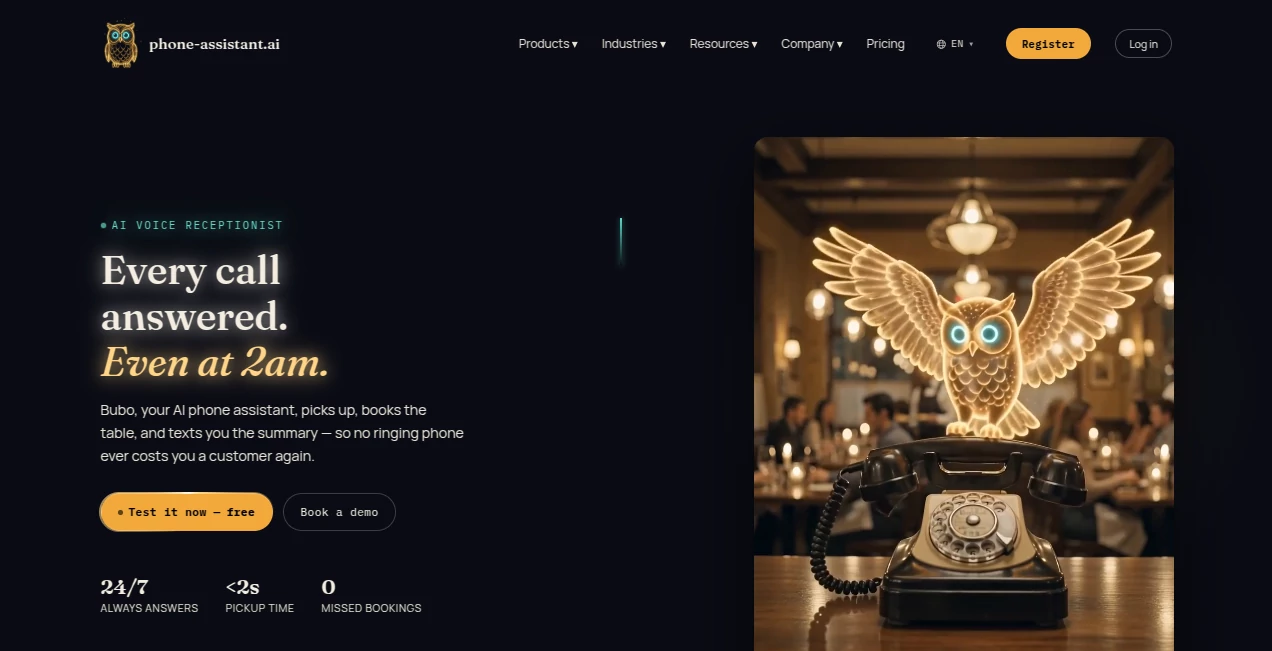
Missing a phone call can mean missing a customer. For restaurants, salons, clinics, tradespeople, retailers, and other service businesses, calls often arrive precisely when staff are busy serving someone else. An AI phone receptionist can take care of that gap by answering incoming calls, understanding what the caller needs, and completing routine tasks without putting another person behind the phone.
AI Phone Assistant is built around that simple idea. It answers calls around the clock, handles reservations and orders, answers business questions, and can send summaries and confirmations through WhatsApp. The service was initially developed with restaurants in mind, but its use cases now extend to hospitality, healthcare and personal care, trades, property services, retail, e-commerce, and rental businesses.
One of its most appealing qualities is that it is designed not to guess. If information has not been provided to the system, it can acknowledge that it does not know rather than inventing an answer. For a business dealing with real customers, that distinction matters.
Key Features
- 24/7 incoming call answering, including outside business hours.
- Support for more than 70 languages.
- Reservation handling with real availability checks.
- Order taking based on the business's actual menu and pricing.
- Business information and FAQ answering.
- WhatsApp confirmations, notifications, and reminders.
- Call summaries for business owners and staff.
- Online booking pages and QR codes.
- Secure booking changes and cancellations.
- Integration with popular booking, calendar, commerce, and business platforms.
User Interface
The experience is designed around the business rather than forcing the business to adapt to a complicated new workflow. Setup revolves around information such as opening hours, services, menus, booking rules, and existing integrations. Once configured, the assistant can work in the background while staff continue using their normal business processes.
For bookings, businesses can also provide their own online booking page and QR code. Phone and web bookings can be managed through the same reservation flow, while customers can receive confirmation messages and secure links for changing or cancelling their booking.
The owner-facing side is particularly useful for businesses that do not have time to monitor every call. Reservations and call summaries provide a quick view of what happened without requiring someone to listen to every conversation from start to finish.
Accuracy & Performance
Speed matters on the telephone. The service advertises a pickup time of less than two seconds, allowing callers to reach an answering system quickly instead of waiting through a long ringing period.
Accuracy is approached through controlled business information rather than simply allowing an AI model to improvise. Menus, prices, opening hours, availability, and other details can be configured for the individual business. If a caller asks something outside the supplied information, the system is designed to avoid making up an answer.
Reservation availability is also checked when the request is made, with the system designed to prevent two callers from claiming the same table or available slot at the same time. That makes it considerably more practical than a basic voicemail replacement.
Capabilities
The platform can recognize the reason for a call and respond according to the request. A restaurant customer might want to reserve a table, place an order, ask about allergens, or check opening hours. A tradesperson might need to capture a new job request while working on another site. A salon may need to handle appointment calls without interrupting a client.
Multilingual communication is another strong point. The service supports more than 70 languages, while the caller's selected language can be maintained throughout the conversation. Returning callers can also have their previous language remembered.
Beyond telephone conversations, the system can connect with services including Formitable, Zenchef, Lightspeed, Mollie, Shopify, Google Calendar, Calendly, Cal.com, Slack, HubSpot, Notion, WooCommerce, Webhooks, and several other platforms.
Security & Privacy
Data handling is clearly positioned around European privacy requirements. Calls, transcripts, and reservations are processed and stored on servers within the European Union, with transfers outside the EU requiring an approved legal safeguard.
The provider states that call content is not used to train third-party general-purpose AI models. Data is protected through encryption in transit, access controls, and vetted subprocessors for speech, language, and related processing.
Businesses can also control call-recording retention according to their needs. The service states that it is designed around GDPR requirements and aligned with current EU AI Act transparency requirements. Businesses should still configure disclosures, retention, and processing according to their own legal obligations and local regulations.
Use Cases
Restaurants are one of the clearest use cases. During a busy dinner service, employees can concentrate on guests in front of them while incoming callers still receive an answer. Reservations can be recorded, orders can be handled, and questions about menus, allergens, prices, or opening hours can be answered from the business information provided during setup.
Hotels, cafés, catering businesses, salons, clinics, barbers, plumbers, electricians, repair businesses, property managers, consultants, retailers, online stores, and equipment rental companies can benefit from the same approach. The common problem is simple: the phone rings when nobody has the time to answer it.
For example, imagine a restaurant that receives a reservation request at 7:30 PM while every member of staff is serving customers. Instead of sending the caller to voicemail, the call can be answered, availability checked, the reservation recorded, and a confirmation sent afterward. That is a small interaction, but repeated across hundreds of calls, it can have a meaningful effect on the business.
Pros and Cons
Pros
- Answers calls 24/7, including outside normal working hours.
- Fast advertised pickup time of under two seconds.
- Supports more than 70 languages.
- Can handle real reservations rather than simply taking messages.
- Can work with orders, business questions, and customer notifications.
- WhatsApp communication adds a useful follow-up layer.
- EU-based data hosting is attractive for European businesses.
- Integrates with several widely used business platforms.
- Designed to avoid inventing information when it does not know an answer.
Cons
- The monthly cost may be higher than a basic voicemail or simple answering service.
- Businesses need to provide accurate information during setup for the best results.
- Usage beyond the included monthly minutes is billed separately.
- More complex or sensitive customer situations may still require a human employee.
- Businesses with very low call volume may not need the full range of features.
Pricing Plans
The pricing structure is based primarily on monthly call minutes. The Starter plan costs €59 per month with a one-time €149 setup fee and includes 150 minutes, two languages, 100 WhatsApp notifications, reservation capture, and call summaries.
The Growth plan costs €149 per month plus the €149 one-time setup fee. It includes 400 minutes, two languages, 300 WhatsApp notifications, reservation capture, and call summaries.
The Scale plan costs €289 per month plus the €149 one-time setup fee. It provides 800 minutes, two languages, 600 WhatsApp notifications, reservation capture, and call summaries.
Additional languages cost €29 per month per language. Extra call minutes are charged at €0.29 per minute, while additional WhatsApp notifications cost €0.12 each. Unused minutes can remain available for up to two months. The reservation dashboard is currently included for an initial period before a €49 monthly charge applies.
How to Use AI Phone Assistant
Getting started is mainly a configuration process rather than a technical development project. A business first provides the information the assistant needs, such as opening hours, services, menus, prices, booking rules, and relevant business details.
The next step is choosing how incoming calls should be handled. Businesses can configure the system to answer every call, handle calls outside business hours, or step in when the regular line is busy.
Once the setup is complete, callers can interact with the assistant naturally. Depending on the business configuration, the system can answer questions, take reservations, process orders, record the conversation summary, and send appropriate WhatsApp notifications.
For the best experience, it is worth reviewing the first calls and adjusting business information where necessary. This is especially useful for businesses with unusual booking rules, large-group policies, detailed menus, or specific customer-service requirements.
Comparison with Similar Tools
Basic answering services usually focus on picking up the phone and taking a message. Calendar assistants are better suited to scheduling meetings initiated through digital channels. Generic chatbots, meanwhile, are normally designed for websites or messaging platforms rather than live telephone conversations.
This service sits in a different part of the market. Its focus is the complete inbound call: understanding why somebody is calling, taking an appropriate action, checking real availability, and following up after the conversation.
That distinction is particularly valuable for businesses where a phone call can directly become a reservation, order, appointment, or new customer. A message saying “someone called” still leaves work for an employee. A completed booking or confirmed request can remove that extra step.
Conclusion
For businesses that regularly miss calls because employees are serving customers, driving between jobs, working with clients, or simply outside the office, an AI receptionist can solve a very practical problem. This service goes beyond answering and forwarding calls by combining conversations with reservations, orders, customer questions, multilingual support, notifications, and business integrations.
The strongest argument is not that an AI should replace every human conversation. It should handle the repetitive calls that do not require one. Staff can then spend their time on customers who genuinely need human attention while routine phone traffic continues to move forward.
With 24/7 availability, fast call pickup, multilingual communication, real booking capabilities, and EU-focused data handling, it is a compelling option for businesses where an unanswered phone can quickly become a lost customer.
Frequently Asked Questions (FAQ)
Can it answer calls outside business hours?
Yes. It is designed to answer calls around the clock, including evenings, weekends, holidays, and periods when the business is closed.
How many languages does it support?
The service supports more than 70 languages. Two languages of the business's choice are included in every standard pricing plan, with additional languages available for a monthly fee.
Can it take restaurant reservations?
Yes. Reservations are one of its core use cases. It can check availability, record bookings, and send follow-up notifications.
Can customers change or cancel a reservation?
Yes. Customers can receive secure links that allow them to change or cancel eligible bookings without needing to call the business again.
Can it handle orders?
Yes. For supported businesses, it can work with the actual menu and pricing information, take orders, confirm relevant details, and provide payment or notification steps where configured.
Does it work with existing business software?
Yes. Available integrations include services such as Formitable, Zenchef, Lightspeed, Mollie, Shopify, Google Calendar, Calendly, HubSpot, Notion, WooCommerce, and Webhooks.
Is customer data stored in Europe?
According to the provider, calls, transcripts, and reservations are stored and processed on servers within the European Union. The service also states that call content is not used to train third-party general-purpose AI models.
What happens when the assistant does not know an answer?
Rather than intentionally inventing information, it is designed to acknowledge when the requested information is unavailable and flag the question for the business.
Is there a free trial?
The website provides a free way to test the assistant live and also offers a seven-day trial option for the service. A demo can additionally be configured around the individual business.
Which pricing plan is best for a small business?
For a business with a steady but relatively modest call volume, the Starter plan is the natural starting point. Businesses handling significantly more calls may find the Growth or Scale plans more suitable.
AI Productivity Tools , AI Scheduling , AI Customer Service Assistant , AI Voice Assistants .
These classifications represent its core capabilities and areas of application. For related tools, explore the linked categories above.
AI Phone Assistant details
Website unavailable — View Alternatives
Pricing
- Freemium
Apps
- Web App
Categories

AI Phone Assistant Alternatives Product

Zush

hd image con…

Hairstyle An…

Betula AI
Wisegrid

Models by Ha…

Jotform AI A…

fasturl

Claude and C…