
AISafe
What is AISafe?
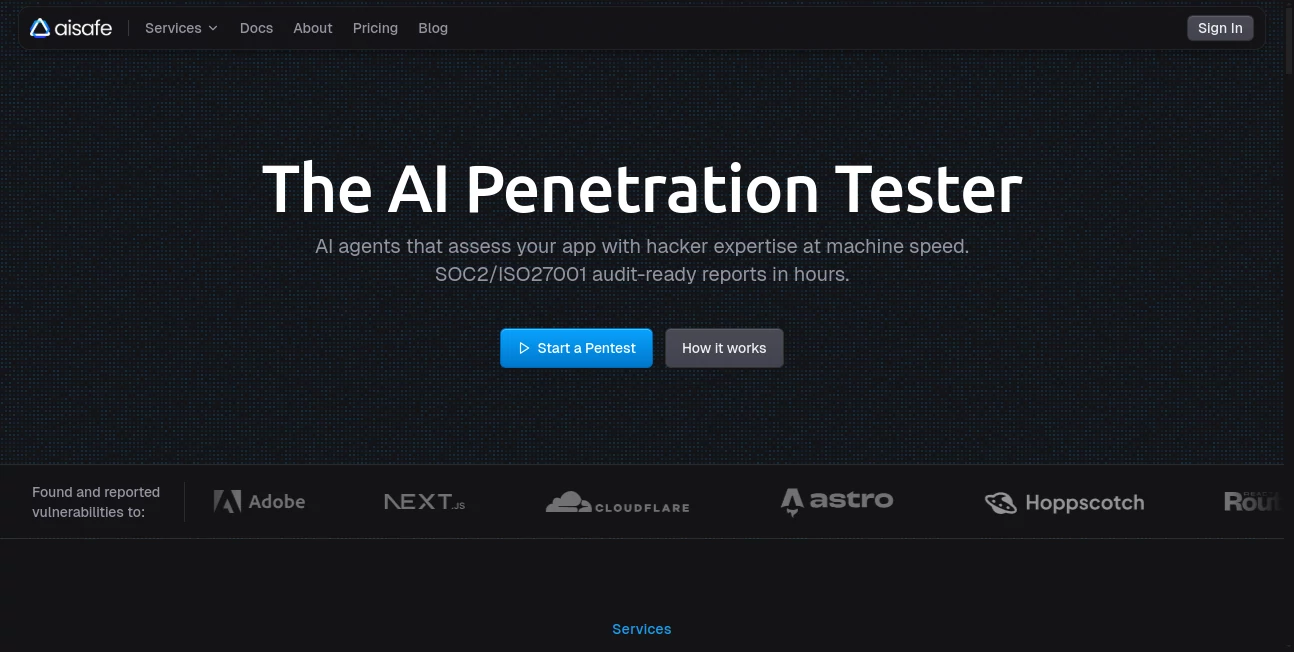
Modern applications evolve rapidly, but security reviews often struggle to keep pace. This platform bridges that gap by combining advanced AI agents with proven penetration testing methodologies to deliver thorough security assessments in a fraction of the time required by traditional approaches. Instead of relying solely on static scanning, it evaluates applications with reasoning that closely resembles the workflow of experienced security professionals.
The platform supports source code auditing, white-box penetration testing, black-box assessments, and continuous security monitoring. Development teams receive actionable reports that focus on verified vulnerabilities rather than overwhelming lists of false positives, making remediation faster and more efficient. Organizations preparing for compliance frameworks such as SOC 2 or ISO 27001 can also benefit from structured, audit-ready reporting.
Key Features
User Interface
The dashboard is designed for security engineers, developers, and DevOps teams who need quick access to assessments and findings. Projects can be configured in minutes, while integrations with development workflows simplify deployment. Reports are well organized, making it easy to prioritize critical issues and monitor remediation progress.
Accuracy & Performance
Unlike conventional scanners that depend on predefined signatures, the platform builds a threat model, analyzes application logic, validates attack paths, and reports only confirmed findings. This verification-first approach significantly reduces false positives while helping teams focus on vulnerabilities that genuinely affect production environments.
Capabilities
- AI-powered source code auditing
- Black-box penetration testing
- White-box penetration testing
- Threat modeling with intelligent reasoning
- Business logic vulnerability detection
- Authentication and authorization testing
- API security assessment
- REST API fuzzing
- Pull request security reviews
- Continuous endpoint monitoring
- Dependency and secret detection
- Detailed audit-ready reporting
- GitHub, GitLab, Jira, and CI/CD integrations
Security & Privacy
Security is a core design principle throughout the platform. Source code, findings, and sensitive information are stored using encryption, while organizations retain control over their projects and can permanently remove stored data whenever needed. Clearly defined testing scopes and execution guardrails ensure assessments remain within approved boundaries, giving teams confidence when evaluating production or staging environments.
Use Cases
- Perform automated penetration testing before software releases.
- Identify security weaknesses during software development.
- Validate authentication and authorization mechanisms.
- Review pull requests for security regressions.
- Prepare documentation for SOC 2 and ISO 27001 audits.
- Continuously monitor production applications for emerging risks.
- Secure APIs and modern cloud-native applications.
- Support DevSecOps pipelines with automated security reviews.
Pros and Cons
Pros
- Combines AI reasoning with practical penetration testing techniques.
- Reports verified vulnerabilities instead of excessive false positives.
- Supports both source code analysis and live application testing.
- Integrates with popular development platforms and workflows.
- Provides compliance-friendly security reports.
- Includes continuous monitoring capabilities.
Cons
- Advanced security concepts may require technical knowledge.
- Larger projects may benefit from higher-tier subscription plans.
- Enterprise features are reserved for business customers.
Pricing Plans
A free Basic plan allows users to explore essential security capabilities, including dependency scanning, AI-assisted static analysis, secret detection, infrastructure scanning, and limited source code audits. The Pro subscription expands functionality with black-box and white-box penetration testing, source code audits, pull request reviews, analytics, REST API fuzzing, and continuous monitoring. Enterprise customers receive custom pricing, dedicated onboarding, self-hosting options, advanced integrations, and priority support.
How to Use AISafe Labs
Start by creating a project and defining the assessment scope. Connect a source code repository or specify the target application for testing. Select the preferred assessment type, such as source code auditing, white-box testing, or black-box penetration testing. Once the analysis begins, AI agents evaluate the application, verify potential vulnerabilities, and generate detailed reports containing confirmed findings, risk levels, and remediation guidance. Development teams can then prioritize fixes and continuously monitor future changes through integrated workflows.
Comparison with Similar Tools
Many automated security scanners primarily depend on signature-based detection or predefined rule sets, often generating long lists of potential issues that require manual verification. This platform differentiates itself by combining intelligent reasoning, threat modeling, exploit validation, and live testing into a unified workflow. The result is higher confidence in reported vulnerabilities and more practical recommendations for engineering teams focused on secure software delivery.
Conclusion
Organizations building modern applications need security solutions that move as quickly as their development cycles. By combining AI-powered reasoning with real penetration testing methodologies, this platform delivers fast, reliable, and actionable security assessments that fit naturally into modern DevSecOps workflows. From startups to enterprise engineering teams, it offers an efficient way to strengthen application security while reducing manual effort and improving confidence before every release.
Frequently Asked Questions (FAQ)
Does it support both source code analysis and live application testing?
Yes. It performs source code audits, white-box assessments, and black-box penetration testing depending on your requirements.
Can it help with compliance?
Yes. The platform produces structured reports suitable for security reviews and compliance preparation, including frameworks like SOC 2 and ISO 27001.
Does it integrate with development workflows?
Yes. It supports integrations with GitHub, GitLab, Jira, CI/CD pipelines, and several other development tools.
Is there a free version?
Yes. A free Basic plan is available for users who want to evaluate core security assessment capabilities before upgrading.
Who is this platform best suited for?
It is ideal for developers, security engineers, DevSecOps teams, software companies, and organizations that require continuous application security testing.
AI Developer Tools , AI Testing & QA , AI Monitor & Report Builder , AI DevOps Assistant .
These classifications represent its core capabilities and areas of application. For related tools, explore the linked categories above.

AISafe Alternatives Product

Fugte

Vurge

Sendmux

TokenCalcula…

Bitbucket

AI Agent Ski…

CloudByte PMS

TruthSpine

DeepSeek V4