


















Escape AI Pentesting
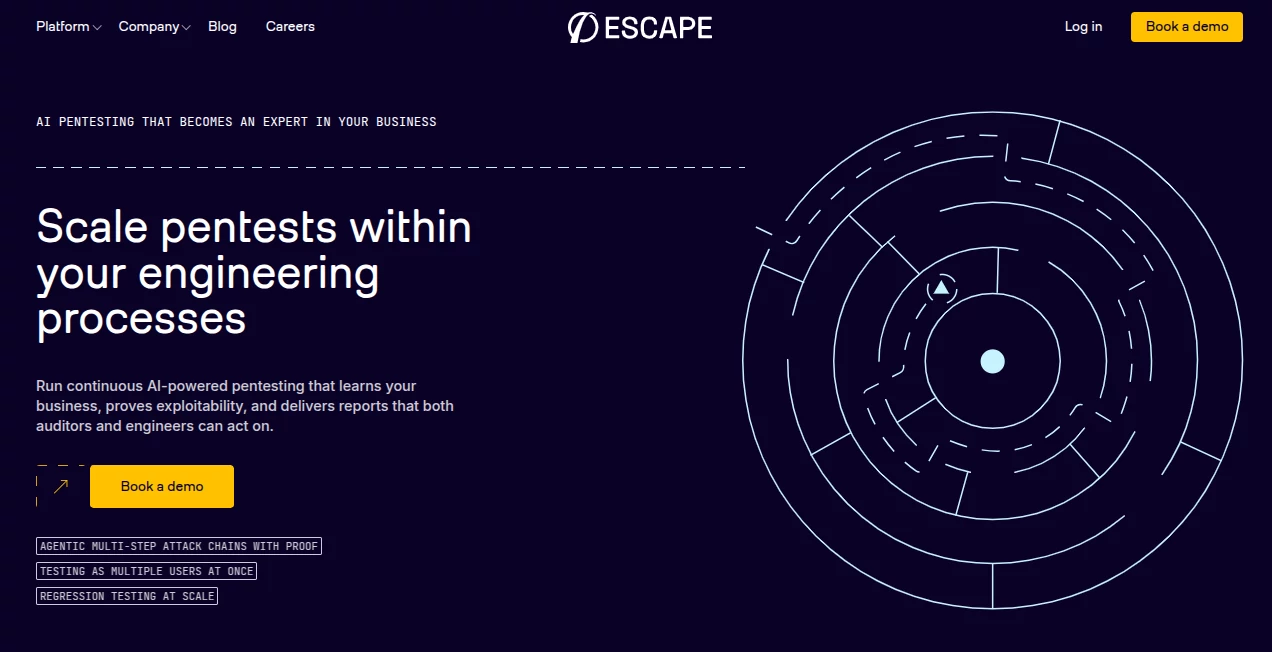
What is Escape AI Pentesting?
Modern development teams ship software faster than ever, making traditional penetration testing increasingly difficult to keep up with. Security reviews that once happened a few times a year are no longer enough to protect fast-moving applications, APIs, and cloud environments. This platform introduces a smarter approach by combining artificial intelligence with continuous offensive security to help organizations identify, validate, and remediate real security risks before attackers do.
Instead of relying solely on scheduled assessments or expensive manual engagements, the solution continuously evaluates applications using AI-driven attack reasoning. It understands business logic, reproduces realistic attack paths, and provides engineering teams with detailed evidence that accelerates remediation. The result is a security workflow that becomes part of everyday software development rather than an occasional compliance exercise. This approach has helped thousands of security teams automate repetitive work while maintaining high testing quality and reducing operational costs. :contentReference[oaicite:0]{index=0}
Key Features
User Interface
The platform offers a clean dashboard designed for both security professionals and developers. Vulnerabilities are presented with screenshots, execution logs, attack graphs, and clear reproduction steps, making it much easier to understand how an issue can actually be exploited. Instead of overwhelming users with raw technical findings, every result is organized in a way that supports rapid investigation and collaboration.
Accuracy & Performance
One of its biggest strengths is the ability to analyze complex business workflows rather than searching only for simple technical flaws. AI agents simulate realistic attacker behavior, chain multiple weaknesses together, and verify exploitability before reporting findings. This significantly reduces unnecessary alerts while helping teams focus on vulnerabilities that present genuine business risk. According to the platform, organizations have reduced manual pentesting timelines from several days to only a few hours while improving overall testing coverage. :contentReference[oaicite:1]{index=1}
Capabilities
- Continuous AI-powered penetration testing.
- Business logic security validation.
- Multi-step attack chain discovery.
- Proof-of-exploit generation with screenshots and execution logs.
- Regression testing using previous findings.
- Integration with CI/CD pipelines.
- Developer-friendly remediation guidance.
- Support for modern authentication systems including OAuth and SSO.
- Compatibility with APIs, web applications, and cloud environments.
- Automation through APIs, CLI, and developer workflows.
Security & Privacy
Security is deeply integrated into every stage of the platform. Organizations can deploy assessments across public or private environments while maintaining control over sensitive infrastructure. Continuous testing supports compliance initiatives for standards such as PCI-DSS, SOC 2, ISO 27001, HIPAA, and other widely adopted frameworks. Every report includes technical evidence that can be shared with auditors or engineering teams without requiring additional manual documentation. :contentReference[oaicite:2]{index=2}
Use Cases
- Continuous penetration testing for modern SaaS applications.
- Securing REST and GraphQL APIs.
- Automating application security inside DevSecOps pipelines.
- Replacing repetitive manual penetration testing.
- Validating bug bounty findings through automated regression testing.
- Reducing remediation time for engineering teams.
- Meeting enterprise compliance requirements.
- Improving security visibility across cloud-native applications.
Pros and Cons
Pros
- Excellent automation for offensive security workflows.
- Finds complex business logic vulnerabilities.
- Provides detailed proof of exploitability.
- Strong developer-focused remediation guidance.
- Integrates naturally with existing engineering processes.
- Supports continuous security instead of periodic testing.
Cons
- Primarily designed for professional security teams rather than individual users.
- Advanced enterprise capabilities may require onboarding and configuration.
- Pricing is customized instead of publicly listed.
Pricing Plans
Public pricing is not available. Organizations can request a personalized demonstration and receive a custom enterprise quotation based on their infrastructure size, security requirements, and deployment model. :contentReference[oaicite:3]{index=3}
How to Use Escape AI Pentesting
Start by connecting your applications, APIs, or cloud infrastructure to the platform. Configure authentication and integrate the solution with your development pipeline. Once connected, automated penetration tests begin discovering attack paths and validating exploitability. Security findings include reproduction steps, visual evidence, and remediation recommendations that developers can immediately use. Previous findings can also be converted into regression tests, ensuring the same vulnerabilities are automatically checked in future releases.
Comparison with Similar Tools
Unlike many traditional vulnerability scanners that rely on static signatures or payload injection, this solution emphasizes business logic awareness and AI-driven attack reasoning. Rather than simply reporting possible weaknesses, it validates exploitability through realistic attack chains and provides developers with actionable fixes. Compared with conventional penetration testing services, it delivers continuous coverage while reducing both turnaround time and long-term operational costs. Its close integration with engineering workflows also makes remediation significantly faster than traditional reporting processes. :contentReference[oaicite:4]{index=4}
Conclusion
Organizations looking to modernize application security will appreciate a platform that combines intelligent automation with practical engineering workflows. By continuously testing applications, validating complex attack paths, and producing evidence developers can immediately act upon, it transforms penetration testing from an occasional project into an ongoing security program. For companies building cloud-native applications or API-first products, this represents an efficient way to strengthen security while keeping development velocity high.
Frequently Asked Questions (FAQ)
What types of applications can be tested?
The platform supports modern web applications, APIs, cloud-native environments, and complex authentication workflows.
Does it replace manual penetration testing?
It automates a large portion of penetration testing activities while continuously validating vulnerabilities, making it an effective replacement for many repetitive manual assessments.
Can previous vulnerabilities be tested automatically?
Yes. Existing findings can be converted into regression tests that automatically run during future software releases.
Is it suitable for DevSecOps teams?
Yes. It integrates with engineering workflows and CI/CD pipelines, allowing security testing to become part of the development lifecycle.
Is there a free plan?
No public free plan is advertised. Interested organizations should contact the sales team for a demo and customized pricing.
AI Testing & QA , AI API Design , AI Developer Tools , AI DevOps Assistant .
These classifications represent its core capabilities and areas of application. For related tools, explore the linked categories above.
Escape AI Pentesting details
Website unavailable — View Alternatives
Pricing
- Free
Apps
- Web App
Categories

Escape AI Pentesting Alternatives Product

Ito AI

Layven

Tate-A-Tate

Designmd.fun

DDS Gub

Latency Atlas

BootstrapKing

ClawBridge

GLM 5
