
Limestone Digital
What is Limestone Digital?
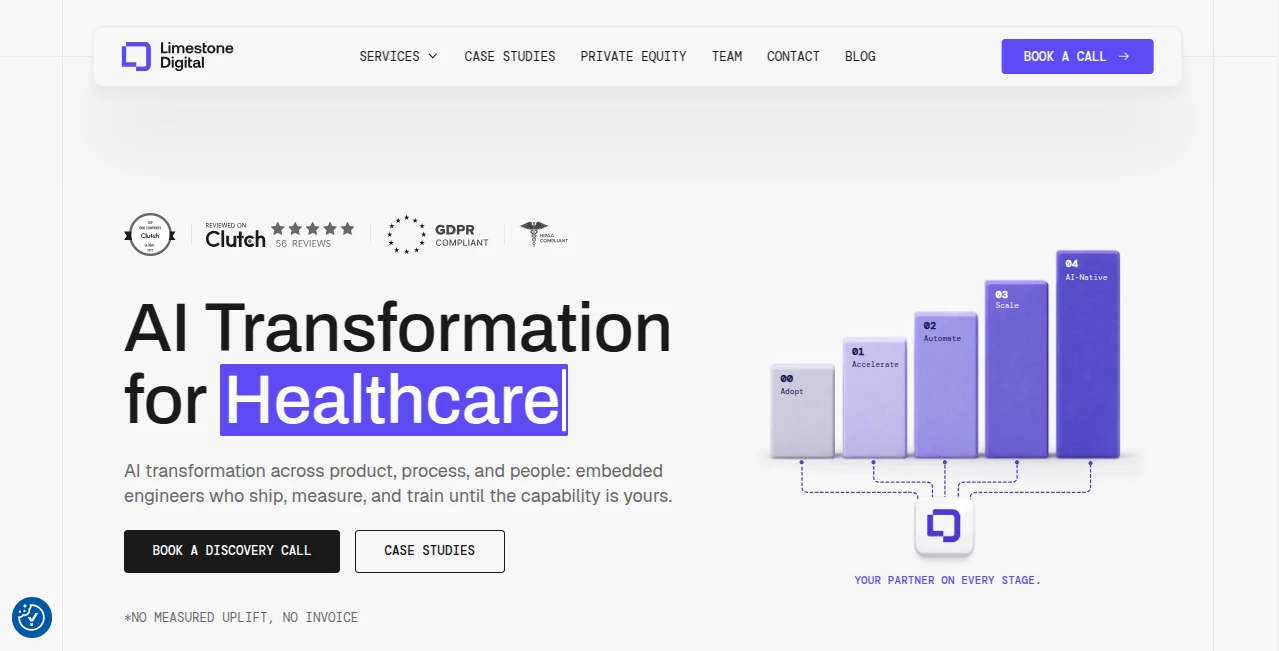
Limestone Digital is an AI transformation and engineering partner built for companies that already have software, teams, customers, and the usual constraints that come with running a mature technology business. Instead of asking organizations to replace everything with a new AI stack, the service works inside existing codebases and workflows to introduce practical AI capabilities, improve software delivery, and help teams measure the results.
The focus is particularly strong in areas where reliability and governance matter. Healthcare, insurance, lending, logistics, financial services, compliance-heavy environments, and enterprise SaaS are among the industries the company works with. Its approach combines embedded engineers, AI-native development practices, custom agents, training, automation, and delivery measurement.
One of the more interesting ideas behind the service is its emphasis on measurable improvement rather than simply adding another collection of AI tools. Teams can begin with a diagnostic phase, establish a baseline, and then track changes in areas such as cycle time, review load, release quality, and AI usage.
Key Features
- Custom AI agent development for products, engineering workflows, and business operations
- AI-native software delivery through embedded engineering pods
- AI training and enablement for engineering and leadership teams
- Legacy system modernization without requiring a complete rewrite
- QA automation and quality gates designed around faster delivery
- Delivery telemetry through the DevInt developer intelligence platform
- Workflow automation for engineering, finance, operations, procurement, and other business functions
- AI governance, monitoring, cost controls, and human-in-the-loop processes
User Interface
This is not a traditional AI application where users spend their day inside a chat window. Much of the experience happens inside the customer's existing development environment, repositories, project-management systems, and team workflows.
The DevInt layer brings another interface into the picture by connecting information from version control, issue tracking, and AI usage. Instead of looking at disconnected statistics, engineering leaders can get a consolidated view of cycle time, review activity, AI-assisted work, and related delivery signals.
For a CTO, this approach can be considerably more useful than another AI dashboard filled with generic usage numbers. The important question becomes what the engineering team actually shipped and whether AI changed the outcome.
Accuracy & Performance
Performance is approached from an engineering perspective rather than being reduced to model benchmark scores. AI-assisted work is expected to pass review, testing, and quality controls before reaching production.
The company reports measurable results from embedded delivery engagements, including 42% faster delivery in two months for a logistics platform, an 85% reduction in incident rates over three months for a fintech SaaS company, and 35% faster cycles alongside 40% higher sprint predictability for an industrial software project.
These figures are presented as improvements against individual client baselines rather than broad industry averages. That distinction makes the numbers more meaningful because the goal is to establish whether a particular organization is actually getting better at shipping software.
Capabilities
The platform and services cover several layers of AI adoption. Custom agents can support code review, release notes, specification generation, retrieval systems, product copilots, and business-process automation. AI-native delivery pods can also take work from tickets through specifications, planning, pull requests, testing, and release processes.
For organizations with older systems, legacy modernization is another important capability. Rather than treating an existing codebase as something that needs to be thrown away, the approach is designed around improving mature products while respecting their architecture, infrastructure, and operational requirements.
The service also supports AI enablement. Teams can learn how to incorporate AI into their actual workflows instead of attending generic training sessions that never make it into day-to-day engineering work.
Security & Privacy
Security is a significant part of the offering, particularly because many target customers operate in regulated industries. The company's stated approach includes least-privilege access, work performed within the customer's repositories and cloud environment, and revocable access.
It also states that intellectual property produced during engagements is assigned to the client, with NDAs included as standard. AI-assisted code is reviewed, tested, and attributable to a human owner before merging.
Another notable policy is that client code is not used to train models. AI provider selection is intended to follow the customer's compliance requirements rather than being dictated by a single provider preference.
Use Cases
- Software Development: Accelerate specifications, planning, coding, code review, testing, and pull-request workflows.
- Custom AI Agents: Build production-oriented agents for engineering teams, customer-facing products, and internal operations.
- Legacy Modernization: Improve older platforms without forcing a disruptive rewrite.
- DevOps: Improve delivery pipelines, release hygiene, observability, and quality gates.
- QA Automation: Automate testing and introduce controls that help quality keep pace with faster development.
- Healthcare: Introduce AI capabilities into clinical and medical technology platforms while maintaining compliance considerations.
- Financial Services: Support AI-enabled workflows in environments where releases, data, and processes require strong oversight.
- Logistics: Improve dispatch, routing, tracking, fulfillment, and software delivery processes.
- Enterprise SaaS: Add intelligent product features while working within existing multi-tenant architectures.
Pros and Cons
- Pros: Strong focus on measurable outcomes, experienced embedded engineering model, custom AI agent development, support for legacy systems, AI governance, QA automation, and practical enterprise use cases.
- Pros: The reported case studies provide concrete performance figures instead of relying exclusively on general AI productivity claims.
- Pros: Month-to-month engagement and a stated risk-free starting model can make experimentation easier for organizations that do not want a long-term outsourcing commitment.
- Cons: This is primarily an enterprise engineering service rather than a simple self-service AI tool that an individual can open and start using immediately.
- Cons: Organizations looking for a lightweight consumer AI application may find the offering much broader and more involved than necessary.
- Cons: Pricing is not presented as a standard public subscription menu, so companies generally need to discuss their requirements directly.
Pricing Plans
The service does not present a conventional self-service pricing structure with monthly individual plans. Engagements are designed around the customer's engineering requirements, transformation goals, and the size of the team involved.
Its AI Velocity Pod model is described as a dedicated forward-deployed engineer supported by a smaller orbit of AI productivity, product-management, business-analysis, and customer-success resources. The company also states that engagements are month-to-month rather than requiring a 12-month contract.
For organizations considering a larger AI transformation, the lack of fixed public pricing is understandable because the scope can vary significantly between a single AI agent, an engineering acceleration program, a legacy modernization project, and an organization-wide enablement initiative.
How to Use Limestone Digital
The process begins by identifying where the organization is losing delivery time or failing to turn AI investment into measurable value. A typical engagement starts with a diagnostic sprint in which delivery activity is measured and a baseline is established.
The next stage introduces AI-driven improvements into the existing production environment. Embedded engineers work alongside the client's team rather than operating as a detached vendor. Planning, development, review, testing, and release practices can be adjusted around AI-native workflows.
Once the initial improvements are running, performance is measured continuously. Organizations can then decide whether to expand the approach, create internal playbooks, increase the number of engineering pods, or develop additional AI agents.
Comparison with Similar Tools
Traditional AI coding assistants generally concentrate on helping an individual developer write or modify code. AI transformation services take a wider view, covering the surrounding engineering system as well: team workflows, delivery processes, testing, governance, infrastructure, and measurable business outcomes.
This makes the service closer to an engineering transformation partner than a standalone coding assistant. A company that simply wants autocomplete or conversational programming help may need something much smaller. On the other hand, a CTO dealing with slow releases, legacy infrastructure, scattered AI adoption, or difficulty proving AI's financial impact may benefit from the broader model.
The distinction is especially relevant for regulated or mature organizations. Introducing an AI model is relatively easy; introducing it into an established production environment while maintaining ownership, security, testing, compliance, and accountability is a considerably different challenge.
Conclusion
For companies that have already experimented with AI but have not seen a clear improvement in software delivery, this offering presents a practical alternative to simply purchasing more AI licenses. Its strength lies in combining AI engineering with embedded teams, measurement, automation, governance, and hands-on implementation.
The emphasis on existing codebases is particularly appealing for organizations that cannot afford to pause operations while rebuilding their technology stack. Custom agents, AI-native engineering pods, training, QA automation, and delivery telemetry provide several routes into AI adoption without making a complete technology reset a prerequisite.
With documented examples of faster delivery, reduced incidents, and improved predictability, the approach is worth considering for technology leaders who care less about having the newest AI feature and more about what their engineering organization can actually ship.
Frequently Asked Questions (FAQ)
What type of service is this?
It is an enterprise AI transformation and software engineering service that helps organizations introduce AI into existing products, engineering workflows, and business processes.
Does it build custom AI agents?
Yes. Custom agent development covers engineering workflows, in-product AI features, retrieval systems, and business-process automation.
Can it work with an existing codebase?
Yes. Working with mature and existing codebases is a central part of the approach, including legacy platforms and systems with complex operational constraints.
Does it provide AI training?
Yes. AI training and enablement are designed for engineering teams, technical leadership, and broader business teams, with an emphasis on applying AI inside real workflows.
How is AI performance measured?
The delivery process can be measured using indicators such as cycle time, review load, pull-request activity, AI-assisted hours, lead time, change-fail rate, and other engineering signals.
Is it suitable for regulated industries?
Yes. Healthcare, insurance, lending, compliance, logistics, financial services, and other enterprise environments are specifically addressed, with security and governance built into the engagement model.
Does the company require a long-term contract?
The service states that its engineering engagements can operate month-to-month rather than requiring a 12-month contract.
Is this suitable for individual developers?
The offering is primarily designed for companies and engineering organizations rather than individual developers looking for a standalone coding assistant.
What makes the approach different from hiring more engineers?
The focus is not simply on adding headcount. The model combines embedded engineering talent with AI-native workflows, automation, quality gates, governance, and delivery measurement so that increased AI usage is connected to actual engineering outcomes.
AI Productivity Tools , AI Developer Docs , AI Developer Tools , AI DevOps Assistant .
These classifications represent its core capabilities and areas of application. For related tools, explore the linked categories above.
Limestone Digital details
Website unavailable — View Alternatives
Pricing
- Freemium
Apps
- Web App
Categories

Limestone Digital Alternatives Product

Velokey
Defapi
HostFinder

BulkPicTools

Create Filla…

ace.me
Timestamp Ro…

NetlifyAPP

XreplyAI