Raghim
What is Raghim?
Raghim is an enterprise AI platform built for organizations that need a secure and intelligent way to manage documents, knowledge, and business workflows. Rather than acting as a simple chatbot, the platform combines document understanding, semantic search, workflow automation, and AI-powered assistants into a unified environment. It supports businesses that work with large volumes of information and want faster access to accurate knowledge while maintaining strict security standards.
The platform is designed for companies that value privacy and compliance as much as productivity. With support for multiple document formats, OCR, multilingual processing, AI-driven search, and deployment options for both cloud and offline environments, it provides flexibility for organizations operating in highly regulated industries. Teams can organize information, automate repetitive processes, connect external services, and collaborate through AI without compromising sensitive business data.
Another standout advantage is its enterprise-first architecture. Businesses can integrate existing systems through APIs, manage user permissions with role-based access controls, and create intelligent workflows without extensive development work. The combination of knowledge management, document intelligence, and automation makes it suitable for modern organizations looking to improve operational efficiency.
Key Features
User Interface
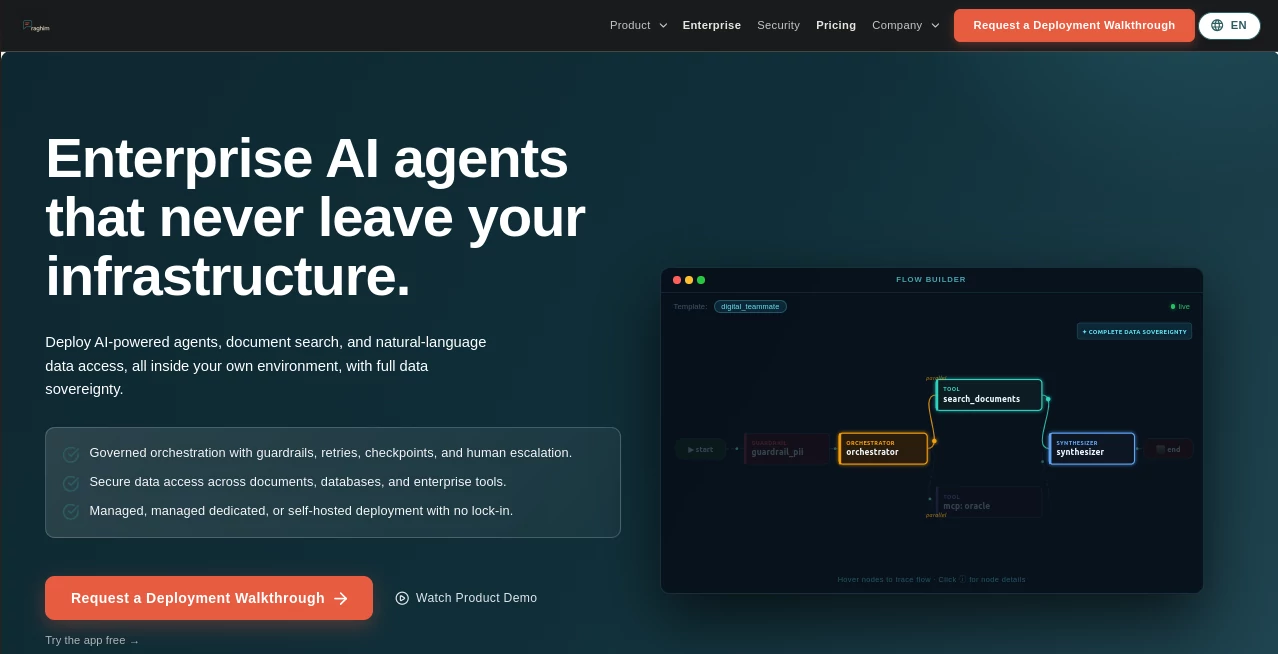
The dashboard offers a clean and professional workspace where users can upload documents, organize collections, search knowledge bases, manage AI agents, and monitor workflows from one location. Navigation remains straightforward even when handling complex enterprise projects.
Accuracy & Performance
Semantic search, OCR technology, intelligent document extraction, and AI-assisted retrieval help users locate relevant information quickly. GPU acceleration and real-time processing improve performance for demanding enterprise workloads.
Capabilities
The platform supports PDF, DOCX, TXT, and Markdown documents, multilingual processing, AI-powered document analysis, workflow automation, visual no-code flow creation, REST APIs, WebSocket communication, voice interaction, speech recognition, speech synthesis, external integrations, SQL querying, and intelligent knowledge retrieval.
Security & Privacy
Security is a major strength. Enterprise-grade encryption, role-based access control, multi-factor authentication, Single Sign-On, Row-Level Security, client-side encryption for sensitive information, and support for compliance standards such as GDPR, HIPAA, ISO 27001, SOC 2, PCI DSS, and CCPA make it suitable for organizations handling confidential data.
Use Cases
Organizations can use the platform to build internal knowledge bases, automate document processing, analyze contracts, search company documentation, create AI-powered customer support systems, improve employee onboarding, manage compliance documentation, process financial records, automate business workflows, develop enterprise AI assistants, and connect existing software through APIs and workflow integrations.
Pros and Cons
Pros
Enterprise-grade security and compliance.
Supports offline deployment for sensitive environments.
Excellent document intelligence with OCR capabilities.
Powerful semantic search and knowledge retrieval.
No-code workflow builder simplifies automation.
Comprehensive API and integration support.
Voice interface and multilingual capabilities.
Cons
Primarily designed for enterprise users rather than individuals.
Advanced deployment may require technical expertise.
Full enterprise infrastructure benefits from higher hardware resources.
Pricing Plans
Pricing is not publicly listed. Organizations can request enterprise information based on deployment requirements, infrastructure, and business needs.
How to Use Raghim
Create an enterprise workspace and configure authentication settings. Upload business documents or import existing knowledge repositories. Organize collections, configure AI models, and build workflows using the visual automation tools. Connect external systems through available APIs or connectors, define user permissions, and begin using AI-powered search, document analysis, and knowledge management across the organization.
Comparison with Similar Tools
Compared with traditional document management systems, this platform adds advanced AI understanding and semantic search. Unlike many general AI chatbots, it focuses on enterprise knowledge management, compliance, secure deployment, workflow automation, and deep document intelligence. Businesses requiring private infrastructure or offline AI deployment will find these capabilities especially valuable.
Conclusion
For organizations seeking more than a conversational AI assistant, this enterprise platform delivers an impressive combination of intelligent document processing, knowledge management, automation, and enterprise security. Its emphasis on privacy, compliance, flexible deployment, and scalable integrations makes it an excellent choice for businesses that need reliable AI solutions without sacrificing control over sensitive information. Whether supporting internal teams or powering customer-facing workflows, it provides a solid foundation for modern AI-driven operations.
Frequently Asked Questions (FAQ)
What types of documents are supported?
The platform supports PDF, DOCX, TXT, and Markdown files, including OCR processing for scanned documents.
Can it be deployed without cloud services?
Yes. Offline enterprise deployment is available for organizations that require complete control over their infrastructure.
Does it support workflow automation?
Yes. It includes a visual no-code workflow builder with conditional logic, scheduling, approvals, and integrations.
Is it suitable for regulated industries?
Yes. Enterprise security features and support for multiple compliance standards make it appropriate for industries with strict data protection requirements.
Can developers integrate existing business systems?
Yes. REST APIs, WebSockets, connectors, and external integration capabilities allow businesses to extend existing workflows.
AI Workflow Management , AI Documents Assistant , AI Knowledge Base , AI Developer Tools .
These classifications represent its core capabilities and areas of application. For related tools, explore the linked categories above.

Raghim Alternatives Product

Somnio
JSON to TOON…

Zush

justmarkdown

Privacy Scru…

Yorph AI

Helploom

onuml

ABC Dynamic …