












Roofline
Verified Blue CheckMark
Verified Blue CheckMark products are featured above free or unverified listings.
This badge indicates authenticity and builds trust, giving your product higher visibility across the platform.
Upgrade to get verified
Verified Blue CheckMark products are featured above free or unverified listings. This badge indicates authenticity and builds trust, giving your product higher visibility across the platform.
Upgrade to get verified
What is Roofline?
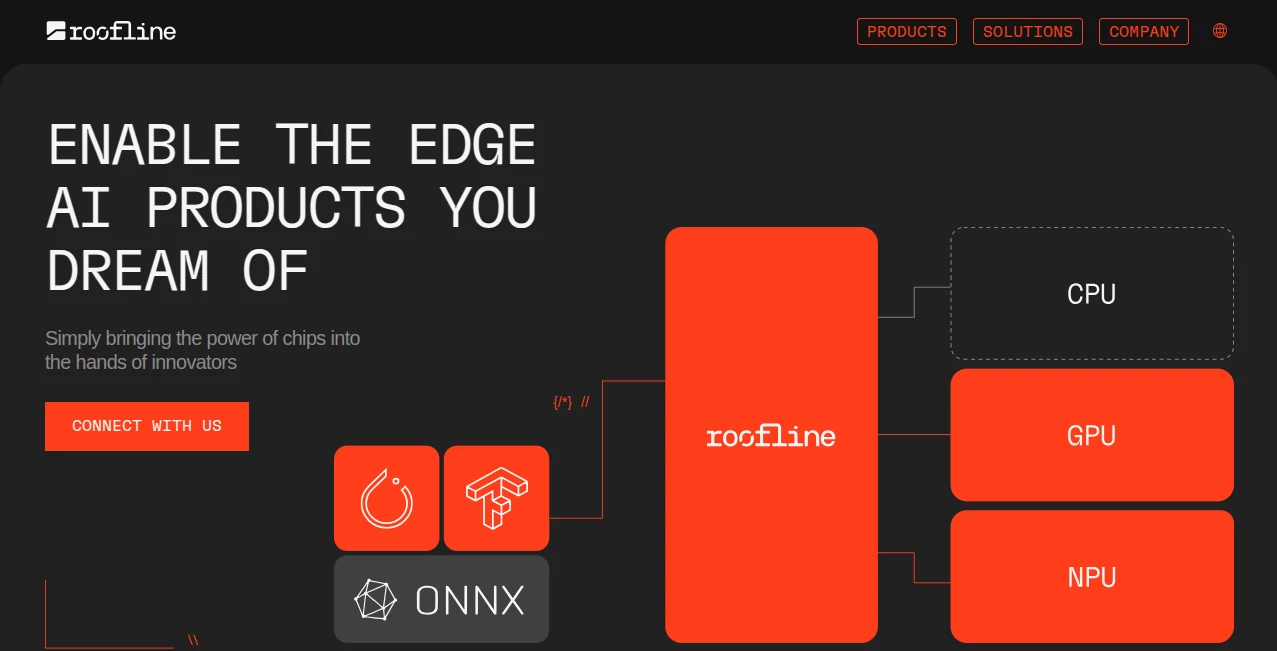
Roofline is an edge AI deployment platform designed to help developers and technology companies bring modern AI models onto real-world devices more efficiently. Instead of treating AI deployment as a separate optimization project for every processor, the platform provides a complete software stack for compiling, running, and evaluating models across different edge hardware.
Its approach is particularly interesting for teams building products that need AI inference close to the device rather than relying entirely on cloud infrastructure. The technology is built around a next-generation compiler based on MLIR and is designed to make the capabilities of CPUs, GPUs, and NPUs within an SoC more accessible.
The platform supports a broad range of AI workloads, including language models, computer vision, audio applications, and other edge inference scenarios. It can also work with proprietary models, which makes it relevant to companies developing their own AI-powered products rather than only experimenting with public models.
Key Features
- AI model compilation for resource-constrained edge devices
- Support for CPUs, GPUs, and NPUs across supported hardware
- LLM deployment capabilities including tokenizer integration
- Quantization support for efficient inference
- Heterogeneous execution across components of an SoC
- Performance evaluation and tracking through a dedicated dashboard
- Support for popular AI frameworks including PyTorch, TensorFlow Lite, TensorFlow, and ONNX
- Support for proprietary AI models
User Interface
The developer experience is built around a straightforward workflow rather than a collection of complicated hardware-specific tools. The SDK provides a Python interface, allowing developers to compile models and target different devices without rebuilding their entire development process around each platform.
This is one of the more practical aspects of the platform. A team working on an AI-enabled device can keep much of its existing model workflow while using the compiler and runtime layer to handle deployment requirements underneath.
The Performance Dashboard adds another useful layer by giving teams a way to evaluate and track real-world performance. For engineering teams, that can make benchmarking and comparing deployment results much easier than relying on isolated tests.
Accuracy & Performance
Performance is clearly one of the main reasons to consider this technology. The compiler is designed for efficient ahead-of-time compilation on resource-constrained devices, while its heterogeneous execution capabilities can distribute workloads across different processing units within an SoC.
The published demonstrations cover a wide selection of models and hardware. The platform has been tested with models ranging from smaller language models to larger architectures, alongside computer vision workloads.
Its published research also shows ambitious performance gains in specific workloads. For example, one on-device image-to-text demonstration using a multimodal model on Qualcomm edge hardware reported approximately 9x faster performance than TorchInductor. Another study on dynamic input shapes demonstrated up to 23x higher prefill performance for a specific Qwen model on an NVIDIA RTX 3070. These figures are workload- and hardware-specific, but they show the level of optimization the compiler is targeting.
Capabilities
The platform covers much more than basic model conversion. Its compiler translates models from major AI frameworks into optimized intermediate representations before producing executables for different hardware backends.
Language models are an important part of the offering. The platform supports LLM pipelines, including tokenizer-related integrations, and has been demonstrated with models such as Qwen, Llama, Gemma, Mistral, DeepSeek, and other popular architectures.
Computer vision is another strong area. Supported examples include object detection, image classification, segmentation, image-text applications, and other vision workloads. The model list also includes architectures such as YOLO, ResNet, MobileNet, CLIP, and several multimodal models.
Recent development has also extended into Mixture-of-Experts models. The deployment stack has demonstrated end-to-end compilation and execution of MoE models, including models ranging from roughly 1 billion to 15 billion total parameters.
Security & Privacy
Privacy can be particularly important when AI inference is moved from the cloud onto edge devices. The platform states that proprietary models are supported and remain private during the deployment workflow. Models can be compiled and deployed using the same general process as other supported models.
For businesses developing proprietary AI products, keeping inference closer to the device can also reduce dependence on sending every input to an external cloud service. The exact privacy characteristics of a final deployment will still depend on the hardware, application architecture, and data-handling practices chosen by the product team.
Use Cases
The platform is aimed primarily at teams that need to put AI into physical products and edge systems. A robotics company, for example, could use on-device vision and language models without making every inference request dependent on a remote server.
It can also be useful for consumer electronics manufacturers, automotive technology companies, industrial systems, smart cameras, and other embedded products where latency, power consumption, connectivity, or hardware constraints matter.
For developers working with LLMs, the ability to compile models for edge CPUs, GPUs, and NPUs opens another route for building applications that can operate locally. This becomes especially attractive when a product needs predictable response times or must continue functioning when cloud connectivity is limited.
Hardware and IP vendors can also benefit from the platform because its compiler architecture is designed to adapt to new hardware backends, particularly NPUs. That makes the technology relevant not only to AI application developers but also to companies building the silicon underneath those applications.
Pros and Cons
Pros
- Strong focus on real-world edge AI deployment
- Supports CPUs, GPUs, and NPUs
- Works with several major AI model frameworks
- Supports proprietary models
- Includes LLM, vision, audio, and other AI workloads
- Python-based SDK simplifies the developer workflow
- Quantization and heterogeneous execution support
- Performance benchmarking is included through a dedicated dashboard
Cons
- The platform is primarily aimed at professional developers and technology companies rather than casual AI users
- Getting the most from the system requires an understanding of model deployment and edge hardware
- Hardware support can vary depending on the specific device and backend
- Performance improvements depend heavily on the model, hardware, and workload
Pricing Plans
No public self-service pricing plans are prominently listed on the website. The platform appears to be positioned as a professional technology solution for product vendors and hardware or IP companies, with prospective customers encouraged to connect with the company for more information and demonstrations.
For businesses evaluating an edge AI deployment stack, contacting the team directly is therefore the most appropriate way to determine availability, commercial terms, supported hardware, and the level of technical assistance available for a particular project.
How to Use Roofline
Getting started is intended to fit into an existing AI development workflow. Developers can use the SDK's Python interface to compile supported models and target different edge devices.
First, select the AI model and target hardware required by the application. The SDK can work with models originating from supported frameworks such as PyTorch, TensorFlow, TensorFlow Lite, and ONNX.
Next, compile the model for the selected target. The compiler handles the transformation into optimized representations and prepares the workload for the available hardware backend.
Depending on the application, developers can then take advantage of quantization, LLM pipeline integrations, or heterogeneous execution. The resulting model can be evaluated using the available performance tooling to understand how it behaves on the target device.
This workflow is especially useful when the same AI product needs to reach several types of edge hardware without creating a completely separate deployment process for every platform.
Comparison with Similar Tools
Traditional AI deployment frameworks can be excellent choices when a team is targeting a specific ecosystem or wants a familiar inference workflow. The difference here is the emphasis on hardware flexibility and full SoC utilization.
Rather than focusing exclusively on one processor type, the platform is designed to work across CPUs, mobile GPUs, and NPUs while providing a compiler layer capable of adapting models to different hardware backends.
Its model-agnostic approach is another notable distinction. The company reports testing hundreds of models across different frameworks and supports many common layers, operators, and quantization techniques. That can reduce the amount of model-specific optimization work required when moving an AI application between devices.
For teams building an edge product rather than simply running an AI model on a developer workstation, this broader deployment perspective can be a significant advantage.
Conclusion
Edge AI is becoming increasingly important as more capable models move beyond data centers and onto phones, robots, vehicles, cameras, industrial systems, and other connected products. The challenge is no longer simply finding a good model; developers also need a reliable way to make that model perform well on constrained hardware.
This platform takes a compelling approach to that problem by combining an MLIR-based compiler, an inference runtime, and performance tooling into a broader SoC deployment stack. Its support for modern LLMs, computer vision models, quantization, heterogeneous execution, and multiple hardware types gives it a particularly strong position for teams working on serious edge AI products.
It is not a beginner-oriented AI application, and that is actually part of its appeal. For engineers and companies trying to turn AI models into efficient products running on real hardware, the platform offers a technically focused route from model development to edge deployment.
Frequently Asked Questions (FAQ)
What is Roofline used for?
It is used to compile, deploy, run, and evaluate AI models on edge hardware. Its technology is designed to help product teams use CPUs, GPUs, and NPUs more effectively within edge SoCs.
Which AI frameworks are supported?
The platform supports PyTorch, TensorFlow Lite, TensorFlow, and ONNX, with a particular focus on PyTorch.
Can proprietary AI models be deployed?
Yes. Proprietary models are supported, and the company states that they can typically run without modification when they use supported layers, operators, and quantization techniques.
Does it support large language models?
Yes. LLM deployment is one of the supported areas, including tokenizer integration and models from several popular model families.
Does it support computer vision?
Yes. The supported model portfolio includes object detection, classification, segmentation, multimodal image-to-text workloads, and other computer vision applications.
Can models run on an NPU?
The platform is designed to support NPUs as part of its broader edge deployment strategy. Actual availability depends on the specific hardware backend and integration.
Is it suitable for beginners?
It is primarily designed for developers, engineering teams, product vendors, and hardware companies. Users with experience in AI models, compilers, embedded systems, or hardware deployment will get the most value from it.
What makes its compiler approach different?
The compiler is based on MLIR and is designed to translate models into optimized intermediate representations before generating efficient executables for different hardware backends. This architecture is intended to make the deployment stack more flexible as hardware evolves.