
🧠 AI Quiz
Think you really understand Artificial Intelligence?
Test yourself and see how well you know the world of AI.
Answer AI-related questions, compete with other users, and prove that
you’re among the best when it comes to AI knowledge.
Reach the top of our leaderboard.


















Cinegoai

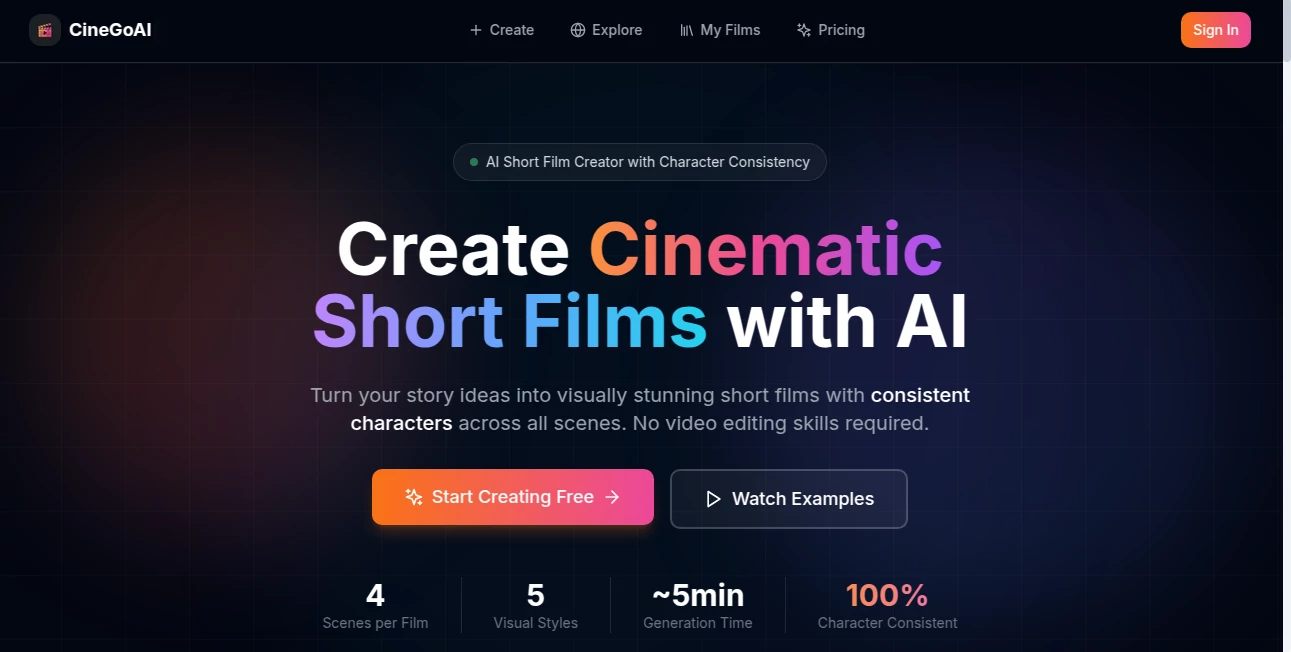
What is Cinegoai?
There’s a special kind of rush when you type a single sentence—“a lone astronaut drifts past Jupiter at golden hour”—and seconds later a short, moody clip plays back with lens flares, subtle camera drift, and lighting that feels like it was shot on actual film. That’s the moment most people fall in love with this tool. It doesn’t just animate; it directs. Faces hold identity, motion has weight, colors grade naturally. I’ve watched creators go from “I can’t afford to shoot this” to “this looks better than what I could have shot anyway.” It’s the rare AI video model that makes you forget you’re using AI.
Introduction
Video is storytelling in motion, but making it has always been expensive—in time, gear, or both. This platform collapses that distance dramatically. A few words, maybe a reference image or audio clip, and you get a short cinematic piece that carries real mood, consistent characters, and purposeful camera language. It’s not about flashy effects or endless options; it’s about nailing the feeling of a scene quickly and reliably. Early users started sharing results that looked like mini short films, not typical AI clips. The difference is in the details: believable physics, emotional continuity, lighting that serves the story. For anyone who thinks in scenes but lacks a full production crew, it’s become an indispensable creative shortcut.
Key Features
User Interface
The workspace is clean and deliberate. Wide prompt field, drag-and-drop for images or audio, simple toggles for aspect ratio, duration, and style strength, then one confident “Generate” button. Previews appear fast enough to keep momentum. No labyrinth of settings—just enough control to guide without drowning you. It’s designed so you spend energy on the idea, not on figuring out the tool.
Accuracy & Performance
Character identity stays locked across shots and lighting changes. Motion follows real-world rules—cloth drapes, hair sways, objects interact naturally. Lighting reacts intelligently to scene description. Generation times sit comfortably in the 20–90 second range for most clips, and the model rarely collapses into the usual AI telltales (melting faces, flickering edges, impossible physics). When it does misstep, it’s usually because the prompt was ambiguous—not random nonsense.
Capabilities
Text-to-video, image-to-video, hybrid guidance (image + text + optional audio), multi-shot narrative flow with natural transitions, native lip-sync for dialogue scenes, cinematic camera moves (push-ins, gentle orbits, motivated pans), multiple aspect ratios (vertical for Reels, horizontal for trailers), and strong stylistic control (cinematic, stylized, vintage film, anime-inspired). It keeps visual continuity, emotional tone, and storytelling logic across cuts—making it feel closer to a director’s rough cut than most AI video attempts.
Security & Privacy
Inputs are processed temporarily and discarded after generation unless you explicitly save the result. No persistent storage of prompts, images, or clips for training or resale. For creators handling brand work, personal projects, or client concepts, that clean boundary is a real comfort.
Use Cases
A small fashion label turns a single product photo into a short runway teaser that performs better than their previous live shoots. A musician generates a visualizer that actually matches the song’s emotional peaks and valleys. A short-form creator builds a consistent character universe for daily Reels without daily filming. A filmmaker mocks up key emotional beats to test tone and pacing before committing to production. The common thread: people who need storytelling impact fast and can’t (or don’t want to) wait for traditional pipelines.
Pros and Cons
Pros:
- Outstanding character and style consistency across shots—rare at this level.
- Cinematic lighting and camera decisions that give clips real mood and intent.
- Hybrid guidance (text + image + audio) offers precise creative steering.
- Generation speed that supports actual creative iteration, not just waiting.
- Free daily credits let anyone experience the quality without commitment.
Cons:
- Clip length caps at 5–10 seconds per generation (though multi-shot workflows extend storytelling).
- Very abstract or contradictory prompts can still lead to unexpected results.
- Higher resolutions and priority queues require paid plans.
Pricing Plans
A meaningful free daily quota lets you test the quality without any upfront cost. Paid plans unlock higher resolutions, longer clips, faster queues, and unlimited generations. Pricing feels fair for the fidelity leap; many creators say one month covers what they used to spend on stock footage or freelance editors for a single social campaign.
How to Use CineGo AI
Open the generator, write a concise scene description (“rainy Tokyo street at night, neon reflections, lone figure in trench coat walking away, slow dolly zoom”). Optionally upload a reference image for stronger visual grounding or audio for lip-sync. Select aspect ratio and duration, then generate. Review the preview—tweak wording, reference strength, or camera notes if needed—and download or generate variations. For longer stories, break into separate shots and stitch in your editor. The loop is fast enough to refine several versions in one creative session.
Comparison with Similar Tools
Many models still suffer from character drift, lighting mismatches, or unnatural motion. This one prioritizes narrative coherence, emotional tone, and cinematic intent, often producing clips that feel closer to human-directed work. The hybrid input mode (text + image + audio) gives creators more precise control than most pure text-to-video or simple image-animation tools. It sits in a sweet spot: powerful enough for pros, approachable enough for everyday creators.
Conclusion
Video remains one of the most demanding creative mediums—until tools like this arrive. They don’t erase the need for taste, timing, or vision; they amplify them. When the distance between “I have an idea” and “here’s a finished clip” shrinks to minutes, storytelling becomes more democratic. For anyone who thinks in scenes—filmmakers, musicians, marketers, creators—this is the kind of quiet revolution that makes you want to keep experimenting just to see what’s possible next.
Frequently Asked Questions (FAQ)
How long can clips be?
Typically 5–10 seconds per generation; longer narratives come from combining multiple connected shots.
Do I need a reference image?
No—text-only works very well—but adding one dramatically improves character and style consistency.
What resolutions are available?
Up to 1080p on paid plans; free tier offers preview-quality.
Can I use outputs commercially?
Yes—paid plans include full commercial rights.
Watermark on free generations?
Small watermark on free clips; paid removes it completely.
AI Animated Video , AI Image to Video , AI Video Generator , AI Text to Video .
These classifications represent its core capabilities and areas of application. For related tools, explore the linked categories above.
Cinegoai details
This tool is no longer available on submitaitools.org; find alternatives on Alternative to Cinegoai.
Pricing
- Free
Apps
- Web Tools
Categories

Cinegoai Alternatives Product

Banana 2 Edi…
Kling 5.0

Veo 3.2

RenderFlow AI

kling 3 AI

seedance 2.0

Sora by Open…

AI ASMR Gene…

Seedance 2.5