
🧠 AI Quiz
Think you really understand Artificial Intelligence?
Test yourself and see how well you know the world of AI.
Answer AI-related questions, compete with other users, and prove that
you’re among the best when it comes to AI knowledge.
Reach the top of our leaderboard.


















Crawlly AI
Verified Blue CheckMark
Verified Blue CheckMark products are featured above free or unverified listings.
This badge indicates authenticity and builds trust, giving your product higher visibility across the platform.
Upgrade to get verified
Verified Blue CheckMark products are featured above free or unverified listings. This badge indicates authenticity and builds trust, giving your product higher visibility across the platform.
Upgrade to get verified
What is Crawlly AI?
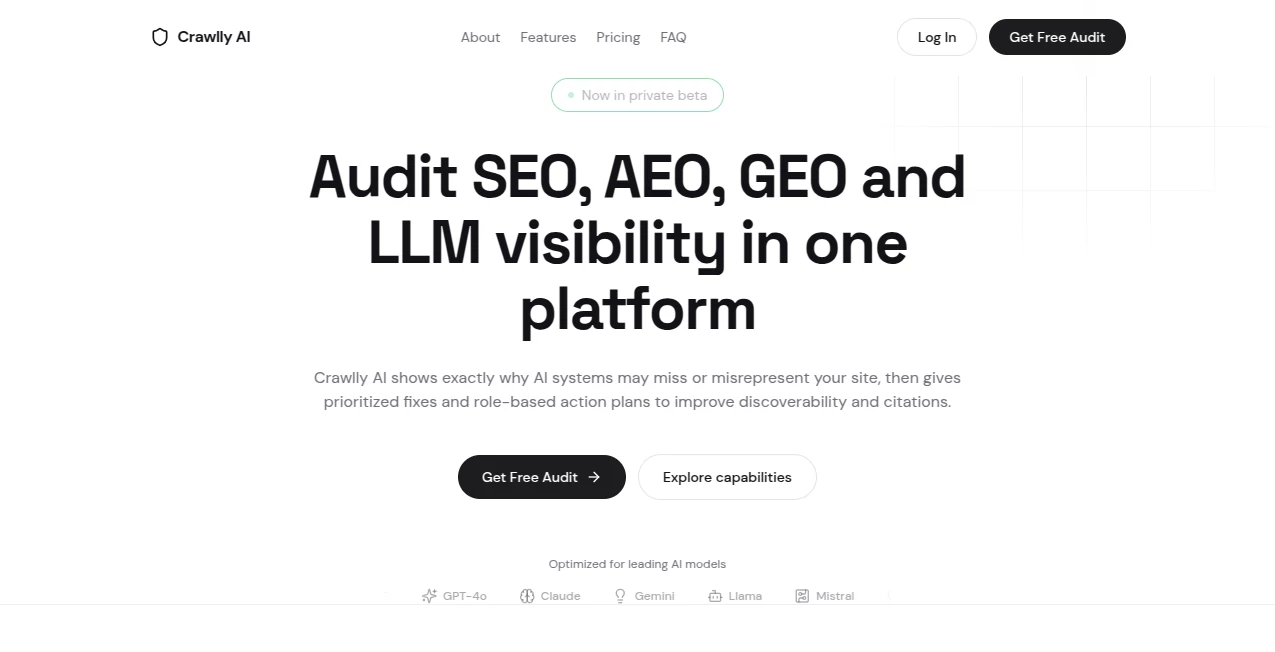
When search results started shifting from simple blue links to AI-generated answers, many teams felt a bit lost. Suddenly it wasn’t enough to rank well in traditional search—you also needed to appear in the summaries, citations, and entity graphs that modern AI systems rely on. This platform steps in as a practical guide through that new landscape. It runs a single, comprehensive audit that looks at your site from four important angles at once: technical discoverability, entity trust, answer readiness, and real LLM visibility. Instead of jumping between different tools and reports, you get one clear picture with prioritized fixes and who should handle them. I’ve talked to SEO leads who said it finally gave their teams a shared language and roadmap for the AI era.
Introduction
Traditional SEO still matters, but the game has expanded. AI systems now decide what content gets surfaced, summarized, or cited. Crawlly AI helps teams understand exactly where they stand in this new environment and what to fix next. You add your domain, provide some brand context, choose a quick or deep audit, and it delivers an executive score plus a detailed issue roadmap. What makes it especially useful is the prompt-level testing—it shows how your brand actually performs when real AI models are asked relevant questions. For companies that want to stay visible as search evolves, it turns vague worry into concrete action items that engineering, content, and SEO teams can actually execute together.
Key Features
User Interface
The dashboard feels clean and purposeful. You start by adding your domain and defining your brand context, then choose the audit depth. Once it runs, everything is presented in one unified report with clear scores, risk bands, and a prioritized roadmap. Issues are grouped by category and severity, with assigned roles so it’s obvious who needs to jump in. The interface avoids overwhelming you with raw data—instead it highlights what matters most and why. Progress tracking lets you compare audits over time, making improvements visible and motivating.
Accuracy & Performance
The audits draw from real signals that AI systems care about, including crawlability, schema markup, entity consistency, and actual prompt performance across major models like GPT-4o, Claude, Gemini, and others. Results are actionable rather than theoretical, with evidence showing where your content is mentioned, cited, or missed. Teams report that the scores and recommendations align well with real-world visibility changes after fixes are implemented. The platform runs efficiently even on larger sites, delivering comprehensive insights without excessive wait times.
Capabilities
It combines classic technical SEO checks with modern AEO (Answer Engine Optimization) and GEO (Generative Engine Optimization) metrics, plus direct LLM visibility testing. You get structured data validation, entity graph analysis, retrieval readiness scoring, and prompt-level evidence showing citation rates and ranks. The output includes role-based action plans so marketing, content, and engineering teams know exactly what to tackle. Re-running audits lets you measure real progress and compare before-and-after states. It’s built to help teams move from reactive SEO to proactive AI readiness.
Security & Privacy
Your domain data and audit results stay within your account. The platform focuses on delivering insights without unnecessary data sharing or long-term retention of sensitive information. For teams handling competitive or proprietary brand details, that thoughtful approach builds confidence that the tool respects boundaries while still providing deep visibility analysis.
Use Cases
An e-commerce brand runs an audit before a major product launch and discovers schema gaps that were hurting AI summaries—fixing them improved visibility in generative results. A SaaS company uses prompt testing to see how often their features get cited in relevant questions, then strengthens content to boost citation rates. A content team tracks score improvements over time after implementing the recommended roadmap, turning vague SEO efforts into measurable gains. Agencies use it to deliver clear, data-backed reports to clients who want to understand their AI search presence. Wherever teams need to bridge traditional SEO and the new generative world, it provides clarity and direction.
Pros and Cons
Pros:
- One unified report covering traditional SEO plus modern AI visibility signals.
- Prompt-level evidence shows exactly how AI systems see your brand.
- Role-based action plans make execution straightforward across teams.
- Progress tracking helps demonstrate real improvements over time.
- Practical focus on both discoverability and citation outcomes.
Cons:
- Still relatively new, so some advanced enterprise features are evolving.
- Full value comes from running multiple audits over time to track progress.
- Best results require clear brand context during setup.
Pricing Plans
It offers a structure that scales with your needs. Entry-level access lets teams run audits and explore insights, while higher plans unlock unlimited runs, deeper analysis, team collaboration features, and priority support. One-time audit top-up packs are available for occasional heavier needs. Many teams find the investment worthwhile once they see how the insights translate into better AI visibility and reduced risk of being overlooked by modern search systems.
How to Use Crawlly AI
Sign up and add your domain. Provide some basic brand context so the audit understands what you offer. Choose quick or deep mode depending on how thorough you want the first pass to be. Once the audit completes, review the executive score and risk band, then dive into the prioritized issue roadmap. Assign tasks to the right roles, implement the highest-impact fixes, and re-run the audit to measure improvement. Use the prompt testing section to see real LLM behavior and refine content accordingly. The cycle is straightforward: audit, act, measure, repeat.
Comparison with Similar Tools
Traditional SEO crawlers focus on links and technical issues but often miss how AI systems actually interpret and cite content. Pure LLM testing tools give prompt results without the full technical foundation. This platform brings both worlds together in one report, with clear scoring, role-based actions, and measurable progress tracking. It’s less about overwhelming data dumps and more about operational clarity—exactly what teams need when adapting to generative search.
Conclusion
As search continues evolving from simple rankings to AI-generated answers and citations, teams need more than traditional SEO checklists. This tool provides a clear, actionable view of where you stand and what to improve next. It turns the complexity of modern visibility into something manageable and measurable. For organizations that want to stay discoverable and cited in the AI era, having one reliable platform that covers technical foundations, entity trust, answer readiness, and real LLM performance is incredibly valuable. It’s the kind of practical help that lets you move forward with confidence instead of guessing.
Frequently Asked Questions (FAQ)
What exactly does the audit cover?
Technical SEO, entity/schema quality, answer engine readiness, and direct LLM prompt testing for mentions and citations.
Do I need technical knowledge to use it?
Not really—the reports are designed to be understandable across SEO, content, and engineering teams, with clear action items.
How often should I run audits?
Many teams run a baseline, implement fixes, then re-audit monthly or after major site changes to track progress.
Can it help with AI citations?
Yes—it specifically tests prompt suites and shows citation rates and ranks across major models.
Is there a way to test before committing?
The platform offers ways to explore capabilities, with paid plans providing full depth and volume.
AI Research Tool , AI Analytics Assistant , AI SEO Assistant , AI Marketing Plan Generator .
These classifications represent its core capabilities and areas of application. For related tools, explore the linked categories above.
Crawlly AI details
Pricing
- Free
Apps
- Web Tools
Categories

Crawlly AI Alternatives Product

Needle

GLM 5

Enji

TrueSource AI

Lebesgue: AI…

Sorank

JSON to TOON…

Quizify - AI…

Jasper
